IMPROVEMENT IN BIT-STOCK WRENCHES.
A brace chuck that doubles as a wrench, jaws following the sleeve by spring
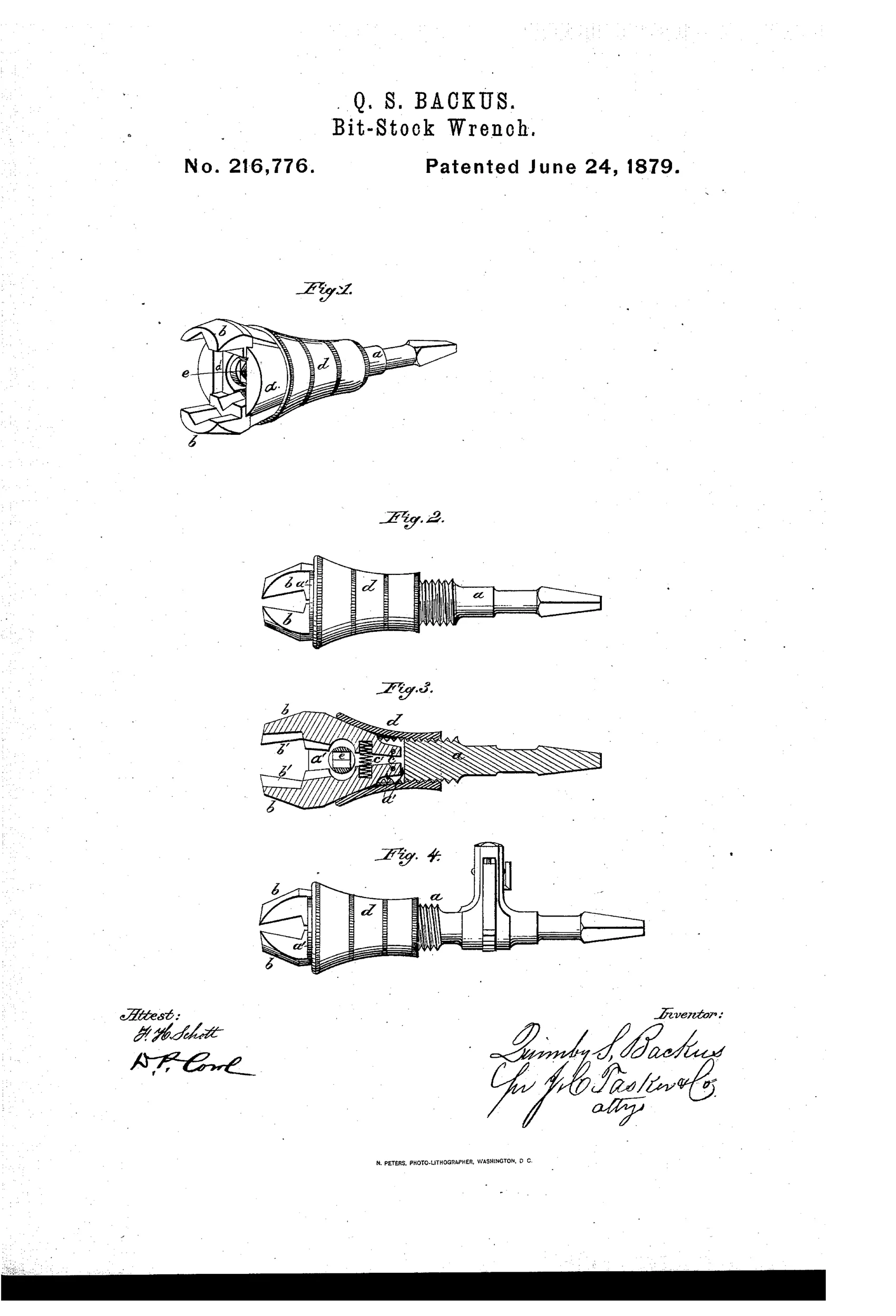
Combination wrench and tool-holder attachment for bit-braces
⚙ How it works
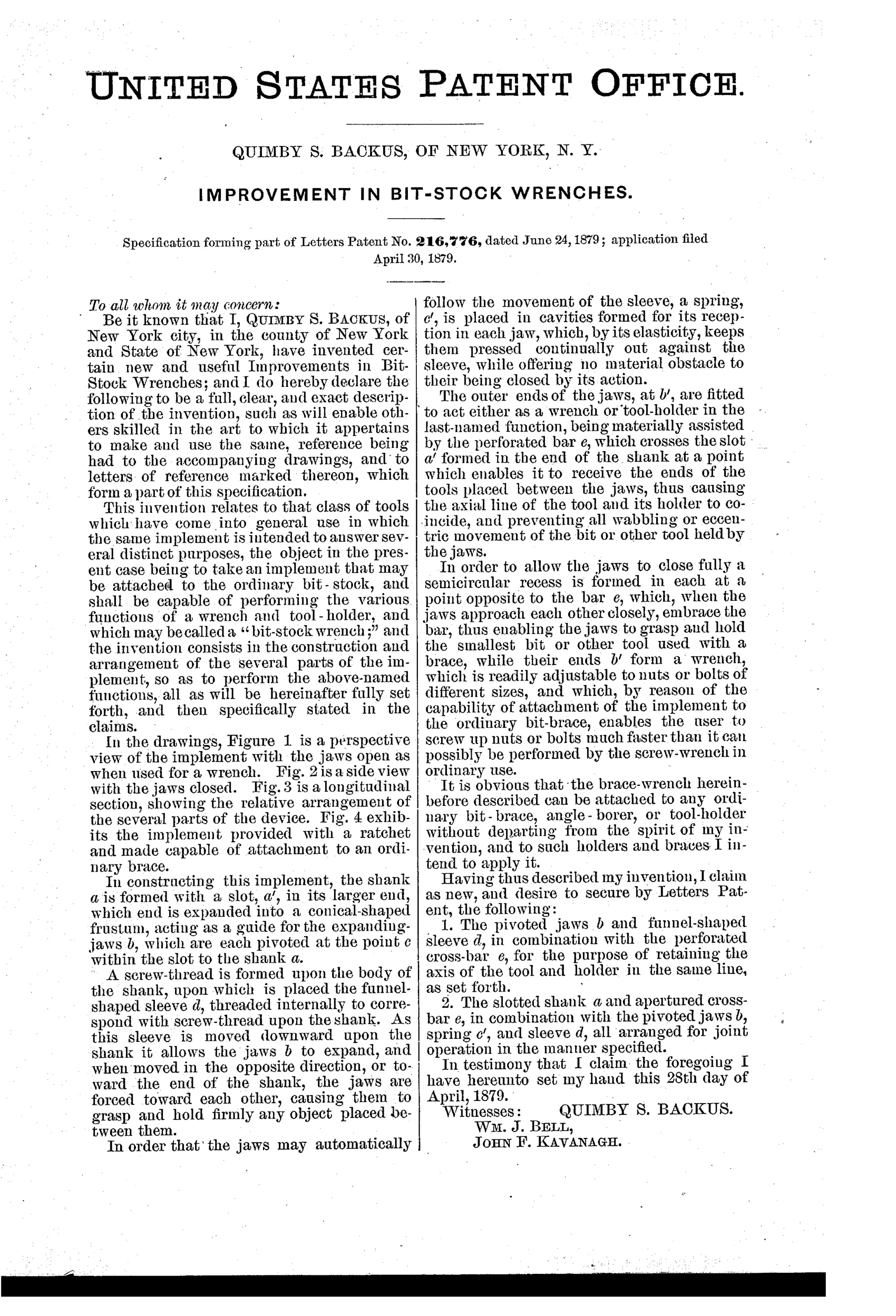
A slotted shank with a conical frustum end guides pivoted expanding jaws. A threaded funnel-shaped sleeve moves along the shank's screw-thread, forcing the jaws together or allowing them to expand as the sleeve is turned. A spring seated in cavities of each jaw keeps them pressed outward against the sleeve so they follow its movement automatically. A perforated cross-bar passes through the slot in the shank end, letting the jaws grip small bits or tools while keeping the tool's axis aligned with the holder, and the outer jaw ends form an adjustable wrench for nuts or bolts.
⚙ What was claimed
“1. The pivoted jaws b and funnel-shaped sleeve d, in combination with the perforated cross-bar e, for the purpose of retaining the axis of the tool and holder in the same line, as set forth.”
In plain English: The pivoted jaws and funnel-shaped sleeve work together with a perforated cross-bar to keep the tool and holder aligned on the same axis.
⚙ In the inventor’s words
“It is obvious that the brace-wrench hereinbefore described can be attached to any ordinary bit-brace, angle-borer, or tool-holder without departing from the spirit of my invention, and to such holders and braces I intend to apply it.”— Quimby S. Backus, from the specification
Fate unknown
Backus's brace hardware was widely manufactured, but I know of no catalogued specimen of this specific wrench attachment; a marked example or DATAMP-linked survivor would settle it.
⚙ Commentary
Bit-stock wrenches — nut-turning heads made to fit an ordinary bit-brace — are their own little corner of the wrench field, and Backus here folds two tools into one fitting. The pivoted jaws close on a nut like any adjustable wrench, but they also grip round bits and small tools, so the same funnel-shaped sleeve serves as both wrench adjuster and chuck.
The quiet cleverness is in how the jaws track the sleeve. A spring seated in cavities in each jaw presses them outward against the sleeve's inner cone, so turning the sleeve up the threaded shank squeezes them in, and backing it off lets them follow it open automatically — no fiddling the jaws apart by hand. The perforated cross-bar in the slotted shank is the other honest detail: without it, a small bit gripped between two flat jaws would sit off-center and wobble in the brace. The cross-bar's hole holds the tool's axis in line with the shank, which is exactly what the first claim protects. Fig. 3's section shows the whole arrangement; Fig. 4 adds a ratchet, anticipating tight corners.
Backus was a serious brace-and-chuck man, and this reads like a chuck designer noticing that his cone-and-jaw mechanism could just as well grab a hex nut. Whether users wanted their wrench on the end of a brace is another question — leverage is poor compared to a proper handle — but as a farm or carriage-kit convenience the logic holds.
Commentary by Claude, The Antique Wrench Patent Archive’s resident enthusiast