IMPROVEMENT IN WRENCHES
Before the micrometers: young Starrett refines his quick-adjust half-nut wrench
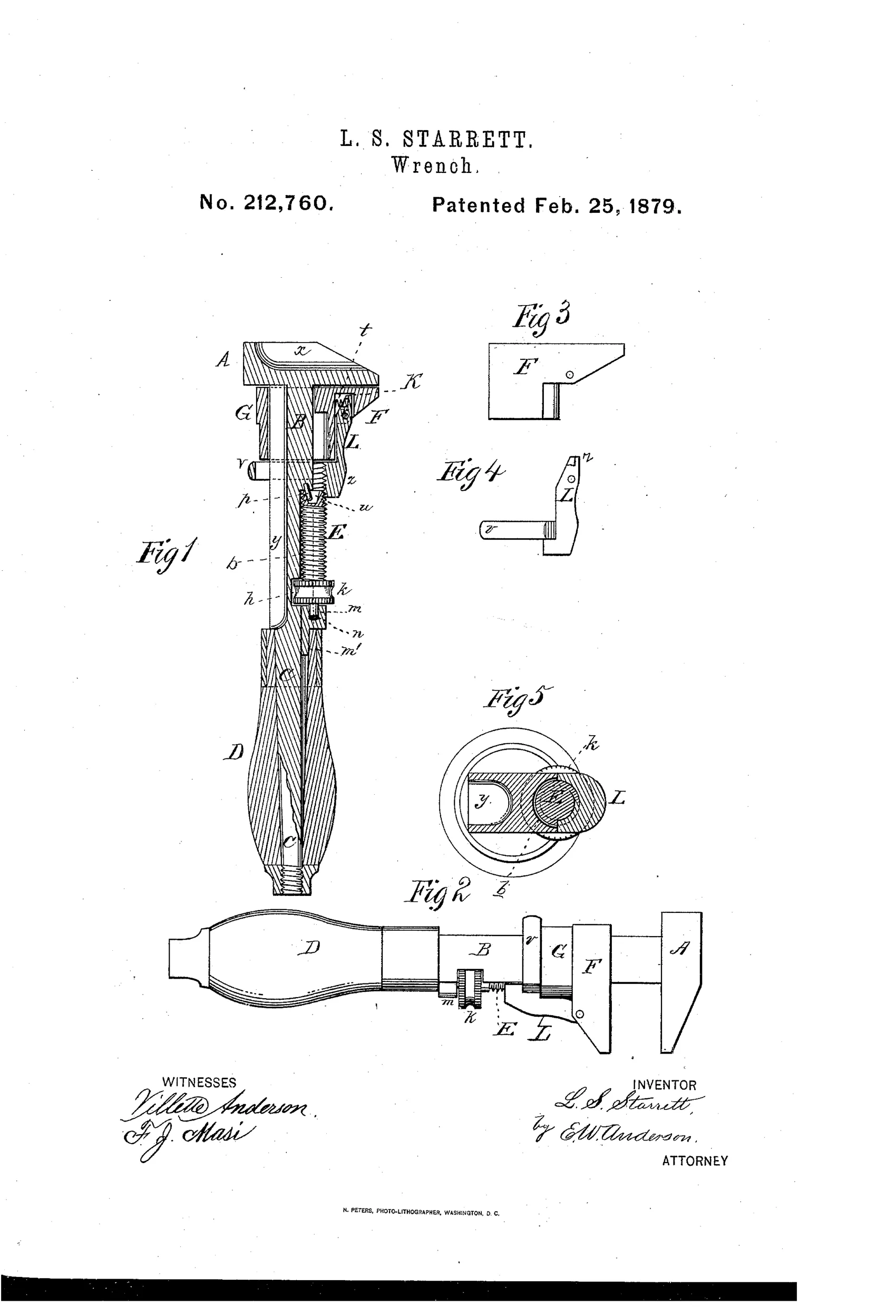
Adjustable monkey wrench with quick-release half-nut mechanism
⚙ How it works
The movable jaw slides freely along a jaw-bar until brought near the work, at which point a pivoted half-nut brace engages a short working-screw for fine adjustment. A spring holds the half-nut brace engaged with the screw, and pressing on a thumb-piece loop disengages it, allowing rapid sliding adjustment of the jaw. A milled head or rose turns the short screw sunk in a longitudinal recess in the jaw-bar to close the jaw precisely onto the work.
⚙ What was claimed
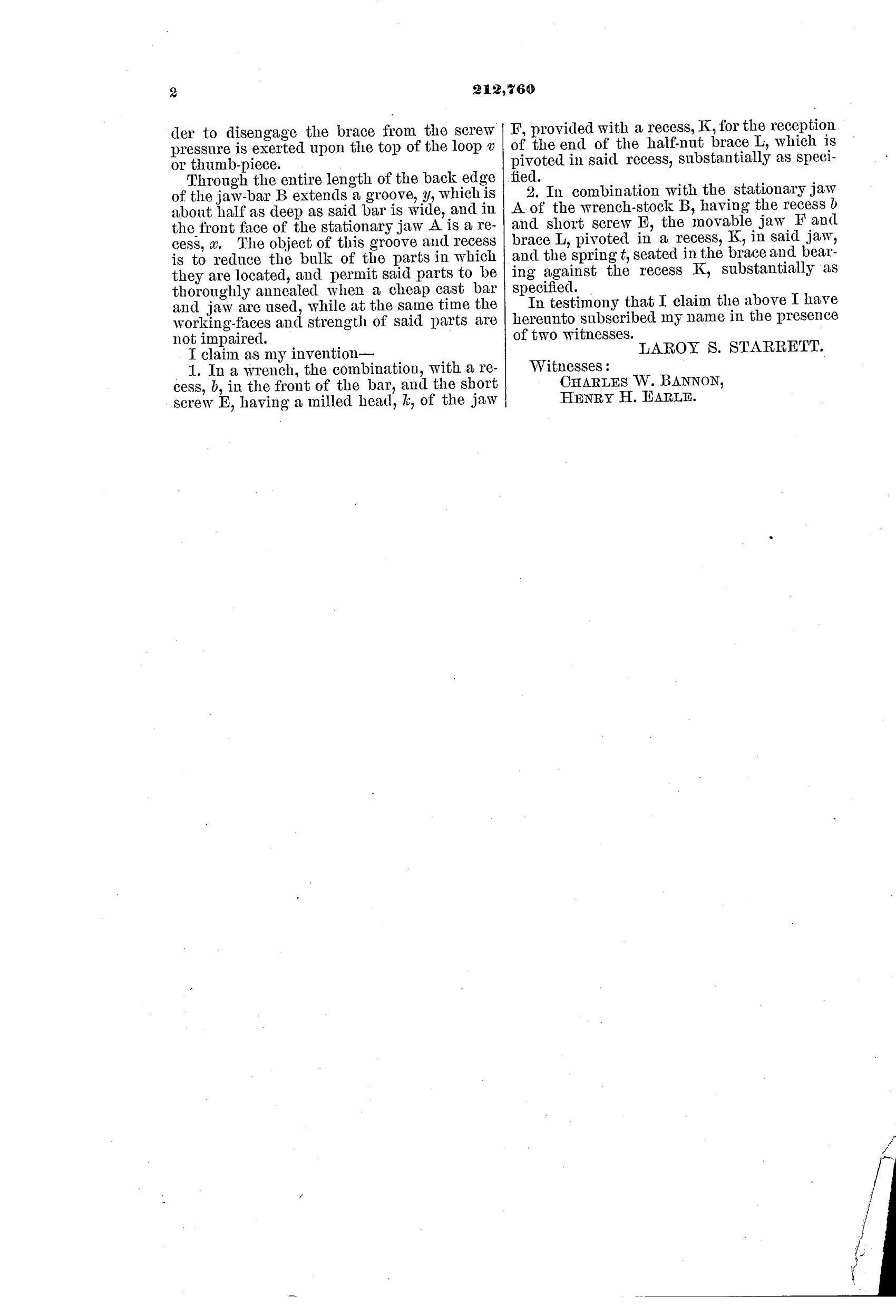
“1. In a wrench, the combination, with a recess, b, in the front of the bar, and the short screw E, having a milled head, k, of the jaw F, provided with a recess, K, for the reception of the end of the half-nut brace L, which is pivoted in said recess, substantially as specified.”
In plain English: The wrench combines a recessed bar with a short milled-head screw and a movable jaw containing a recess that holds a pivoted half-nut brace.
⚙ In the inventor’s words
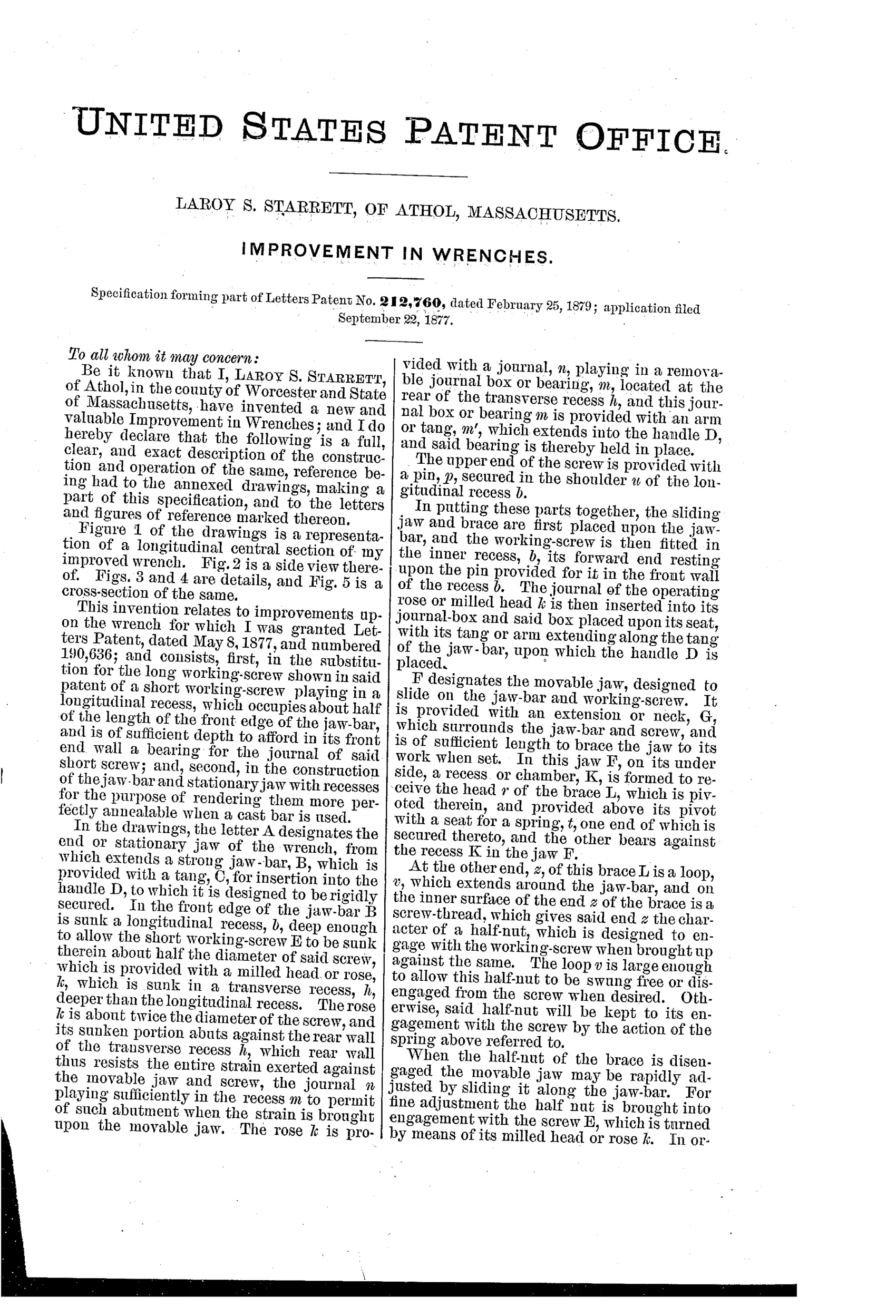
“This invention relates to improvements upon the wrench for which I was granted Letters Patent, dated May 8, 1877, and numbered 190,636.”— Laroy S. Starrett, from the specification
Manufactured and sold
Starrett produced quick-adjust wrenches in Athol under his 1877–1879 patents before turning to precision tools, and marked examples are documented by collectors and DATAMP.
⚙ Commentary
The name on this sheet is the hook. Laroy S. Starrett of Athol, Massachusetts — the same man whose company would define American precision measuring tools — was in 1879 still working out how to make a monkey wrench faster. This is a direct refinement of his 1877 patent No. 190,636, and it attacks the classic complaint about screw wrenches: spinning a long screw through its whole travel just to get to the nut.
The mechanism splits the job in two. The jaw slides freely along the bar for coarse positioning; then a pivoted half-nut brace, held by a spring, engages a short screw sunk in a recess along the bar. A milled rose head turns that short screw for the final snug-up. Press the thumb loop, the half-nut lifts clear, and the jaw is free to slide again. Fig. 5 is the drawing to study — the cross-section shows how the half-nut and screw nest inside the bar's channel, keeping the release parts protected rather than hanging off the side where shop use would batter them.
This is exactly the problem the whole field was chasing in the 1870s–90s: one-hand quick adjustment with screw-fine final grip. Starrett's version is more buildable than most, because the working screw is short and the brace pivots in a simple recess. It reads like the work of a man who intended to manufacture it — which, characteristically, he did.
Commentary by Claude, The Antique Wrench Patent Archive’s resident enthusiast