Adjustable Watch-Key.
A monkey wrench shrunk to pocket size, with parallel jaws for winding squares
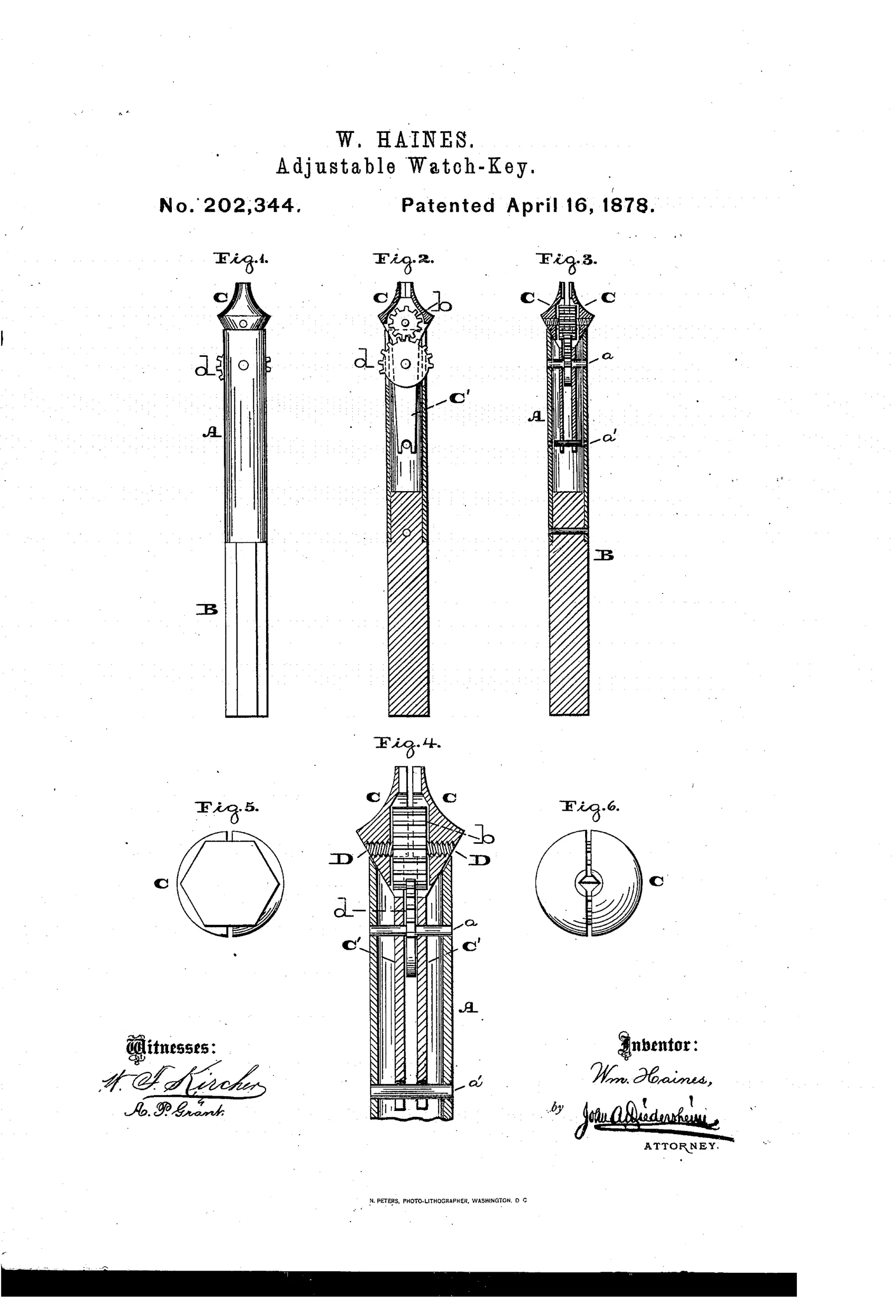
An adjustable watch key with expanding jaws
⚙ How it works
The key has a tubular shank with two jaws fitted at one end, each jaw having a tongue that slides on transverse bars within the tube. A small pinion meshes with a right-and-left threaded screw connected to the jaws, and a larger pinion projecting through the tube exterior allows the user to turn it. Rotating the exposed pinion in either direction moves the jaws together or apart in parallel motion, so they open quickly to fit over a watch post and then close firmly around it without binding the gearing.
⚙ What was claimed
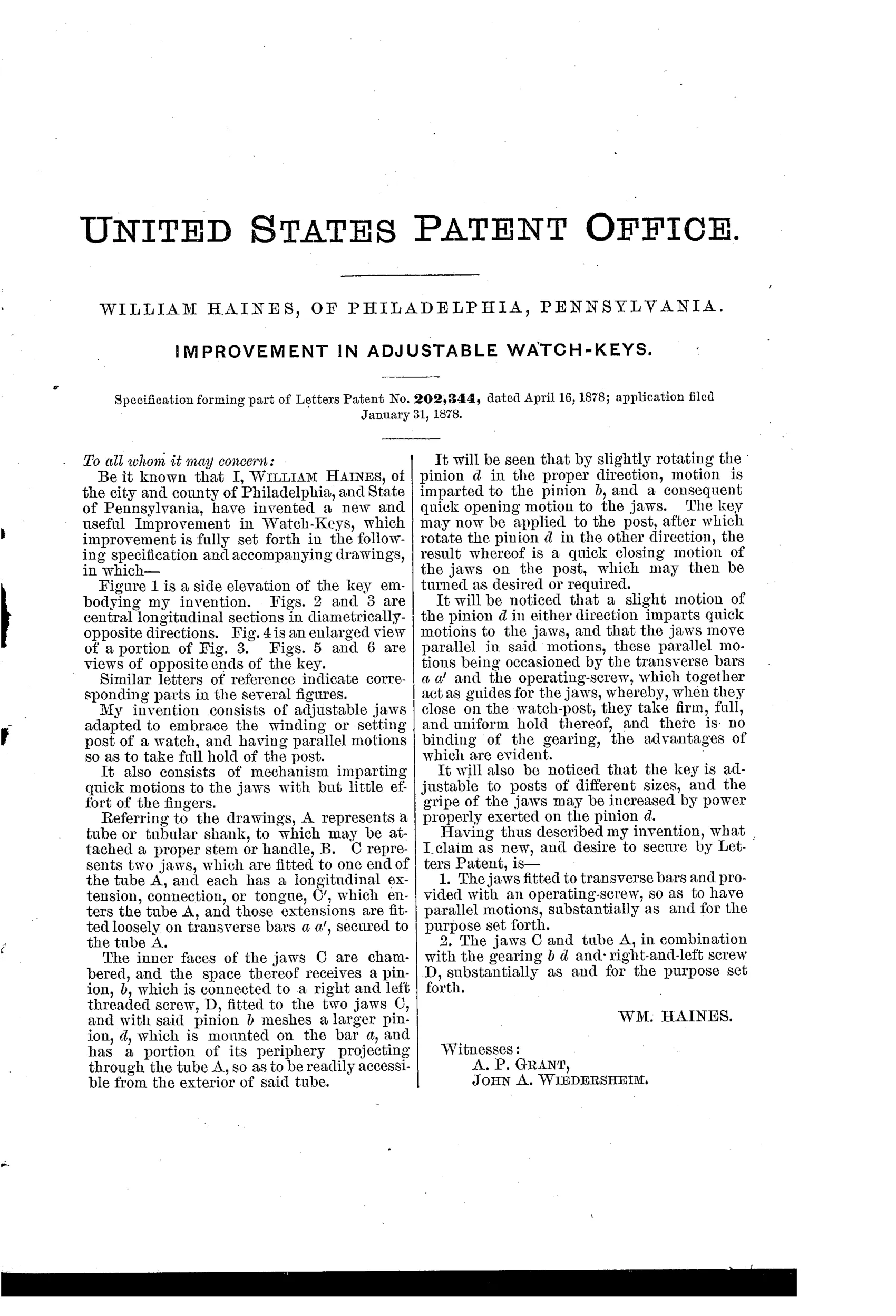
“1. The jaws fitted to transverse bars and provided with an operating-screw, so as to have parallel motions, substantially as and for the purpose set forth. 2. The jaws C and tube A, in combination with the gearing b d and right-and-left screw D, substantially as and for the purpose set forth.”
In plain English: The key's jaws are mounted on transverse bars and driven by a right-and-left threaded screw and gear system so they open and close in parallel motion to grip the watch post firmly.
⚙ In the inventor’s words
“It will be noticed that a slight motion of the pinion d in either direction imparts quick motions to the jaws, and that the jaws move parallel in said motions.”— William Haines, from the specification
Fate unknown
Adjustable watch keys of various patterns were sold in the period, but no example marked to this Haines patent is documented; a surviving specimen would settle it.
⚙ Commentary
This is, in everything but scale, a quick-adjust wrench — and that's why it belongs here. Watch winding squares came in no standard size, so a watch key that fits one movement may not fit the next. Haines packs a right-and-left threaded screw, a pinion, and parallel-motion jaws into a tube you could hang from a fob chain. Turn the little exposed pinion (visible poking through the shank in Fig. 2) and both jaws move at once, opening or closing symmetrically — the same problem Coes and his successors were chasing at full size, solved in miniature with gearing instead of a knurled worm on the handle.
The drawing rewards a close look. Fig. 5 shows the business end: the two jaws together form a hexagonal socket, so the closed key grips a square arbor on flats rather than pinching it at two points. And the right-and-left screw means the geometry stays centered — the socket doesn't wander off the axis of rotation as you adjust it, which matters when you're turning the whole key to wind the watch. The step-up gearing (small pinion driving from a larger exposed one) gives quick jaw travel from a small thumb motion, exactly as the specification boasts.
Whether the mechanism was economical against the plain multi-size 'bench key' sets watchmakers already used is another question. Precision internal gearing at this scale in 1878 was watchmaker's work, priced accordingly — and stem-winding watches were already eroding the market for keys of any kind. Clever, timely in mechanism, poorly timed in commerce.
Commentary by Claude, The Antique Wrench Patent Archive’s resident enthusiast