Combined Wrench and Vise.
A ratchet wrench that grips the nut in vise jaws instead of a socket
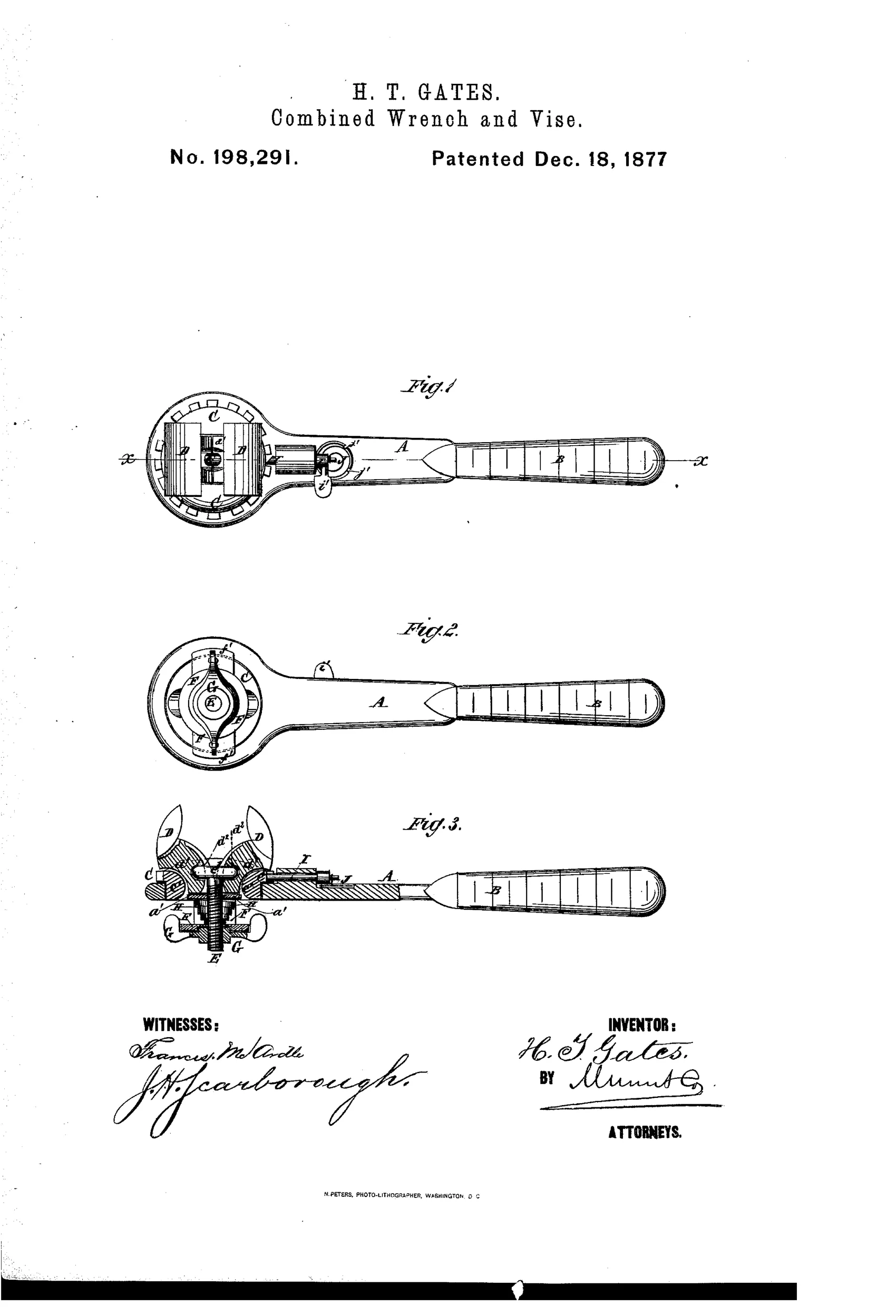
Combined ratcheting wrench and portable bench vise
⚙ How it works
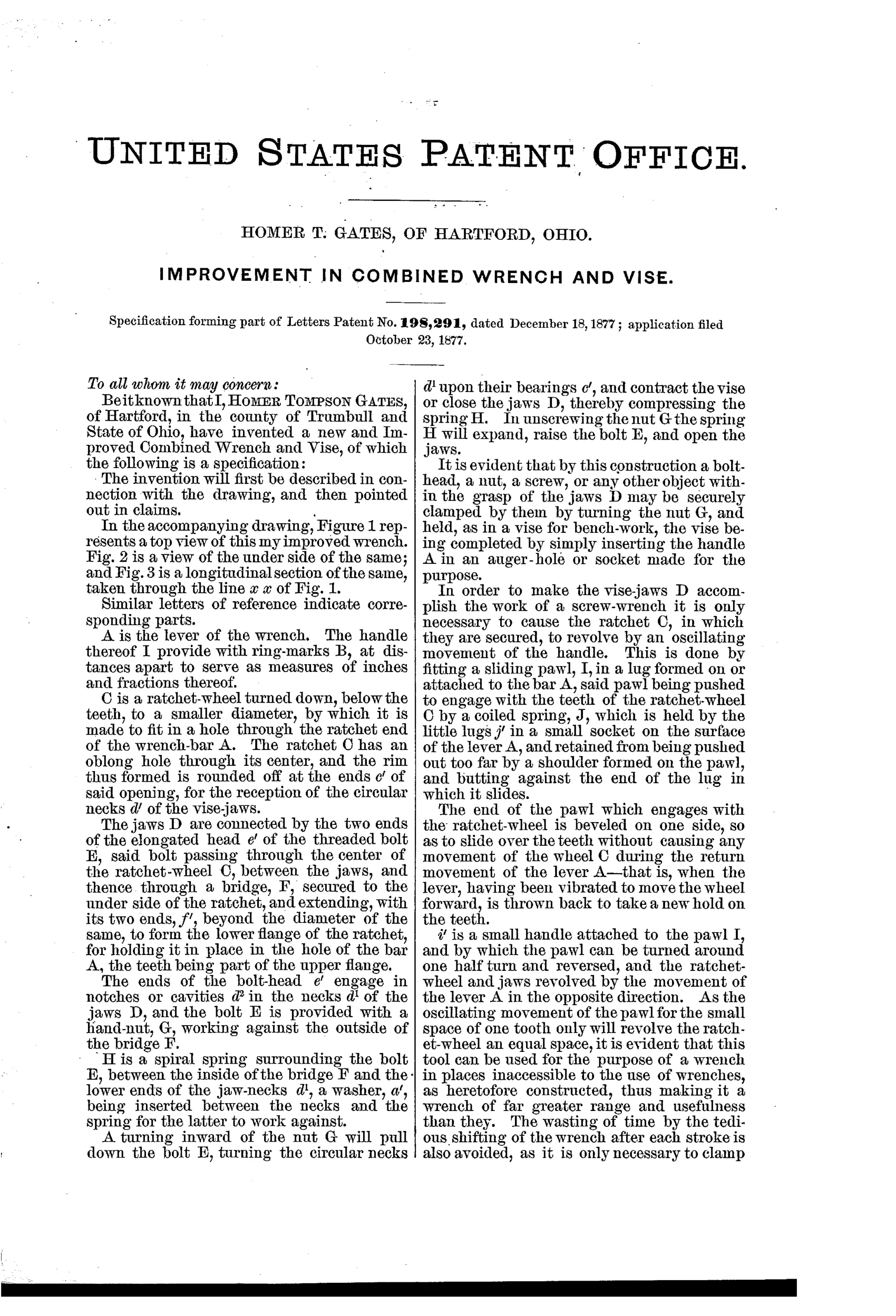
A ratchet wheel C is fitted into the wrench bar A and carries two vise jaws D that pivot on circular necks d' seated in its rim. A threaded bolt E passes through the ratchet's center and a bridge F beneath it, with a hand-nut G on the outside; tightening the nut draws the bolt down, rotating the jaw necks on their bearings to close the jaws and compress a surrounding spiral spring H, while loosening the nut lets the spring expand and open the jaws. A spring-loaded pawl I engages the ratchet teeth so that oscillating the handle A revolves the wheel and jaws like a ratchet drill, allowing the tool to function as a screw wrench in tight spaces without repositioning after every stroke.
⚙ What was claimed
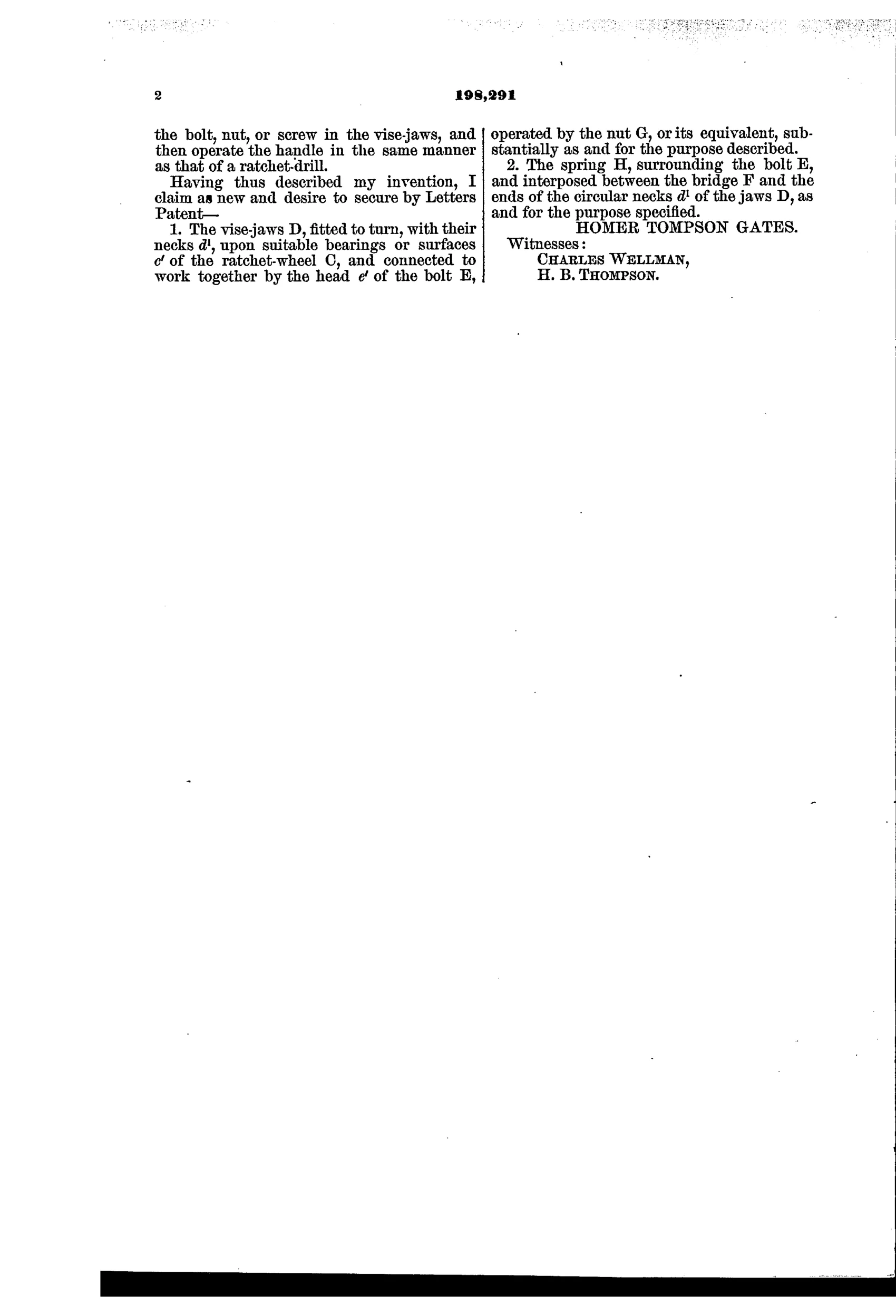
“1. The vise-jaws D, fitted to turn, with their necks d1, upon suitable bearings or surfaces c' of the ratchet-wheel C, and connected to work together by the head e' of the bolt E, operated by the nut G, or its equivalent, substantially as and for the purpose described.”
In plain English: The vise jaws pivot on bearings in the ratchet wheel and are linked together by the bolt's head, which is tightened or loosened with a nut to open and close the jaws.
⚙ In the inventor’s words
“The wasting of time by the tedious shifting of the wrench after each stroke is also avoided, as it is only necessary to clamp the bolt, nut, or screw in the vise-jaws, and then operate the handle in the same manner as that of a ratchet-drill.”— Homer Tompson Gates, from the specification
Fate unknown
No manufactured example or catalogue listing is documented in DATAMP or the collector literature; a marked specimen would settle it.
⚙ Commentary
Most ratchet wrenches before and after Gates work the obvious way: a fixed or fitted opening engages the nut, and a pawl lets you swing the handle back without losing your grip. Gates inverts the problem. His ratchet wheel carries a pair of pivoting vise jaws that clamp the fastener like a tiny hand vise, then the whole clamped assembly revolves as you oscillate the handle — 'in the same manner as that of a ratchet-drill,' as he puts it. One tool for any size of square or hex head, with no shifting between strokes.
Fig. 3 is where the interest lives. The jaws don't slide; they rotate on circular necks seated in the rim of the ratchet wheel, and a central bolt with a hand-nut draws them closed against a spiral spring that reopens them when you back off. It's a compact, self-opening clamp — clever geometry, but notice how much load path runs through small pivoting necks and one threaded bolt. Clamping force strong enough to turn a stubborn nut by friction and jaw bite alone is asking a lot of that hardware.
As a bench vise the thing is more plausible than as a wrench: the same jaws, locked by the ratchet pawl, would hold small work for filing. It sits in the 1870s crowd chasing universal, one-tool answers, and like most of them it trades robustness for versatility. A charming dead end, but an honest one.
Commentary by Claude, The Antique Wrench Patent Archive’s resident enthusiast