IMPROVEMENT IN WRENCHES
A half-threaded nut that flips between free-slide and screw-lock, from Stockton, 1877
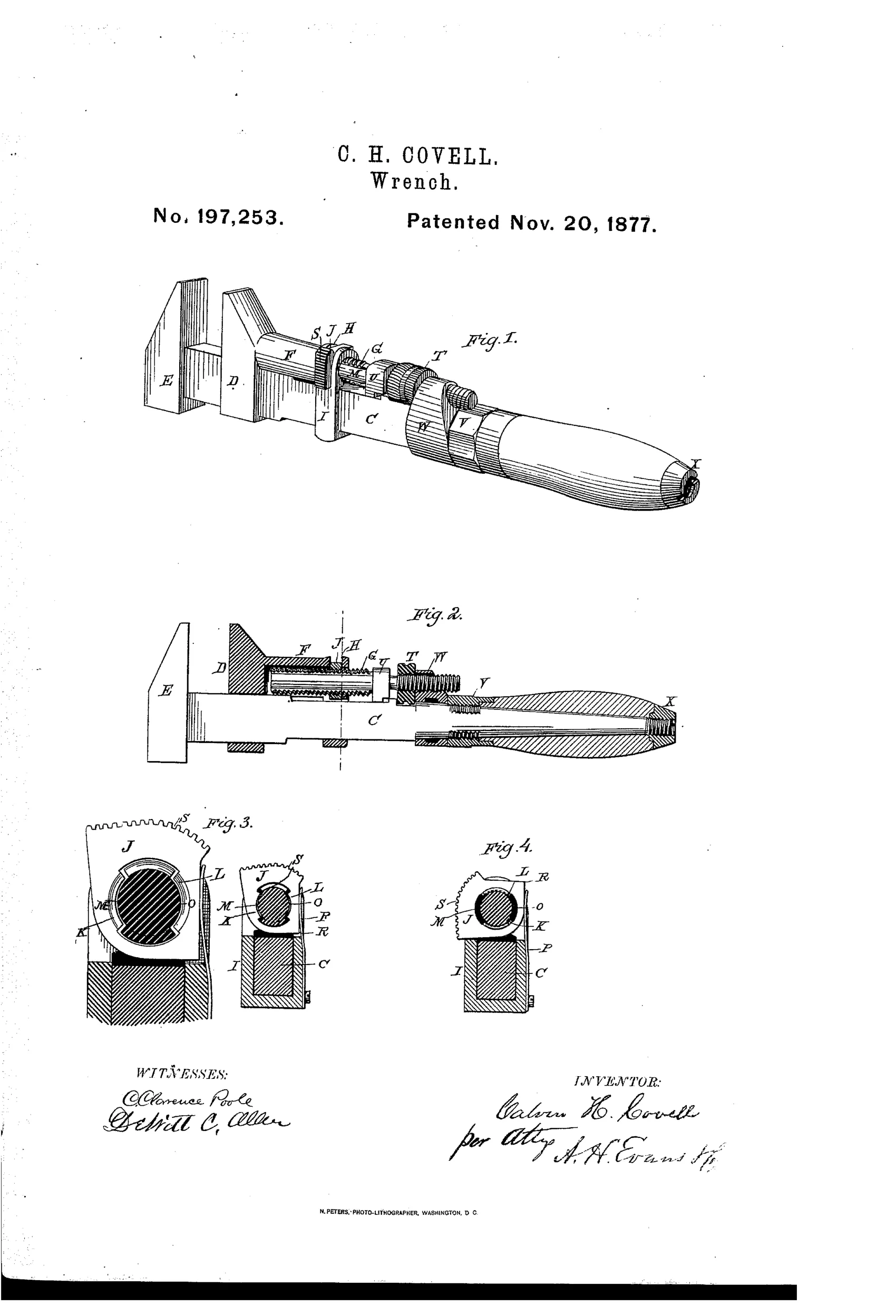
Monkey wrench with quick-adjust sliding jaw
⚙ How it works
The movable jaw D is connected to a sleeve F that encircles the wrench-bar stem G, which has a screw-thread cut away on two opposite sides. A mutilated nut J with matching threads on opposite sides K and L can be turned so its threads align with the stem's threads for rigid fixed positioning, or turned 90 degrees so the threads clear the flat sides, allowing the jaw to slide freely along the bar to any position. Fine adjustment is then made with a separate nut T and screw on the far end of stem G, guided by a bar U that prevents the stem from turning. A conical ferrule V with external screw-thread secures the handle to the wrench-bar and is held by a nut so the wrench can be readily disassembled with another wrench.
⚙ What was claimed
“1. The mutilated nut J, surrounding the stem G, and having the angular corner or stop R, in combination with the spring P, substantially as herein described. 2. The movable jaw D and sleeve F, with the nut J, in combination with the stem G, having the adjusting thread and nut T, the guide U, and bar C, substantially as herein shown and described.”
In plain English: The wrench combines a split-thread nut that can be flipped to either lock or free the sliding jaw, together with a separate fine-adjustment nut and guide bar, to let the jaw be quickly repositioned and then precisely tightened.
⚙ In the inventor’s words
“This form of ferrule is very strong, and is so constructed that it can be readily turned with any wrench, and this gives me a great advantage over ordinary wrenches, which are very difficult to dismount.”— Calvin H. Covell, from the specification
Fate unknown
No catalogued production or marked example of this Stockton design is documented in DATAMP or standard references; a surviving specimen would settle it.
⚙ Commentary
Covell's answer to the quick-adjust problem is a mutilated nut: the stem G has its screw-thread planed away on two opposite flats, and the nut J carries matching part-threads. Turn the nut a quarter-turn one way and its threads mesh with the stem's — the jaw is captive and rigid. Turn it the other way and the threads pass over the flats, letting the jaw slip the full length of the bar in one motion. Figures 3 and 4 are the whole story: the same cross-section shown unlocked and locked, with a spring P and corner stop R to index the nut at each position. Split-nut quick release is a respectable family in this field, and this is a tidy, mechanically honest version of it.
The complication is what happens next. Because the coarse setting lands wherever the flats let it, Covell adds a second, fine-adjustment nut T at the handle end, with a guide bar U to keep the stem from rotating. That's two nuts to manage where a Coes wrench has one — the classic quick-adjust bargain, speed bought at the price of parts and fumble.
The detail a casual reader skips is the ferrule V: a threaded cone securing the handle, deliberately shaped so another wrench can dismount it for repair. An 1877 inventor thinking about serviceability is worth a nod, even if the market kept buying the simpler Worcester pattern.
Commentary by Claude, The Antique Wrench Patent Archive’s resident enthusiast