IMPROVEMENT IN COMBINED WRENCH AND PIPE-CUTTER
A spring-jaw pipe wrench that swaps its grip for a cutting wheel
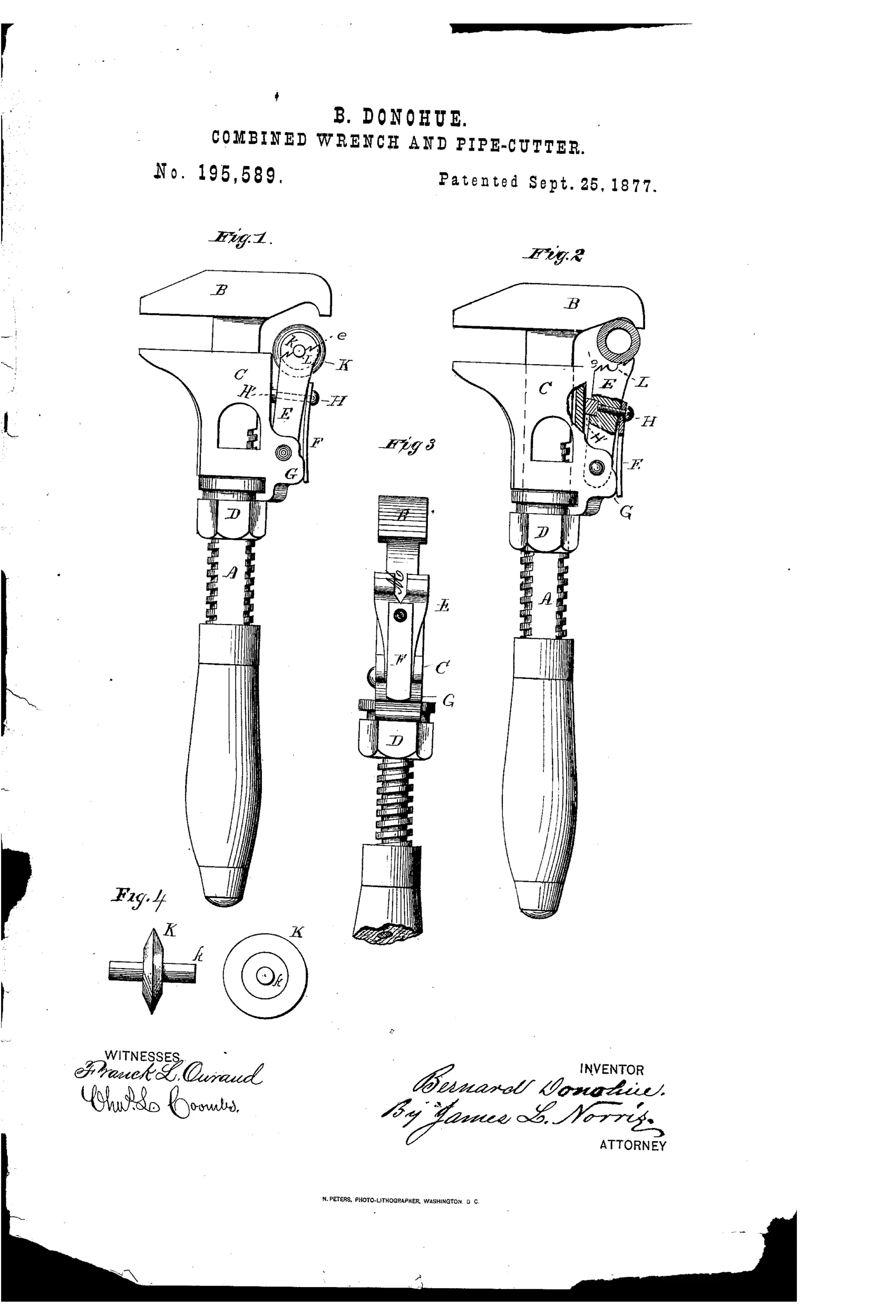
Combined pipe wrench and pipe cutter
⚙ How it works
A stationary jaw and a screw-driven sliding jaw grip the workpiece along the threaded shank. A spring-loaded jaw pivots on the movable jaw and presses against it via a spring, with its serrated bearing surface used for gripping pipe or nuts. Open-ended slots in this spring-jaw form bearings that accept a detachable rotary cutting disk, allowing the same jaw to be converted from a gripping surface to a pipe cutter by inserting the disk and advancing the movable jaw to bring the cutter's edge against the pipe.
⚙ What was claimed
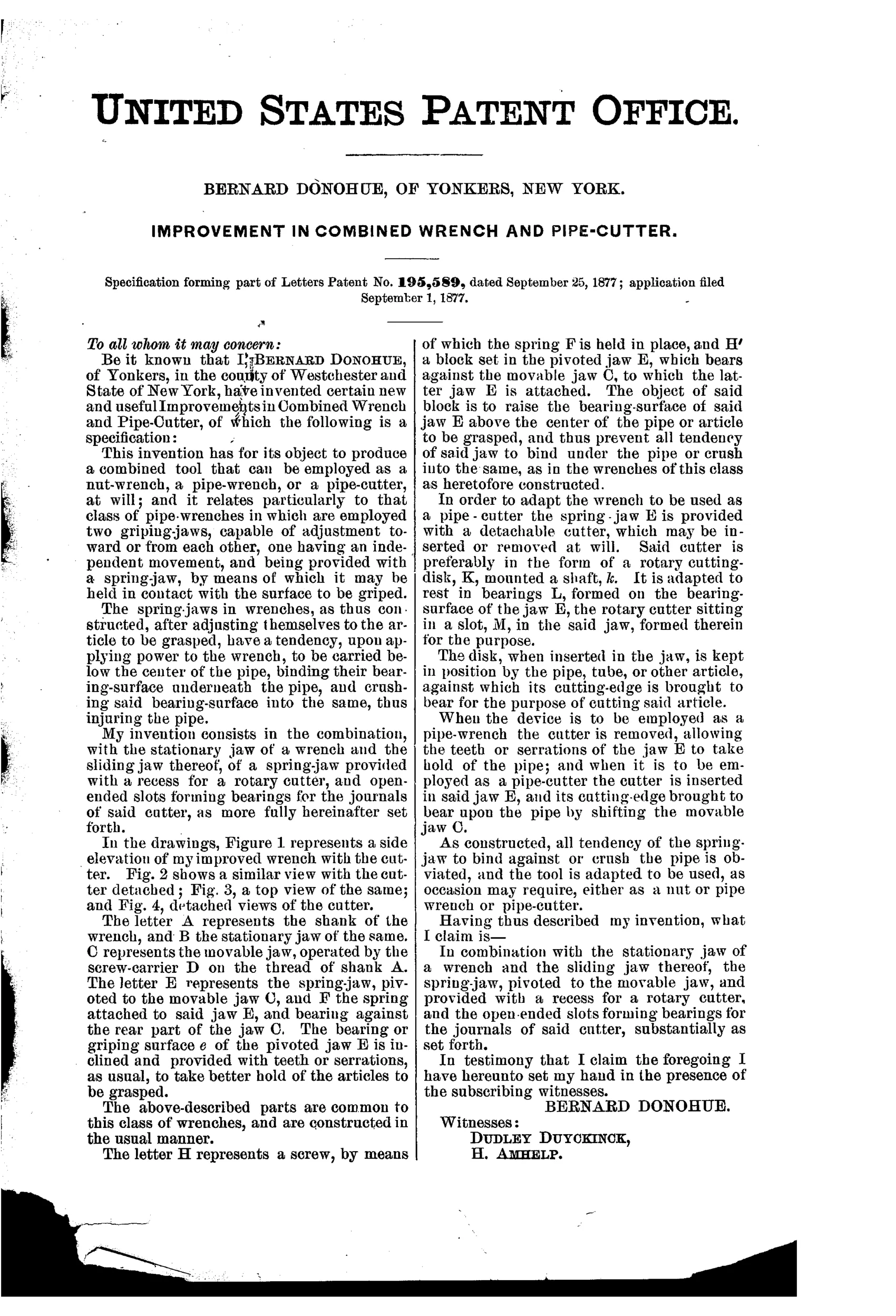
“In combination with the stationary jaw of a wrench and the sliding jaw thereof, the spring-jaw, pivoted to the movable jaw, and provided with a recess for a rotary cutter, and the open-ended slots forming bearings for the journals of said cutter, substantially as set forth.”
In plain English: The invention claims a wrench with a fixed jaw and a sliding jaw, plus a spring-loaded jaw pivoted to the sliding jaw that has a recess and open slots to hold a removable rotary cutting disk.
⚙ In the inventor’s words
“As constructed, all tendency of the spring-jaw to bind against or crush the pipe is obviated, and the tool is adapted to be used, as occasion may require, either as a nut or pipe wrench or pipe-cutter.”— Bernard Donohue, from the specification
Fate unknown
No manufactured example or catalog listing is documented at DATAMP; a marked specimen with the removable cutter would settle it.
⚙ Commentary
Donohue's idea is economy of parts taken seriously. The tool starts as a fairly conventional screw wrench — fixed jaw, sliding jaw driven up the threaded shank — with a spring-loaded auxiliary jaw pivoted on the movable jaw for gripping pipe. The clever bit is that the spring-jaw's serrated face is also a cutter housing: open-ended slots form bearings for the journals of a small rotary cutting disk (Fig. 4). Drop the disk into the slots, advance the screw, and the wrench becomes a pipe cutter, with the same feed screw supplying cutting pressure.
Compare Figs. 1 and 2 on the sheet and you can see the conversion — cutter installed on the left, detached on the right, the hatched spring-jaw doing double duty. The open slots mean no tools are needed to swap modes, which is genuinely thoughtful. The weak point is equally visible: those open slots rely on cutting pressure to keep the disk seated, and a loose disk on a job site is a disk lost in the mud. A dedicated Stillson (patented just eight years earlier) grips pipe better; a dedicated cutter cuts truer.
This sits in the 1870s enthusiasm for combination pipe tools, when gas and water fitting was booming and every inventor wanted the fitter to carry one tool instead of three. Most of these hybrids compromised both functions, and this one likely did too — but the slot-bearing conversion is a tidier solution than most.
Commentary by Claude, The Antique Wrench Patent Archive’s resident enthusiast