IMPROVEMENT IN PIPE TONGS OR WRENCHES.
A wedge jaw on a flat spring — self-tightening grip, self-releasing ratchet backstroke
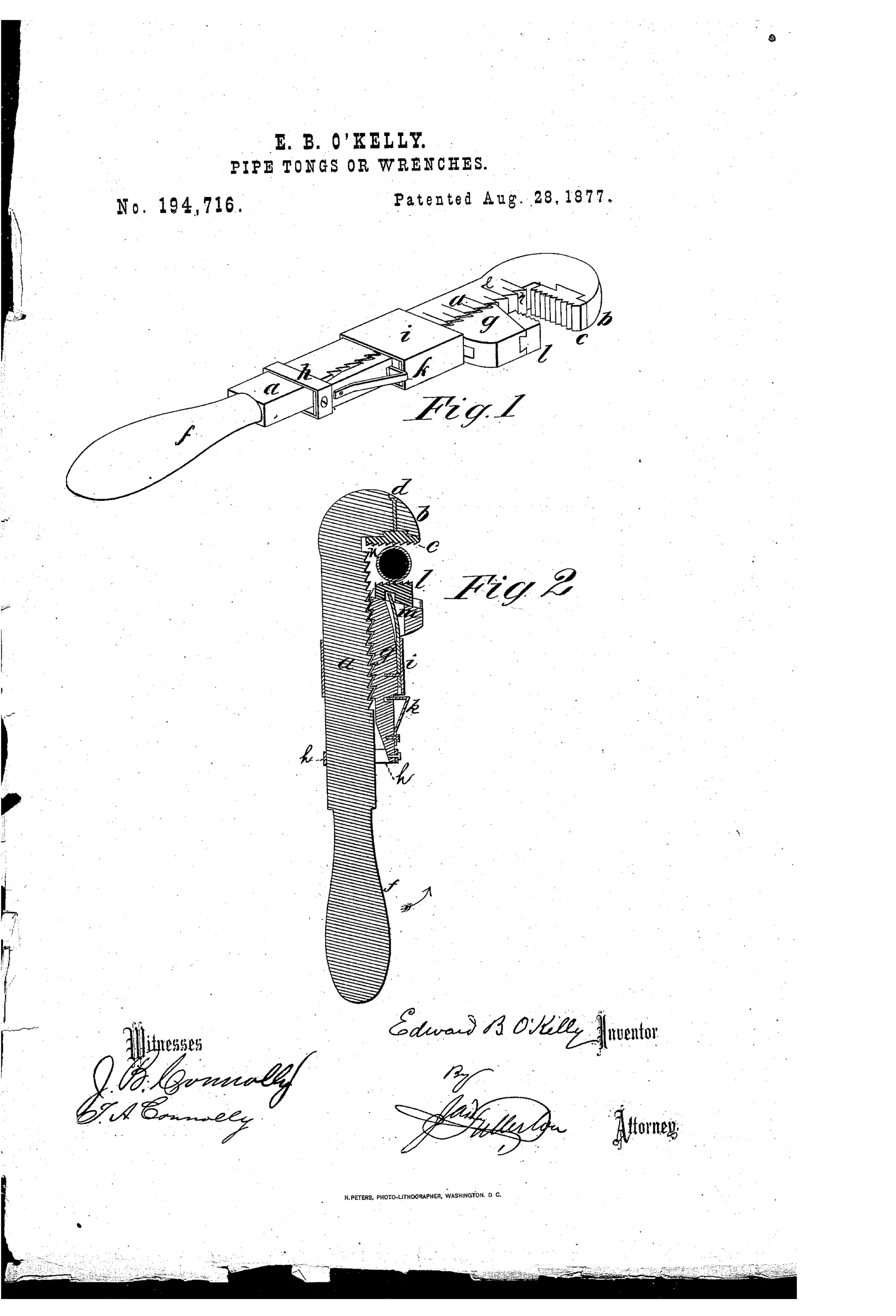
Ratcheting pipe wrench with spring-loaded wedge jaw
⚙ How it works
A lever-bar or shank ends in a fixed fulcrum holding a removable toothed jaw, secured by a screw for easy sharpening or replacement. A sliding bar mounted on the shank carries ratchet teeth that engage the shank's graduated ratchet, allowing precise adjustment to the pipe's diameter, and is held in place by a spring-loaded sliding collar. This sliding bar bears a tongued, wedge-shaped serrated jaw mounted on a flat spring, which grips the pipe with increasing force as pressure is applied due to its wedge shape. Backward motion of the handle releases the spring-loaded jaw automatically, letting the operator quickly reposition the wrench without it binding on the pipe.
⚙ What was claimed
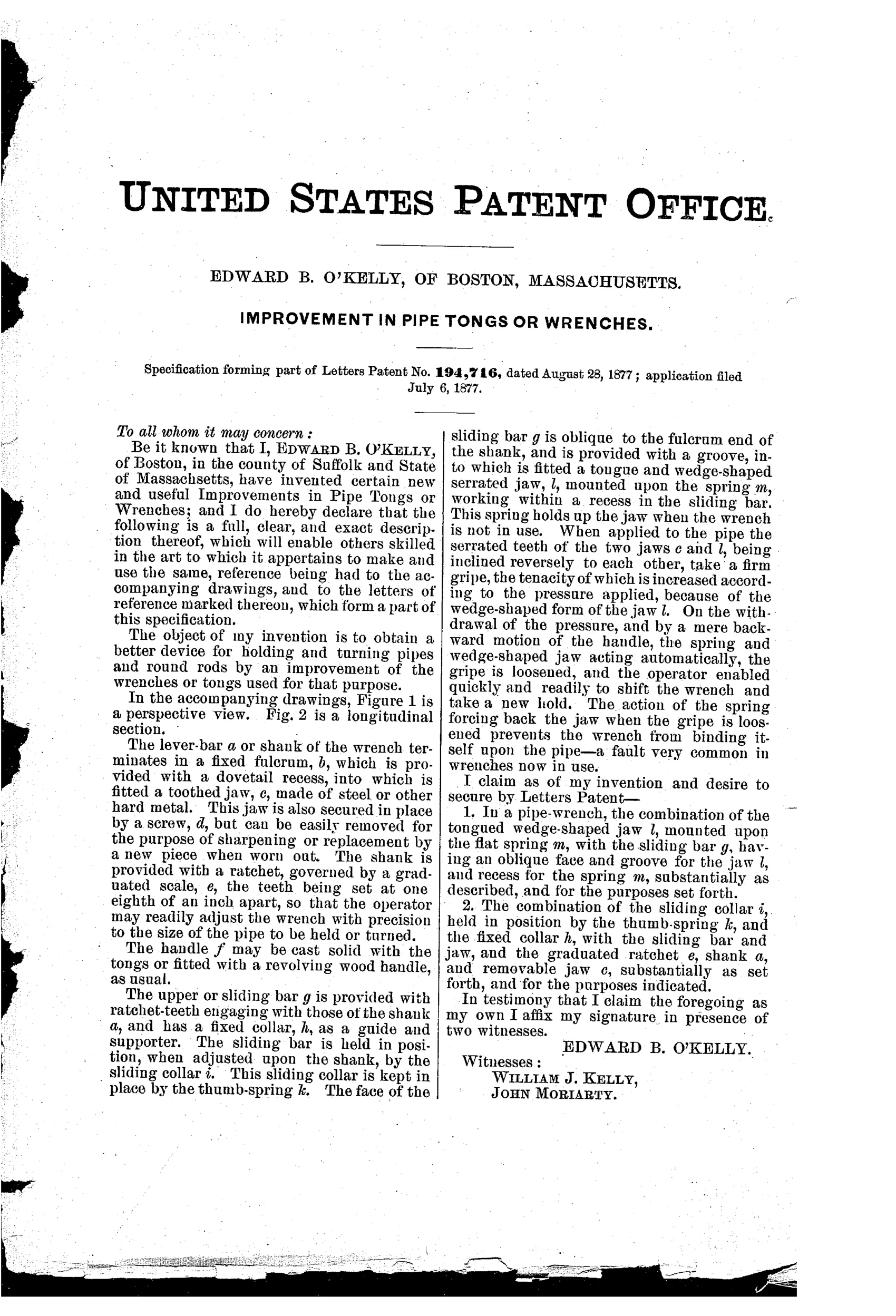
“1. In a pipe-wrench, the combination of the tongued wedge-shaped jaw l, mounted upon the flat spring m, with the sliding bar g, having an oblique face and groove for the jaw l, and recess for the spring m, substantially as described, and for the purposes set forth.”
In plain English: The patent claims a wedge-shaped, spring-mounted jaw fitted into a grooved sliding bar so it can grip and release a pipe automatically.
⚙ In the inventor’s words
“The action of the spring forcing back the jaw when the gripe is loosened prevents the wrench from binding itself upon the pipe—a fault very common in wrenches now in use.”— Edward B. O'Kelly, from the specification
Fate unknown
No manufacturer or catalogued example of this O'Kelly wrench is known to me; a marked specimen or a DATAMP-linked survivor would settle it.
⚙ Commentary
O'Kelly's 1877 pipe wrench attacks two problems at once, and the second one is the interesting one. The self-tightening part is familiar: a serrated wedge jaw riding in an oblique groove, so that the harder the pipe resists, the deeper the wedge drives and the fiercer the grip. Plenty of pipe wrenches before and after used that geometry. What's less common is the flat spring (m in Fig. 2) under the wedge, whose whole job is to shove the jaw back the moment the strain comes off. His own specification names the target: wrenches that bind themselves onto the pipe, a fault 'very common in wrenches now in use.'
That spring makes this effectively a ratcheting tool. Swing forward, the wedge bites; swing back, the spring kicks the jaw loose and the wrench slides around the pipe without the operator having to break it free by hand. Combined with the toothed rack and spring-loaded collar for coarse adjustment, you get a wrench you set once and then pump like a lever. The removable screwed-in fixed jaw, sold as a sharpening convenience, is a nice practical touch for a tool that eats its teeth.
The weak point is the usual one for spring-assisted grips: pipe scale and thread cutting oil in that groove, and the wedge stops returning. It's a clever answer from an era when the Stillson pattern (1869) was already showing how a simpler loose-jointed jaw could do the same release trick with fewer parts — which is likely why history went that way.
Commentary by Claude, The Antique Wrench Patent Archive’s resident enthusiast