IMPROVEMENT IN WRENCHES
A monkey wrench that assembles itself: collar, jaw, and screw hold each other
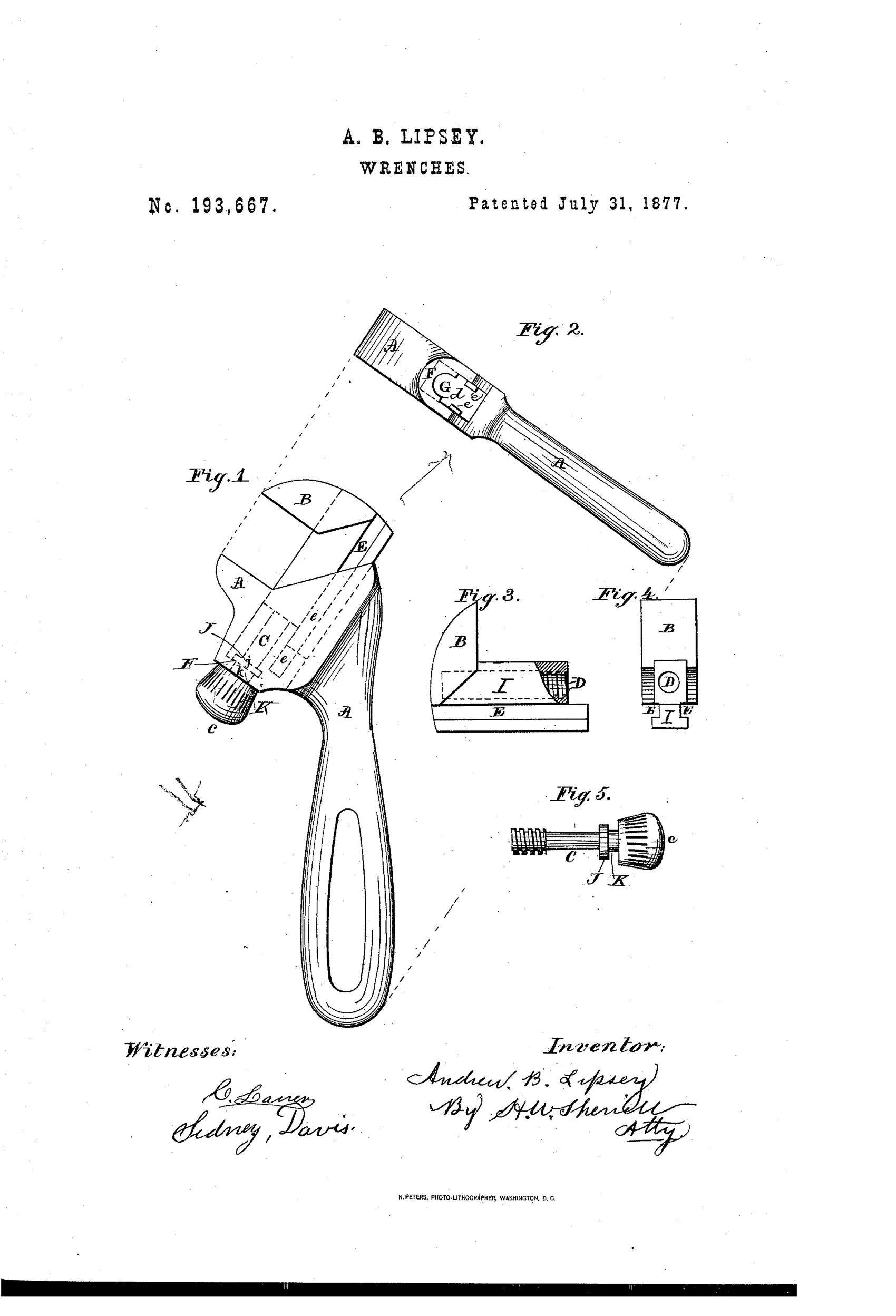
Adjustable wrench with self-securing movable jaw and screw
⚙ How it works
The head contains a transverse slideway with internal ribs and a partly-open segmental collar near the outer end. The movable jaw has a grooved shank that fits and slides within this slideway, guided by the ribs, and includes a threaded socket to receive the actuating screw. The screw has a head, a short neck behind it, and an annular shoulder, and is threaded only near its outer end with the shank turned smaller in diameter, allowing slight play; when assembled, the neck seats in the open collar so the collar, jaw, and screw mutually retain one another without pins, screws, or rivets. Turning the screw within the jaw's socket moves the jaw along the slideway to adjust the wrench opening.
⚙ What was claimed
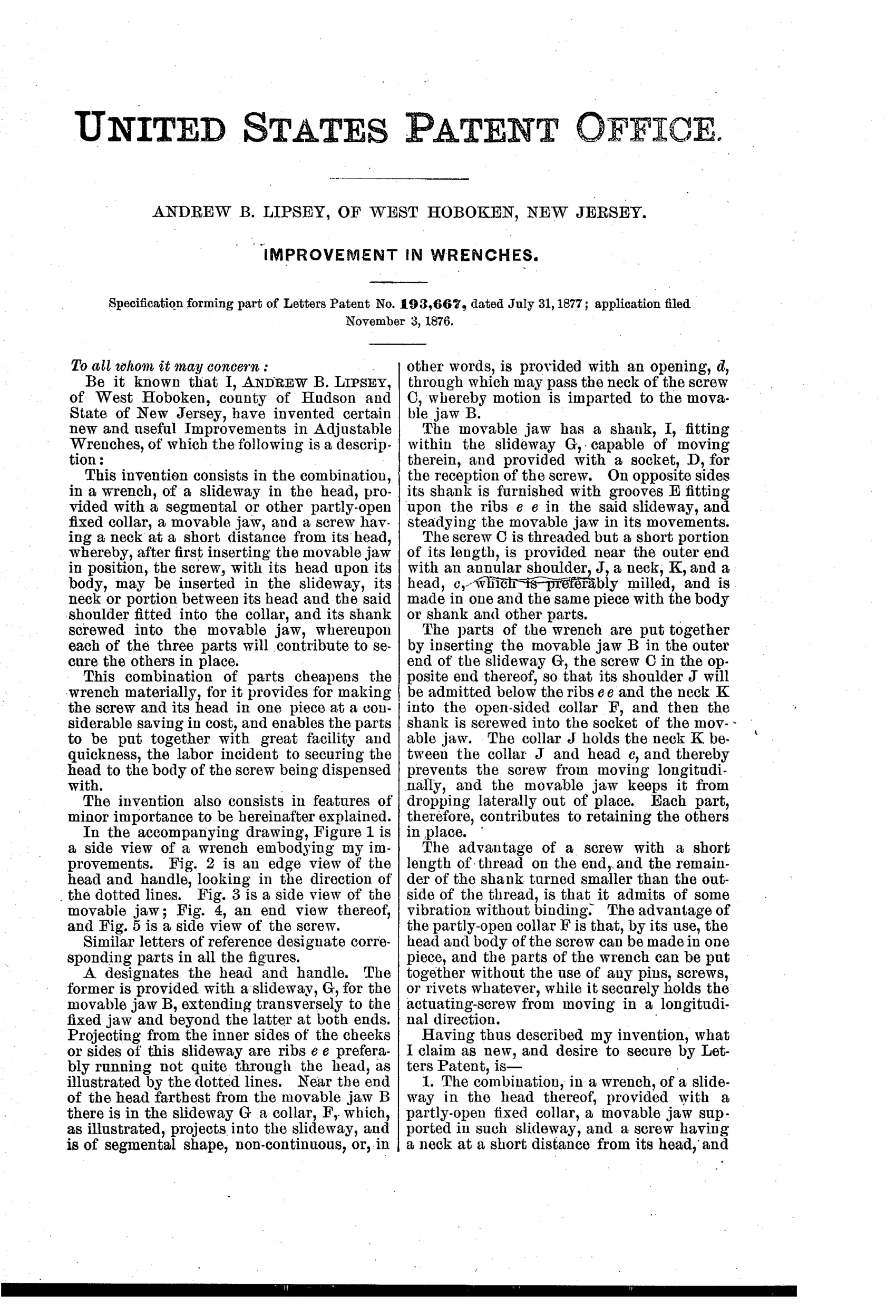
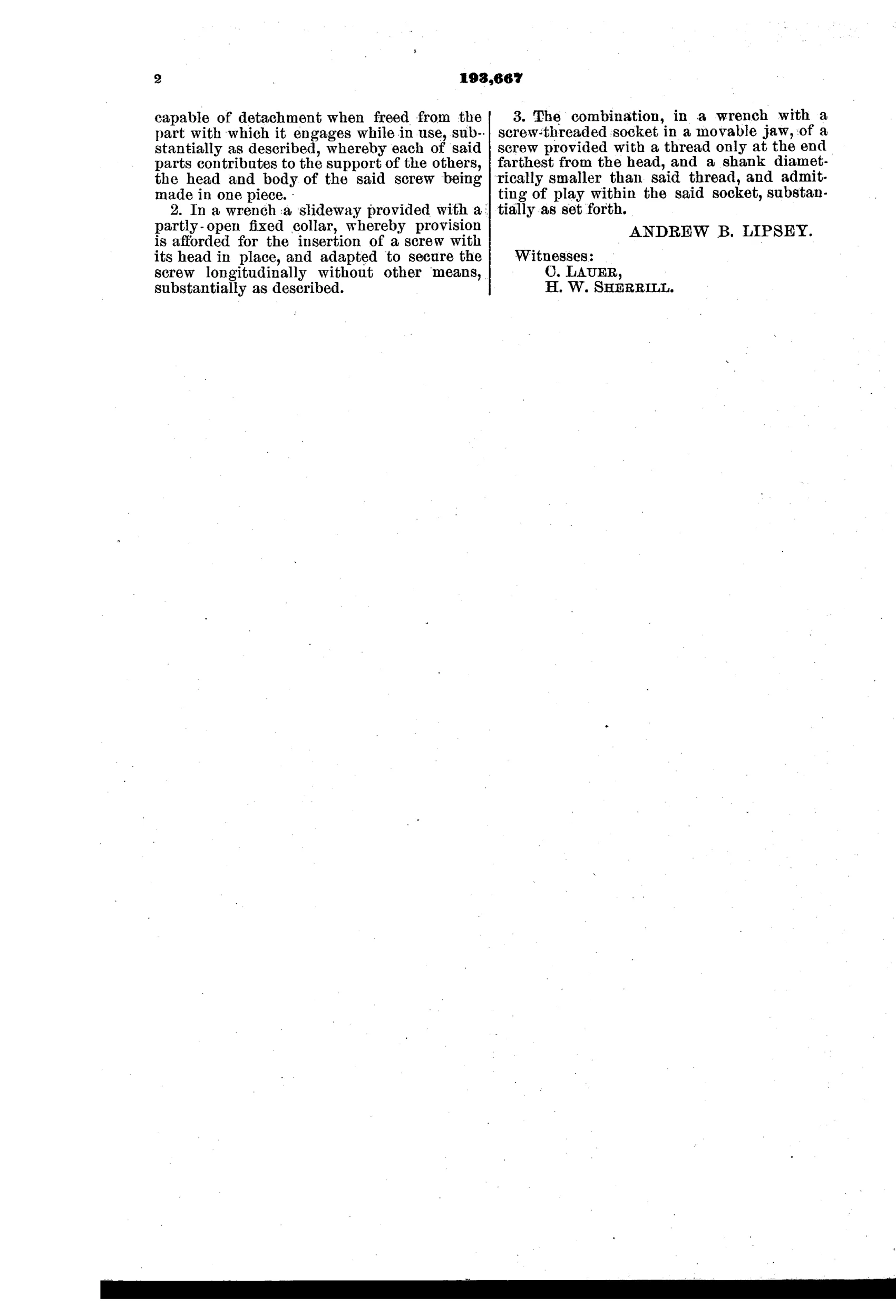
“The combination, in a wrench, of a slideway in the head thereof, provided with a partly-open fixed collar, a movable jaw supported in such slideway, and a screw having a neck at a short distance from its head, and capable of detachment when freed from the part with which it engages while in use, substantially as described, whereby each of said parts contributes to the support of the others, the head and body of the said screw being made in one piece.”
In plain English: The wrench combines a slideway with an open-sided collar, a sliding jaw, and a one-piece screw with a neck near its head, so that each part helps hold the others in place without extra fasteners.
⚙ In the inventor’s words
“This combination of parts cheapens the wrench materially, for it provides for making the screw and its head in one piece at a considerable saving in cost, and enables the parts to be put together with great facility and quickness, the labor incident to securing the head to the body of the screw being dispensed with.”— Andrew B. Lipsey, from the specification
Fate unknown
No maker or catalogued production is tied to Lipsey's design; a specimen with the characteristic open collar and necked one-piece screw would settle it.
⚙ Commentary
Most screw-wrench patents of the 1870s chase a better grip or a faster adjustment. Lipsey chased something less glamorous and arguably more important: the cost of putting the thing together. His claim is a mutual-retention scheme — a slideway in the head with a partly-open collar cast into it, a grooved jaw shank riding in the slideway, and a one-piece screw with a neck just behind its knurled head. Slip the neck into the open collar, thread the screw into the jaw's socket, and each part traps the others. No pins, no rivets, no separate screw head to attach.
Fig. 5 is the tell. Look at the reduced-diameter shank behind the head, threaded only near its outer end: that relief is what lets the screw be fed into the collar sideways and still turn freely once assembled. The patent's own language is refreshingly commercial — it "cheapens the wrench materially" by eliminating the labor of fastening a head to the screw body, which was normally a two-piece job.
As a mechanism it should work fine; it's a Coes-pattern wrench at heart, and the play he allows in the screw is the standard tolerance trick. Where it sits in the story is as a manufacturing refinement, not a mechanical leap — the kind of quiet patent that, if adopted, shows up as a slightly cheaper wrench and no fanfare at all. DATAMP has the record.
Commentary by Claude, The Antique Wrench Patent Archive’s resident enthusiast