WRENCH
Turn the handle, both jaws move: opposed threads double the adjustment speed
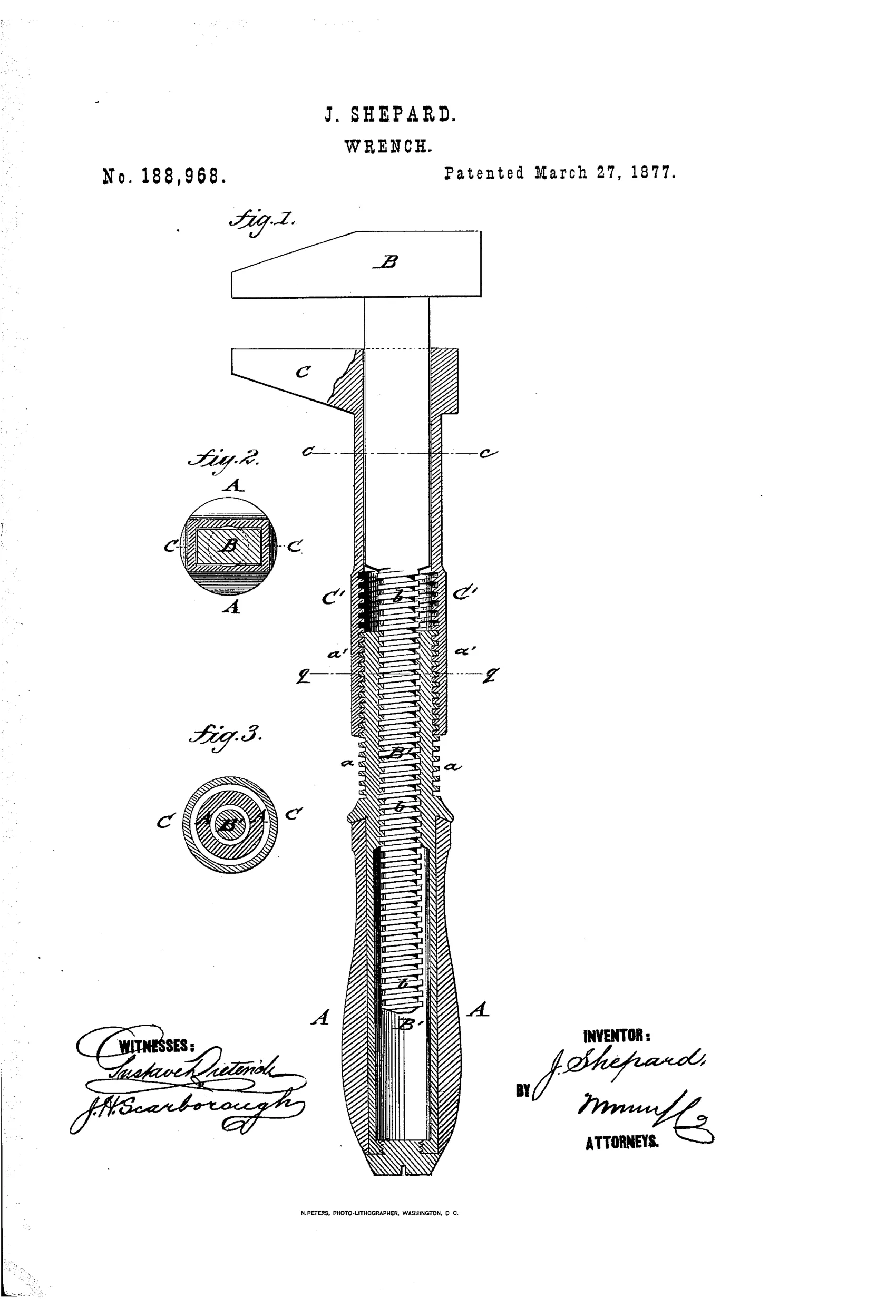
Double-threaded self-adjusting hollow-handle screw wrench
⚙ How it works
The hollow handle A has an exterior left-hand thread that engages an interior thread on the inner jaw C, and an interior right-hand double thread that engages the threaded shank of the outer jaw B, so both jaws are driven by the same rotation. Turning the handle one way draws the inner jaw inward while simultaneously moving the outer jaw outward, opening the jaws; turning it the other way closes them. The outer jaw's shank is oblong in cross-section and slides within a matching opening in the inner jaw to keep the jaws aligned as they move. Because the inner jaw is drawn in over the handle it is reinforced, while the outer jaw's outward travel increases the wrench's overall length and thus its leverage.
⚙ What was claimed
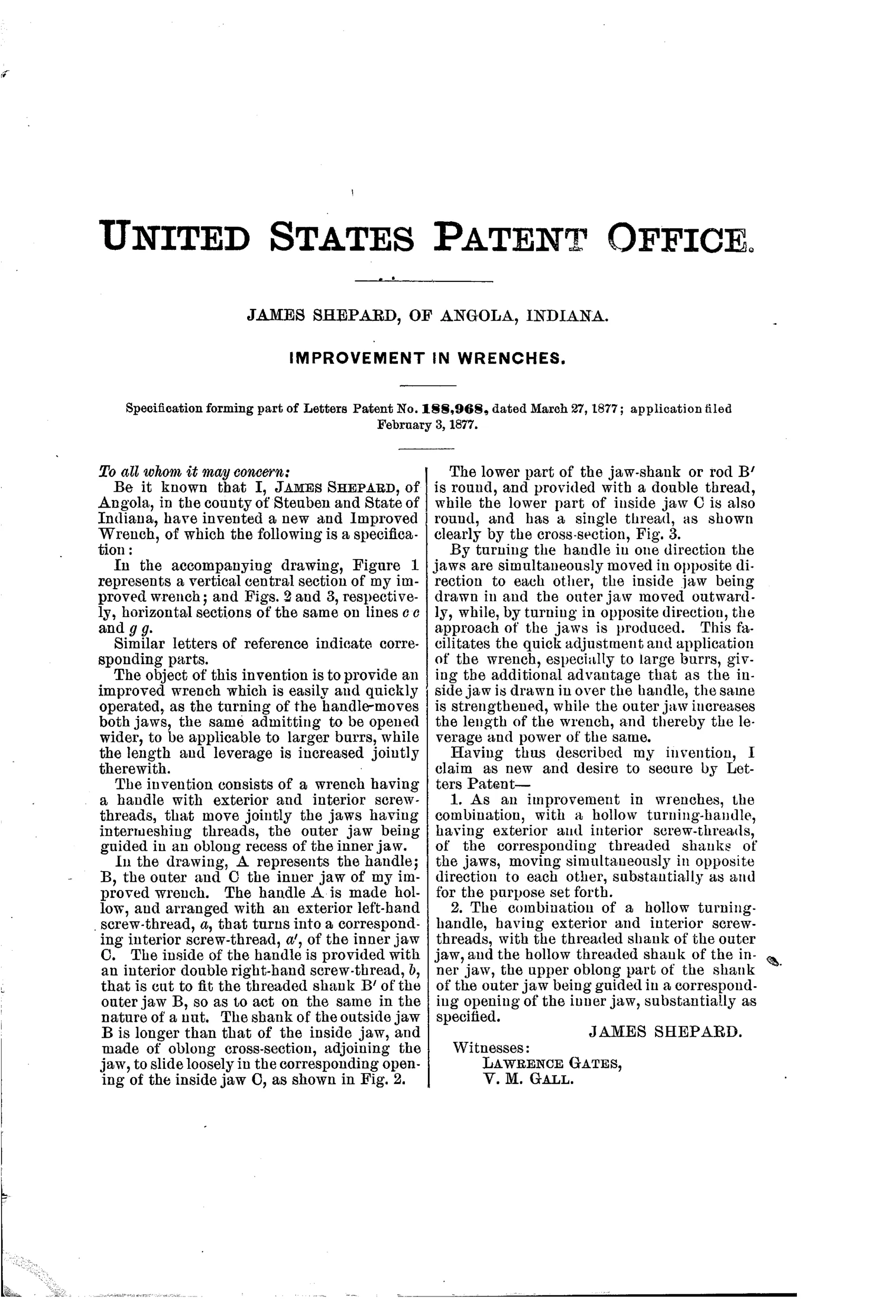
“As an improvement in wrenches, the combination, with a hollow turning-handle, having exterior and interior screw-threads, of the corresponding threaded shanks of the jaws, moving simultaneously in opposite direction to each other, substantially as and for the purpose set forth.”
In plain English: The wrench combines a hollow handle with both outer and inner screw threads that, when turned, move the two jaw shanks toward or away from each other at the same time.
⚙ In the inventor’s words
“This facilitates the quick adjustment and application of the wrench, especially to large burrs, giving the additional advantage that as the inside jaw is drawn in over the handle, the same is strengthened, while the outer jaw increases the length of the wrench, and thereby the leverage and power of the same.”— James Shepard, from the specification
Fate unknown
No catalogued production or marked example is documented at DATAMP; a surviving specimen with this double-thread handle would settle it.
⚙ Commentary
Shepard's idea is easy to state and pleasingly symmetrical: bore out the handle, cut a left-hand thread on its outside and a right-hand double thread on its inside, and let one twist drive both jaws in opposite directions at once. The inner jaw screws onto the handle's exterior; the outer jaw's shank screws into its bore. One rotation of the grip opens or closes the mouth at roughly twice the rate of an ordinary screw wrench — his answer to the field's perennial complaint that Coes-style wrenches are slow to span a large nut.
The section drawing rewards a close look. Fig. 2 shows the outer jaw's shank is oblong where it passes through the inner jaw, which is what keeps the two jaws parallel — without that flat, they'd rotate relative to each other and the wrench would be useless. Shepard also noticed a happy side effect: the inner jaw telescopes back over the handle as it retracts, stiffening the assembly, while the outer jaw's travel lengthens the tool and adds leverage exactly when you're gripping something big.
The cost is machining. Concentric left- and right-hand threads on one hollow handle, plus a matching double-threaded bore, is expensive work for 1877, and the nested tubes limit how beefy any one part can be. It's a clever refinement in the crowded chase for quick adjustment, but the economics point toward paper.
Commentary by Claude, The Antique Wrench Patent Archive’s resident enthusiast