IMPROVEMENT IN LEVER-CLAMPS
A one-man car-mover that grips a four-inch axle like a giant wrench
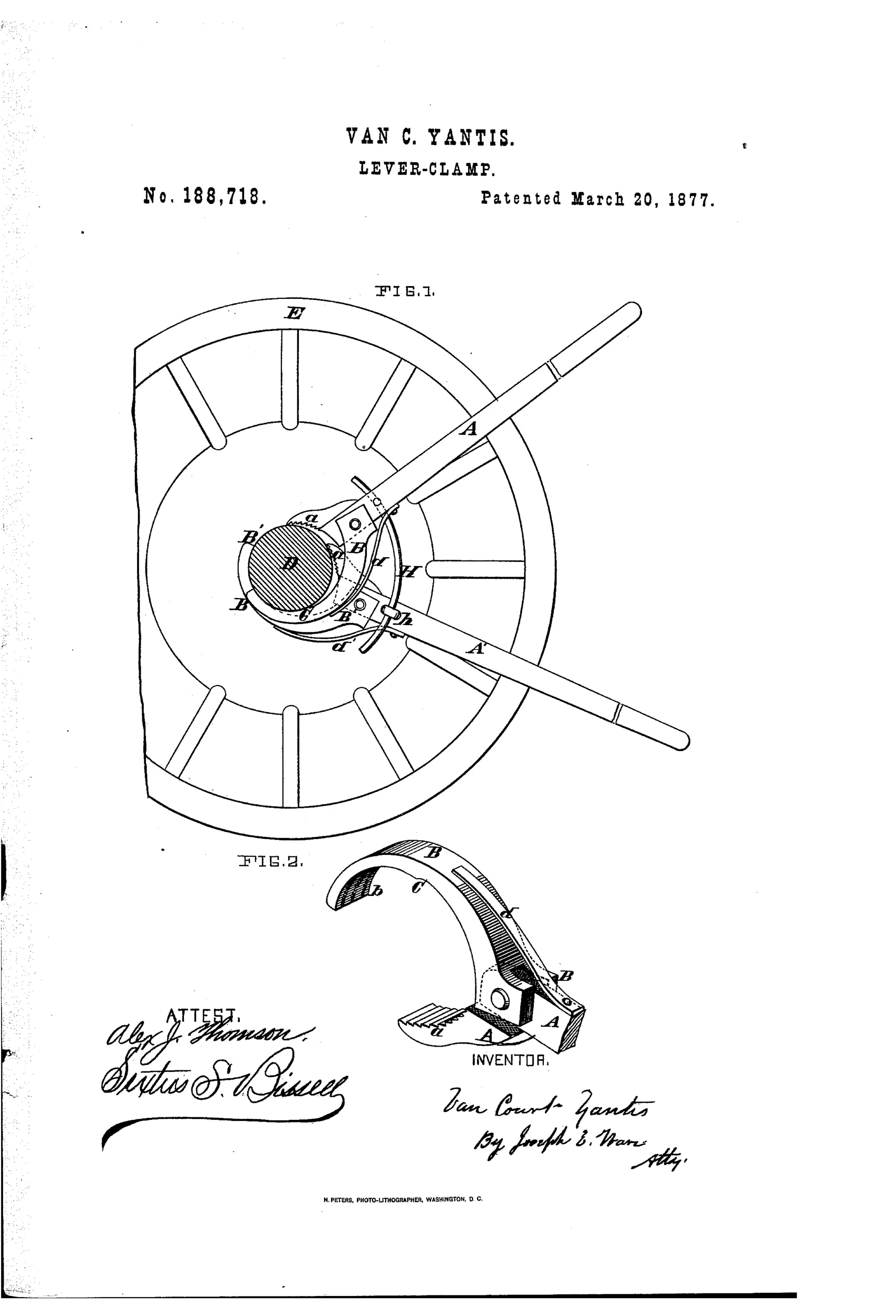
Compound lever-clamp for repositioning railroad freight cars
⚙ How it works
Two curved, roughened jaws pivot to grip a car axle, with the lever's fixed fulcrum shaped to match a four-inch axle's curvature. A spring holds the clamp jaw tight against the axle so it seizes hold when the lever is worked underhand. For heavy or uphill work, a curved coupling-rod links two levers together via a guide-eye on bar H, allowing compound double-lever action; otherwise a single lever and clamp suffices for simple movement.
⚙ What was claimed
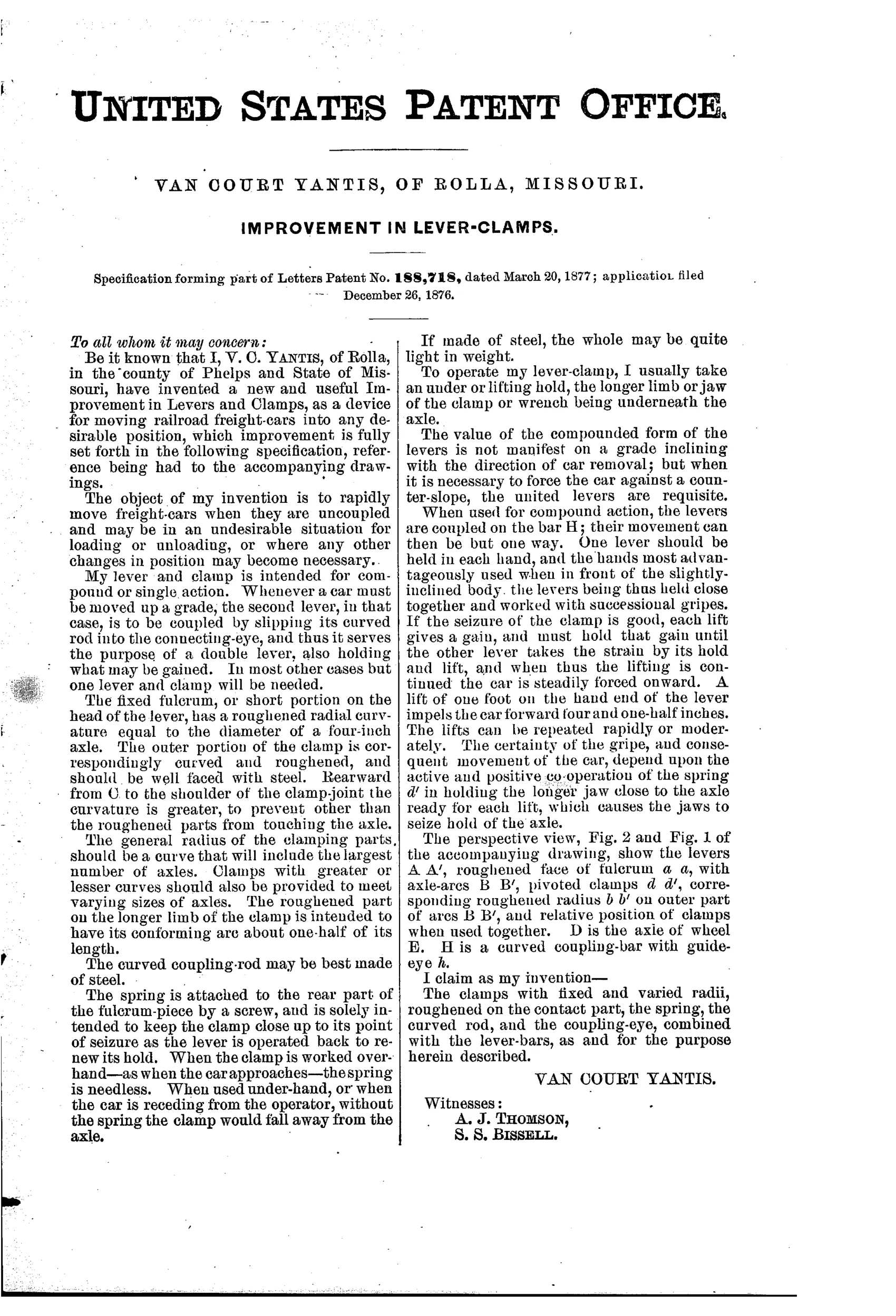
“The clamps with fixed and varied radii, roughened on the contact part, the spring, the curved rod, and the coupling-eye, combined with the lever-bars, as and for the purpose herein described.”
In plain English: The invention is the combination of specially curved, roughened clamp jaws, a spring, a curved connecting rod, and a coupling-eye, all joined to the lever handles to grip and move a railroad car axle.
⚙ In the inventor’s words
“A lift of one foot on the hand end of the lever impels the car forward four and one-half inches.”— Van Court Yantis, from the specification
Fate unknown
No manufactured example or catalogue listing is documented (DATAMP is the place to check); a marked specimen or railroad supply advertisement would settle it.
⚙ Commentary
This one sits at the edge of our category, and I include it happily: strip away the railroad context and what Yantis patented is a spring-loaded gripping jaw on a lever — the same family of thinking as the alligator wrench, scaled up until the "nut" is a freight-car axle. The clamp's fixed fulcrum is curved to match a four-inch axle, the contact face is roughened, and a spring keeps the jaw snugged against the shaft so it bites the instant you heave underhand on the handle. Ratcheting jack-lever car-movers were a real trade in the 1870s; Yantis's twist is gripping the axle directly rather than prying against the rail or wheel tread.
The detail a casual reader will skim past is the coupling arrangement in Fig. 1: a curved rod through a guide-eye links two levers so a second man's stroke compounds the first. That's the honest engineering here — Yantis knew one lever moves a car on level track but not up a grade, and he designed for both cases instead of overclaiming. His own arithmetic is charmingly specific: a one-foot lift at the handle advances the car four and a half inches.
Whether a roughened jaw would hold on a greasy axle under that load is the fair doubt. Wheel-tread movers won this market, which suggests the axle-grip approach was a dead end — but a thoughtfully worked-out one from Rolla, Missouri.
Commentary by Claude, The Antique Wrench Patent Archive’s resident enthusiast