IMPROVEMENT IN WRENCHES
Coes himself, thirty-five years on, finally kills the wooden handle
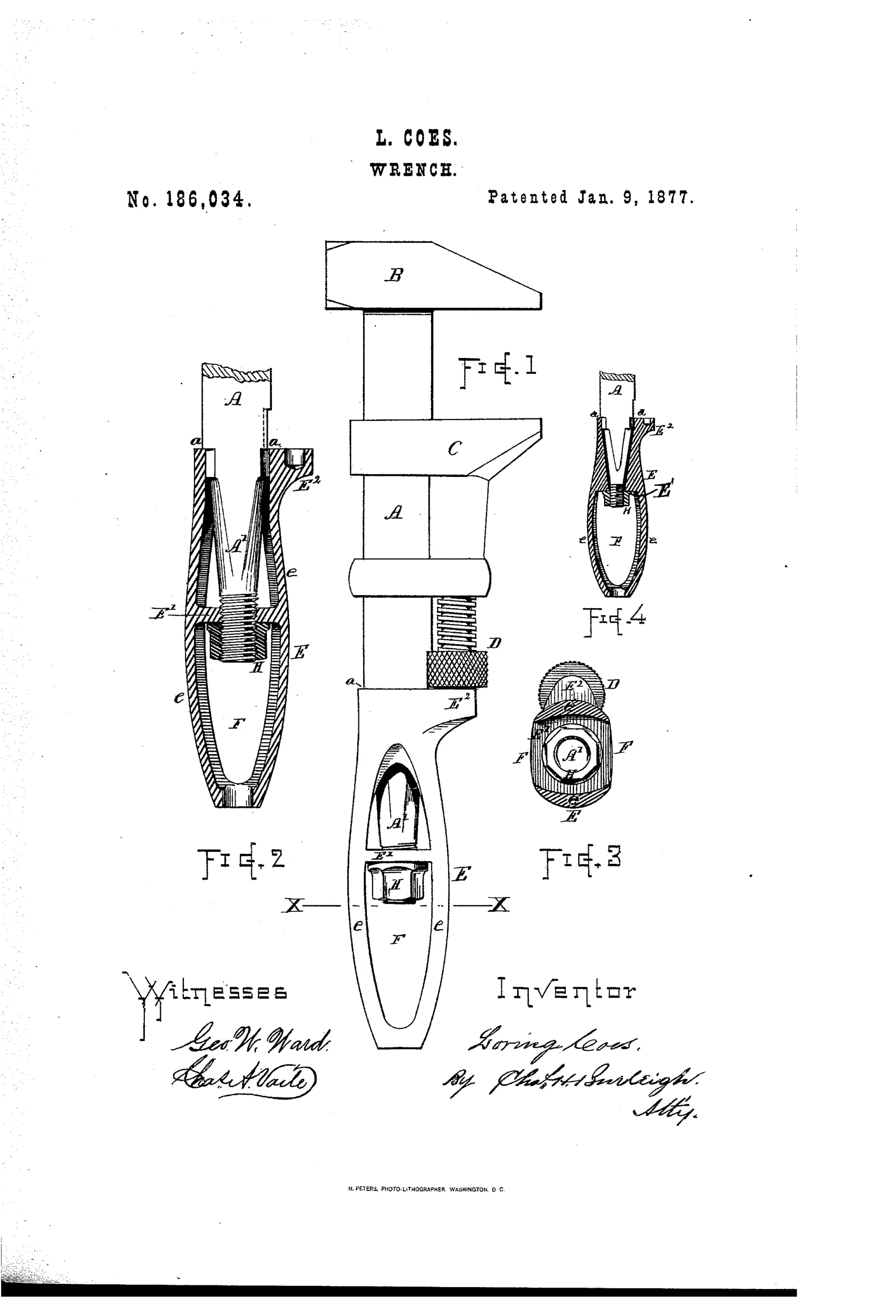
Metal-handled screw wrench with cast handle
⚙ How it works
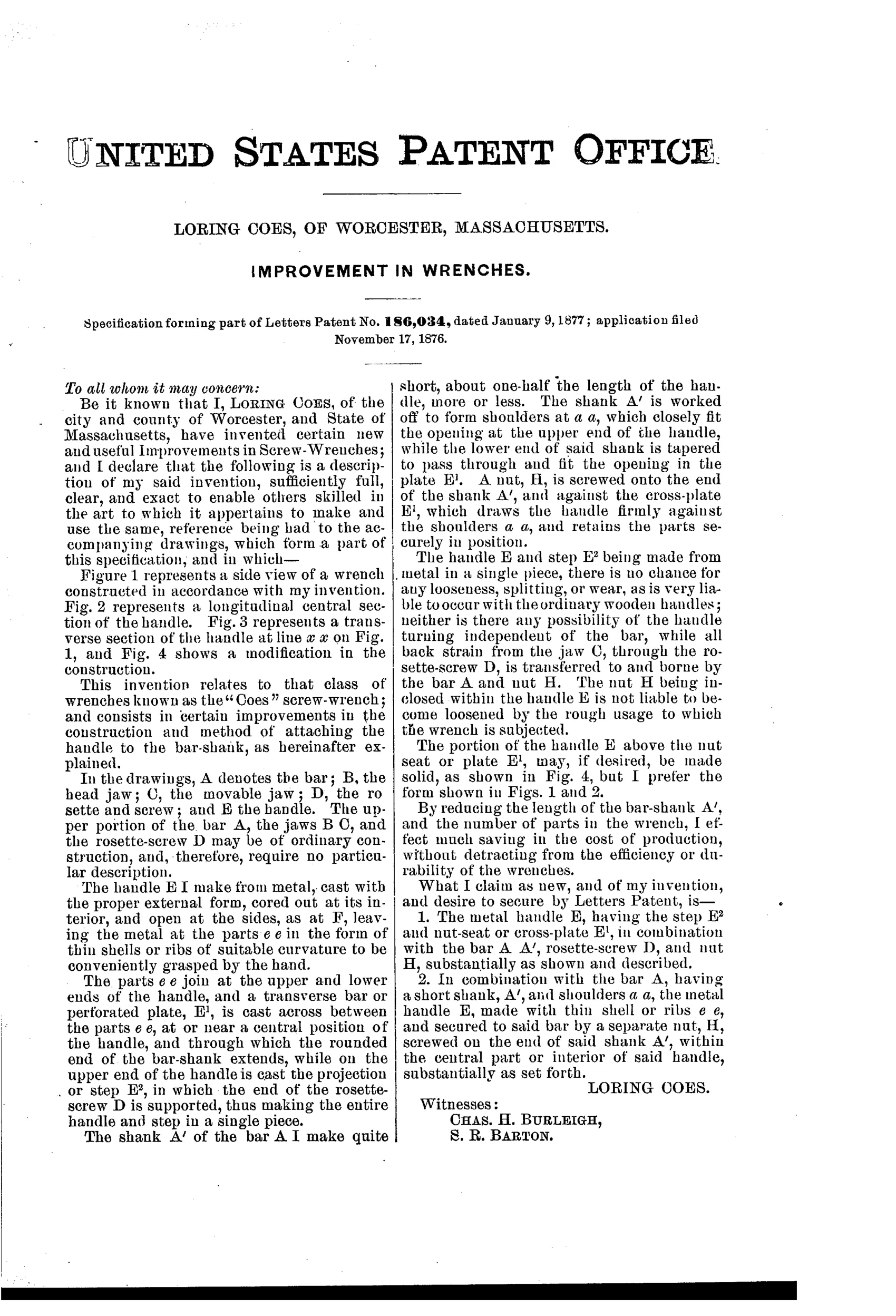
The wrench has a bar with head jaw and movable jaw adjusted by a rosette screw. A metal handle, cast in one piece with a step and cross-plate, receives the shank of the bar. The shank passes through the cross-plate and is secured by a nut screwed onto its end, drawing the handle firmly against shoulders on the shank so it cannot loosen or split like a wooden handle. Back strain from the movable jaw is transferred through the rosette screw to the bar and nut rather than to the handle attachment.
⚙ What was claimed
“1. The metal handle E, having the step E2 and nut-seat or cross-plate E1, in combination with the bar A A', rosette-screw D, and nut H, substantially as shown and described.”
In plain English: A one-piece cast metal handle with a built-in step and cross-plate, used together with the wrench's bar, rosette screw, and a securing nut.
⚙ In the inventor’s words
“The handle E and step E2 being made from metal in a single piece, there is no chance for any looseness, splitting, or wear, as is very liable to occur with the ordinary wooden handles.”— Loring Coes, from the specification
Manufactured and sold
Coes of Worcester manufactured metal-handled screw wrenches in quantity, and DATAMP ties this patent to that production line.
⚙ Commentary
This is the man who defined the American monkey wrench going back to fix its weakest point. Every Coes screw wrench since 1841 had carried its load through a wooden handle, and every user knew what happened eventually: the wood dried, shrank, split at the ferrule, and worked loose on the shank. Here Coes casts the handle, step, and cross-plate as a single piece of metal, slides it over the bar's shank, and cinches it down with a nut bearing against the internal cross-plate. Figures 2 and 3 are the ones to study — the sectional views show the nut H seated inside the hollow handle against that cast plate, drawing the whole assembly hard against shoulders on the shank. Nothing can migrate.
The quieter piece of engineering is in the load path. The back strain from the movable jaw goes through the rosette screw into the bar and that securing nut, not into the joint between handle and shank. The handle attachment only has to stay tight; it doesn't have to fight the wrenching forces. That separation of duties is what makes the design durable rather than merely rigid.
As patents go this is a refinement, not a revelation — but it's the kind of refinement that comes from a factory listening to warranty complaints for three decades. Coes wrenches with metal and reinforced handles became a standard product line, and this patent is a step on that road.
Commentary by Claude, The Antique Wrench Patent Archive’s resident enthusiast