IMPROVEMENT IN PIPE-WRENCHES
A pivoted hook jaw does the gripping; the screw only sets the gap
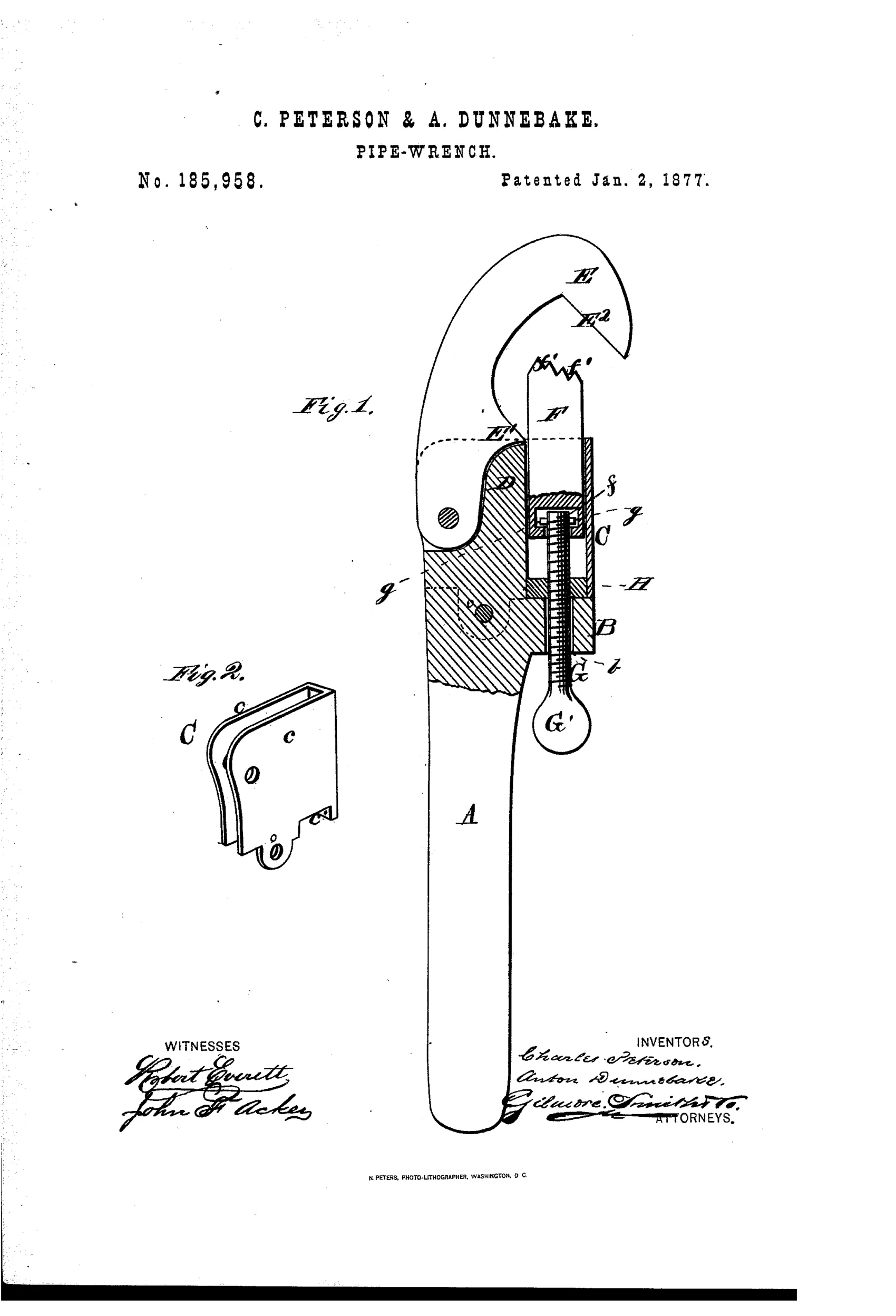
Adjustable pipe/gas-fitting wrench with pivoted hooked jaw
⚙ How it works
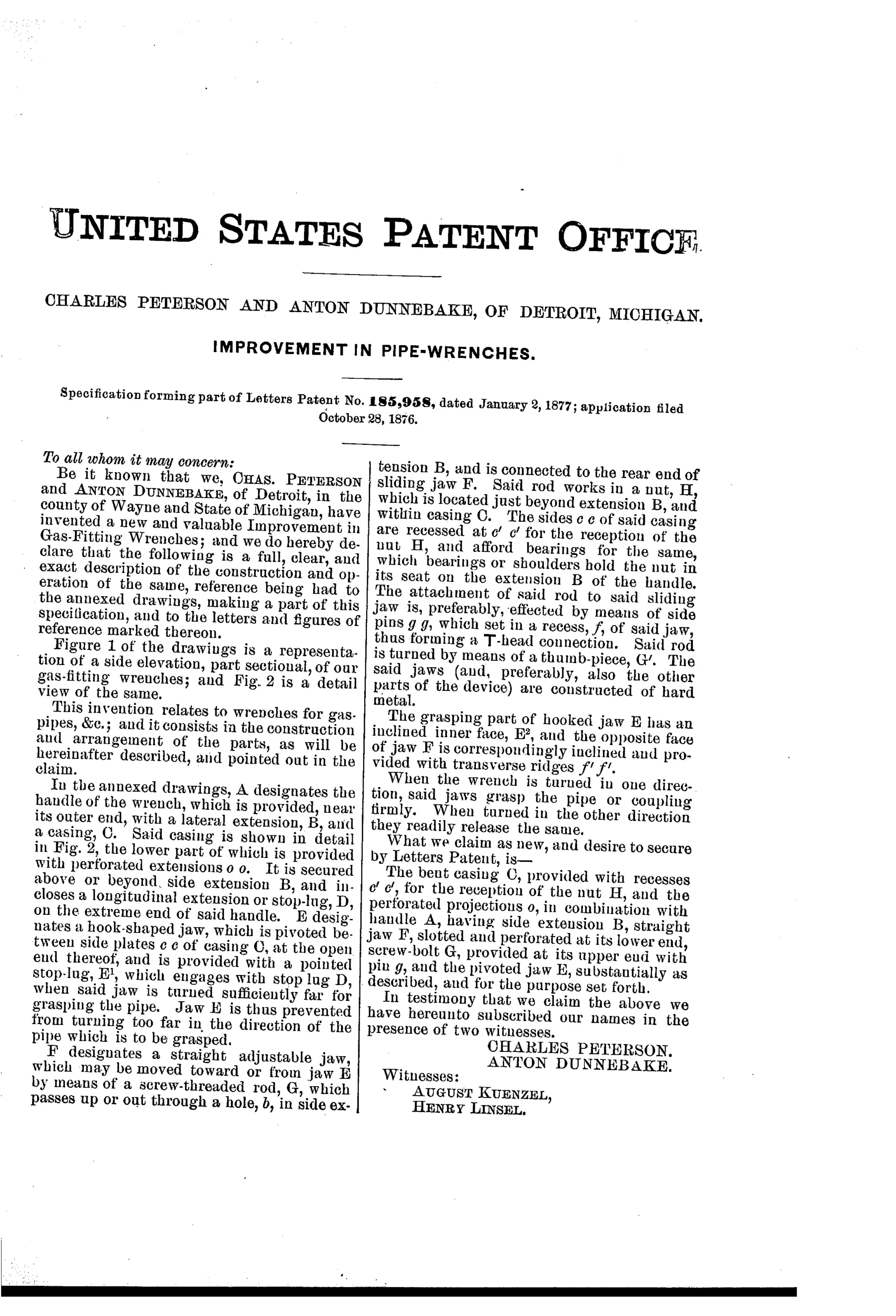
The wrench has a handle A with a lateral extension B and casing C at its outer end. A hook-shaped jaw E pivots between side plates of the casing and engages a stop-lug D to limit its rotation. A straight jaw F slides toward or away from jaw E via a screw-threaded rod G, which is turned by a thumb-piece G' and works through a nut H seated in recesses of the casing. Inclined and ridged surfaces on the jaws (E2 and f' f') cause them to grip the pipe tightly when turned one way and release when turned the other.
⚙ What was claimed
“The bent casing C, provided with recesses c' c', for the reception of the nut H, and the perforated projections o, in combination with handle A, having side extension B, straight jaw F, slotted and perforated at its lower end, screw-bolt G, provided at its upper end with pin g, and the pivoted jaw E, substantially as described, and for the purpose set forth.”
In plain English: The claim covers the specific combination of a bent, recessed casing holding an adjusting nut, together with a handle with a side extension, a slotted sliding jaw operated by a pinned screw-bolt, and a pivoted hooked jaw, all working together as described.
⚙ In the inventor’s words
“When the wrench is turned in one direction, said jaws grasp the pipe or coupling firmly. When turned in the other direction they readily release the same.”— Charles Peterson and Anton Dunnebake, from the specification
Fate unknown
No manufactured example or catalog listing is documented to my knowledge; a marked specimen would settle it.
⚙ Commentary
The heart of this Detroit design is the division of labor between its two jaws. The screw-and-thumbwheel arrangement — rod G turned by that round knob G' dangling below the casing — is not the gripping mechanism at all. It merely positions the straight jaw F for the pipe diameter at hand. The actual bite comes from the hooked jaw E, which pivots between the side plates of casing C and cams down onto the work when the handle is pulled. Turn the wrench one way and the inclined, ridged surfaces tighten; turn it back and they let go. That self-energizing, ratchet-like action is the same principle every serious pipe wrench of the era was chasing, because a rigid two-jaw grip on a round pipe simply slips.
Look at Fig. 2 and you can see where the inventors spent their claim: the bent casing with its recesses c' c' that seat the nut H. It is a practical answer to a real shop problem — how to anchor the adjusting nut without threading the forged handle itself. The casing is essentially a stamped or cast bracket that traps the nut and carries the pivot, which would have kept machining costs down.
As pipe wrenches go, this sits mid-stream: after the crude chain and alligator tools, before Stillson's pattern swept the field. It would work, though the exposed thumbwheel at the bottom looks vulnerable to a dropped tool or a tight corner. DATAMP records the patent; the wrench itself is harder to find.
Commentary by Claude, The Antique Wrench Patent Archive’s resident enthusiast