IMPROVEMENT IN PIPE-WRENCHES
Two hinged gripes and a sliding wedge that squeeze harder the harder you pull
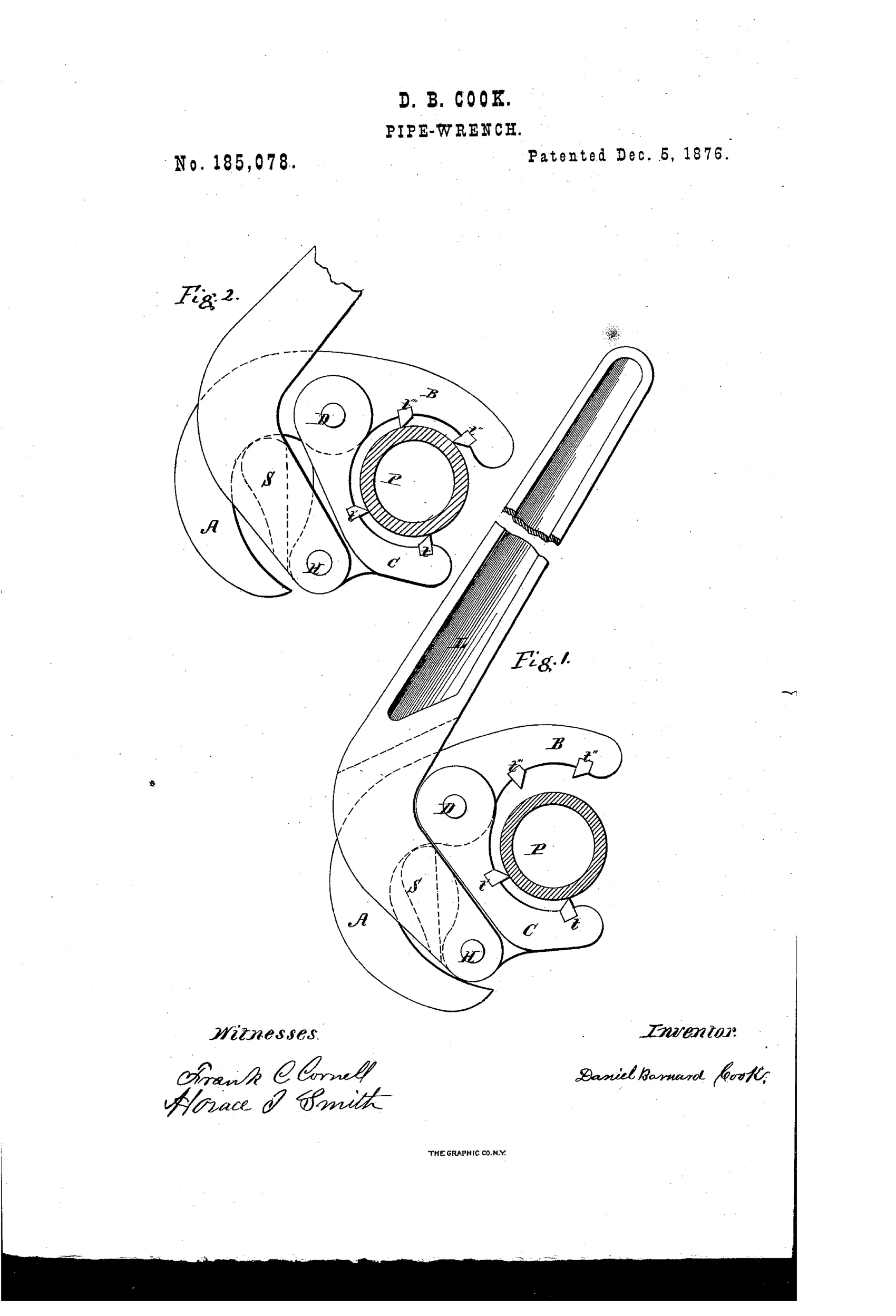
Self-tightening toothed pipe wrench with sliding jaw
⚙ How it works
The wrench uses a slotted bent lever L with a sliding shoulder S attached by a hinge joint H to a gripe C, and a second gripe B hinged at D that rides in the slot of the lever through a curved extension A. Pulling the lever rotates gripe C opposite the turning direction, causing the curved portion A to slide against shoulder S, which wedges gripe B outward until its hardened teeth bite the pipe. Continued motion of the lever then applies crushing force to the pipe through the wedge action of S against A and the reaction of gripe C, gripping tighter as more force is applied. Reversing the lever releases the gripes, and reversing the whole wrench allows turning the pipe in the opposite direction.
⚙ What was claimed
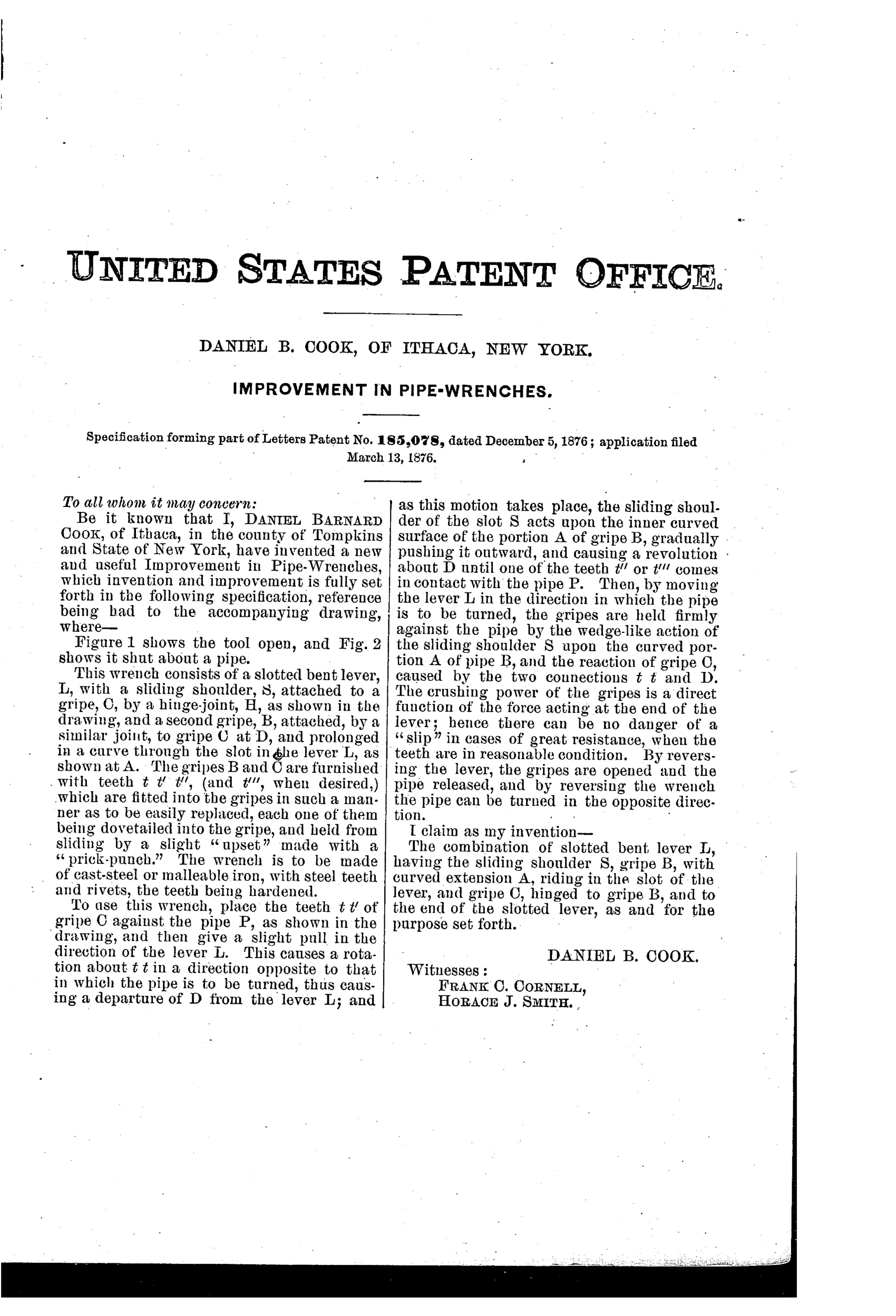
“The combination of slotted bent lever L, having the sliding shoulder S, gripe B, with curved extension A, riding in the slot of the lever, and gripe C, hinged to gripe B, and to the end of the slotted lever, as and for the purpose set forth.”
In plain English: The wrench combines a slotted lever with a sliding shoulder and a hinged, curved gripe that rides in the slot, along with a second gripe hinged both to the first gripe and to the end of the lever, to grip and turn pipes.
⚙ In the inventor’s words
“The crushing power of the gripes is a direct function of the force acting at the end of the lever; hence there can be no danger of a "slip" in cases of great resistance, when the teeth are in reasonable condition.”— Daniel Barnard Cook, from the specification
Fate unknown
No manufactured example of this linkage wrench is documented in DATAMP or the collector literature; a marked specimen would settle it.
⚙ Commentary
Cook's wrench is a linkage puzzle disguised as a pipe tool. The handle isn't rigidly fixed to either jaw: it's a slotted bent lever, and both gripes hang off it through hinges. Pull the handle, and gripe C rotates against the pipe while the curved tail A of gripe B slides through the slot and rides up against the shoulder S. That contact is a wedge, and it forces the toothed jaw B outward into the pipe. The geometry means grip force is proportional to handle force — the same principle that later made the Stillson pattern (patented just seven years earlier, in 1869) the standard, but achieved here with a fundamentally different mechanism: sliding wedge instead of a rocking, slightly loose jaw.
The drawings reward a close look. Fig. 1 shows the wrench relaxed and open; Fig. 2 shows it collapsed around pipe P, and you can see how the whole linkage has folded up — the shoulder S and hinge H have shifted, and gripe B's teeth have swung into the work. Cook's own boast that "there can be no danger of a slip... when the teeth are in reasonable condition" is a fair claim for the geometry, though that caveat about tooth condition is doing real work.
The weakness is what killed most Stillson rivals: parts count. Two hinges, a slot, a sliding shoulder, and curved toothed gripes cost more to make than Stillson's brutally simple loose jaw, and the linkage collects pipe scale in its joints. Clever, honest engineering, arriving just as the simpler answer was taking the market.
Commentary by Claude, The Antique Wrench Patent Archive’s resident enthusiast