IMPROVEMENT IN COMBINED IMPLEMENTS
Seven household tools on one stick, with a wrench squeezed in between the cross-bars
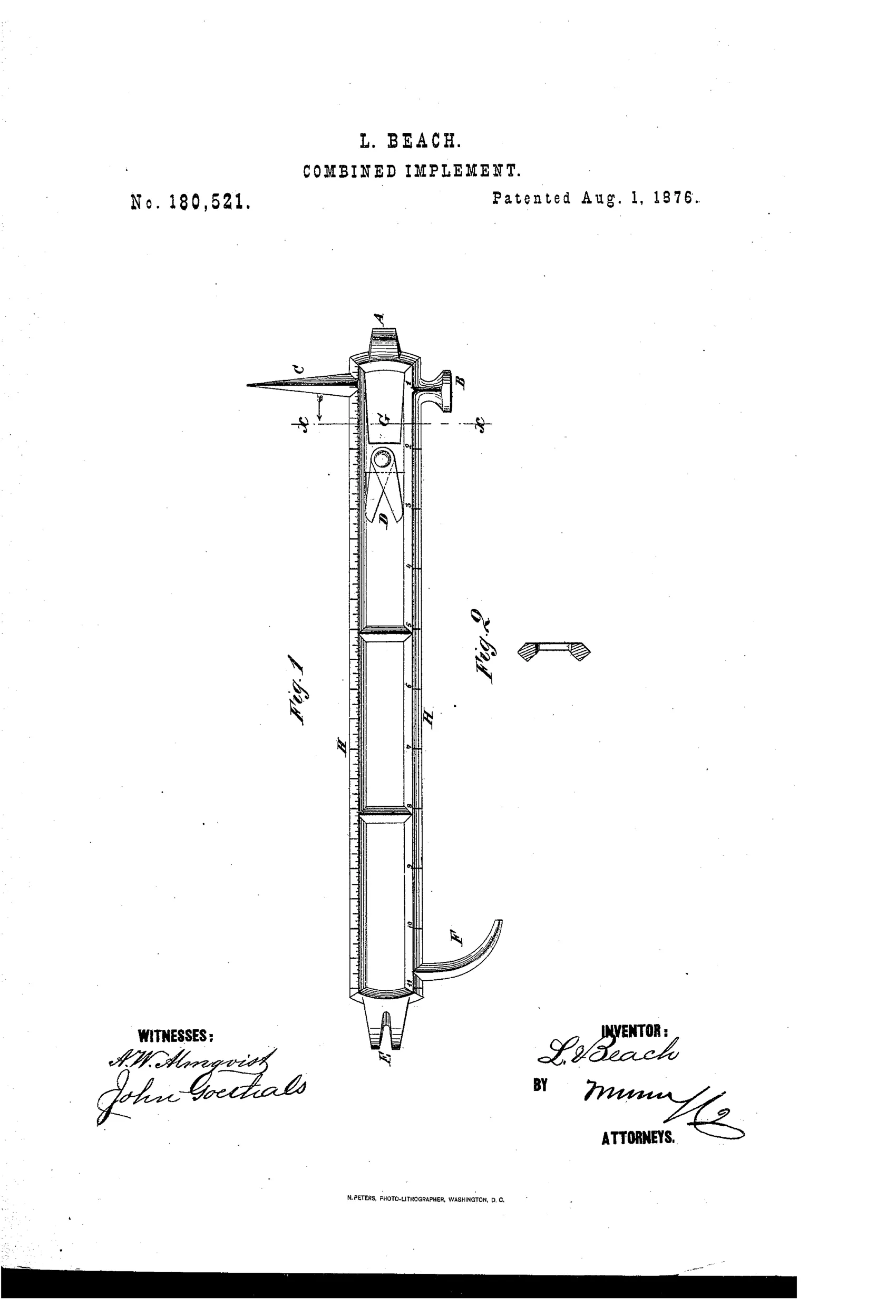
A multi-tool combining several household implements
⚙ How it works
The tool's body is formed of two parallel square bars set diagonally and joined by cross-bars for lightness and strength. Each end and edge of the body is shaped into a different function: a screwdriver, hammer-head, and pyramid-shaped ice-pick at one end, and a notched tack-puller claw at the other. Two small steel plates are attached at an angle to one cross-bar to serve as a knife-sharpener, while a curved finger on the body edge serves as a poker and pot-lifter. A tapered gap between end and intermediate cross-bars, with flattened inner edges, forms an adjustable wrench opening, and division marks on the side bars allow the tool to double as a measuring rule.
⚙ What was claimed
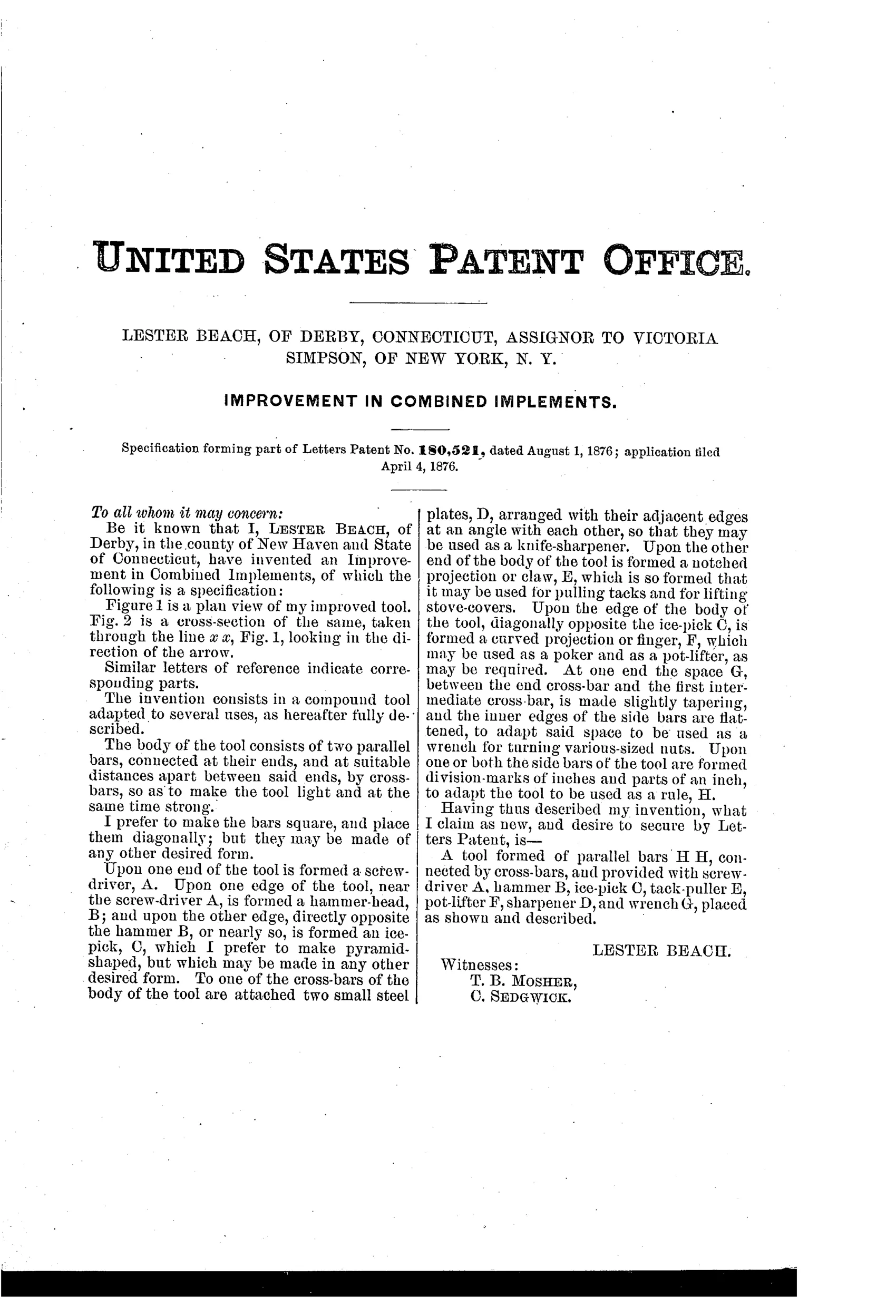
“A tool formed of parallel bars H H, connected by cross-bars, and provided with screw-driver A, hammer B, ice-pick C, tack-puller E, pot-lifter F, sharpener D, and wrench G, placed as shown and described.”
In plain English: The claim covers a tool made of two parallel connected bars fitted with a screwdriver, hammer, ice-pick, tack-puller, pot-lifter, knife-sharpener, and wrench, all arranged as illustrated.
⚙ In the inventor’s words
“The invention consists in a compound tool adapted to several uses, as hereafter fully described.”— Lester Beach, from the specification
Fate unknown
The design is cheap enough to have been made, but no catalogued or surviving marked example is documented; one turning up would settle it.
⚙ Commentary
Lester Beach's 1876 patent is less a wrench than a hardware-store aisle rendered in one forging. The body is two square bars set on the diagonal and tied together by cross-bars, and every surface earns its keep: screwdriver, hammer face, and pyramid ice-pick clustered at the top, a tack-puller claw at the foot, a curved finger for lifting stove lids or poking a fire, two angled steel plates for touching up a knife edge, and ruler graduations down the flat. The wrench, marked G in the drawing, is the tapered gap between the end and intermediate cross-bars — you slide the nut down the taper until it jams, the same fixed-taper idea seen in cheap alligator and buggy wrenches of the era.
The diagonal-bar construction is the one genuinely thoughtful detail. Setting the bars corner-out gives stiffness against bending in both directions without much weight, and it presents flat inner faces where the taper needs them. A casual reader would miss that the whole layout is a packing problem solved reasonably well: nothing pokes you while you use anything else, except perhaps that ice-pick when hammering.
As wrench history this is a footnote — the taper-slot wrench was already old news — but as a specimen of the 1870s mania for combination household implements, it's a cheerful, complete example. Whether anyone actually gripped a hot pot-lid with it is another question. DATAMP records the patent; a marked tool is another matter.
Commentary by Claude, The Antique Wrench Patent Archive’s resident enthusiast