PIPE-CUTTER.
Four cutting corners on one bit — flip it, don't grind it
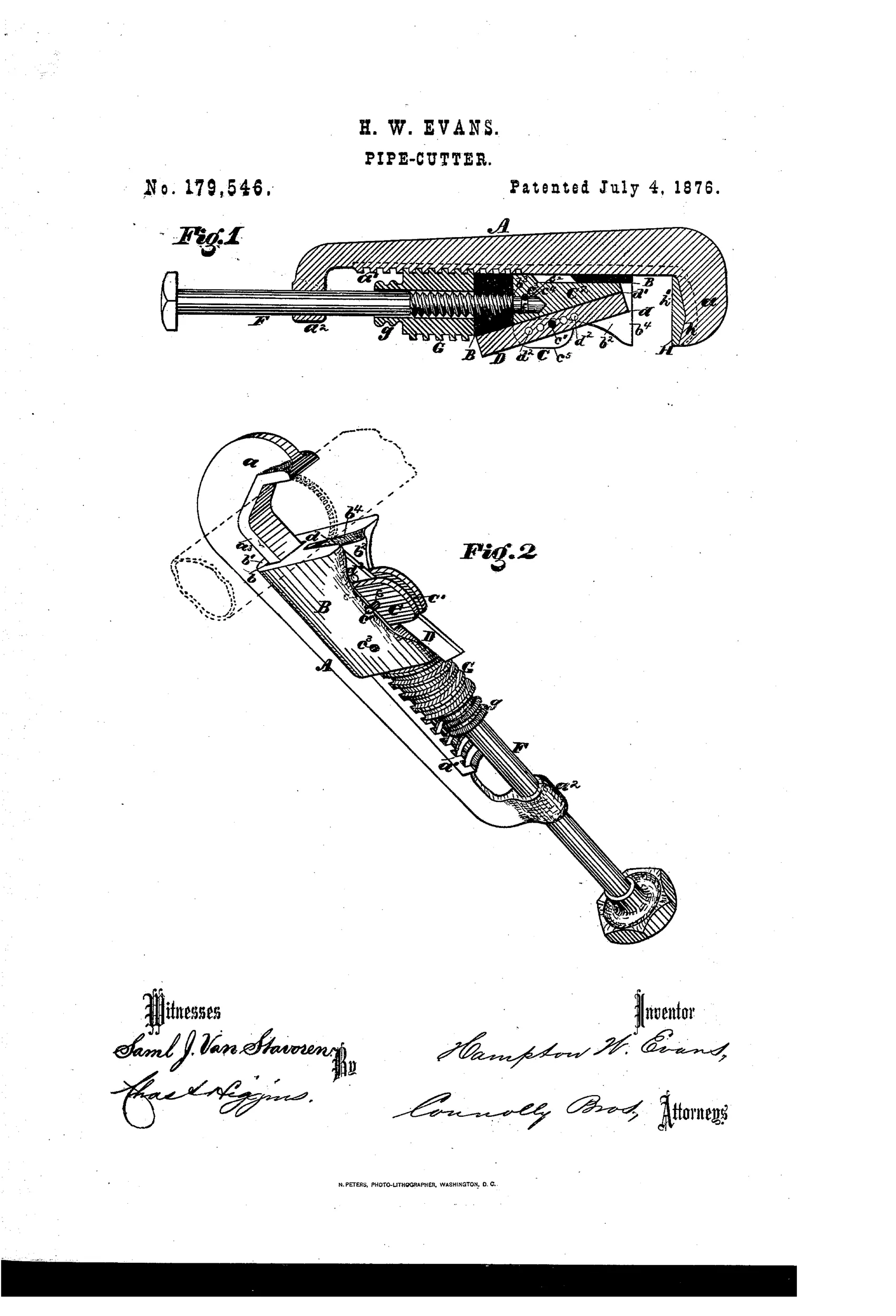
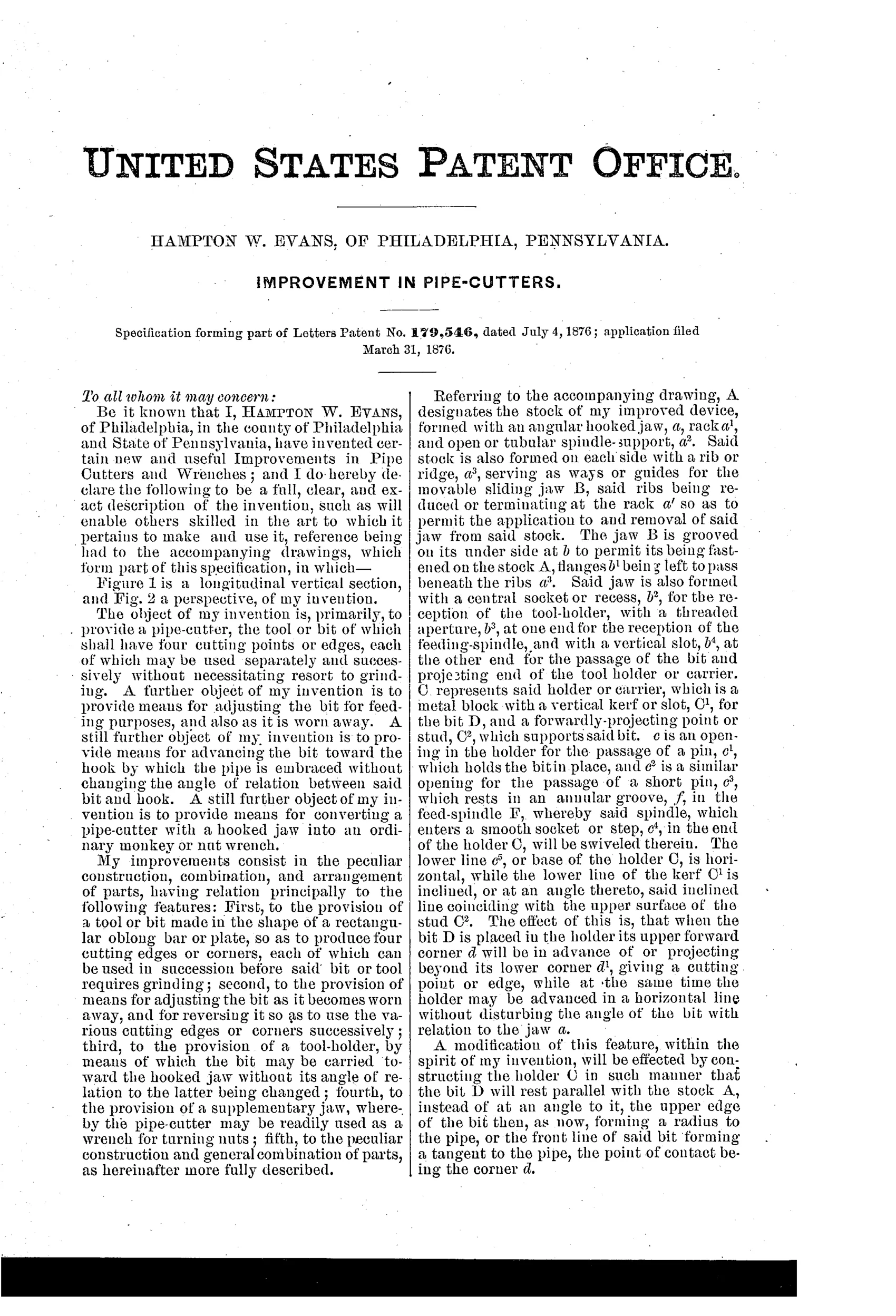
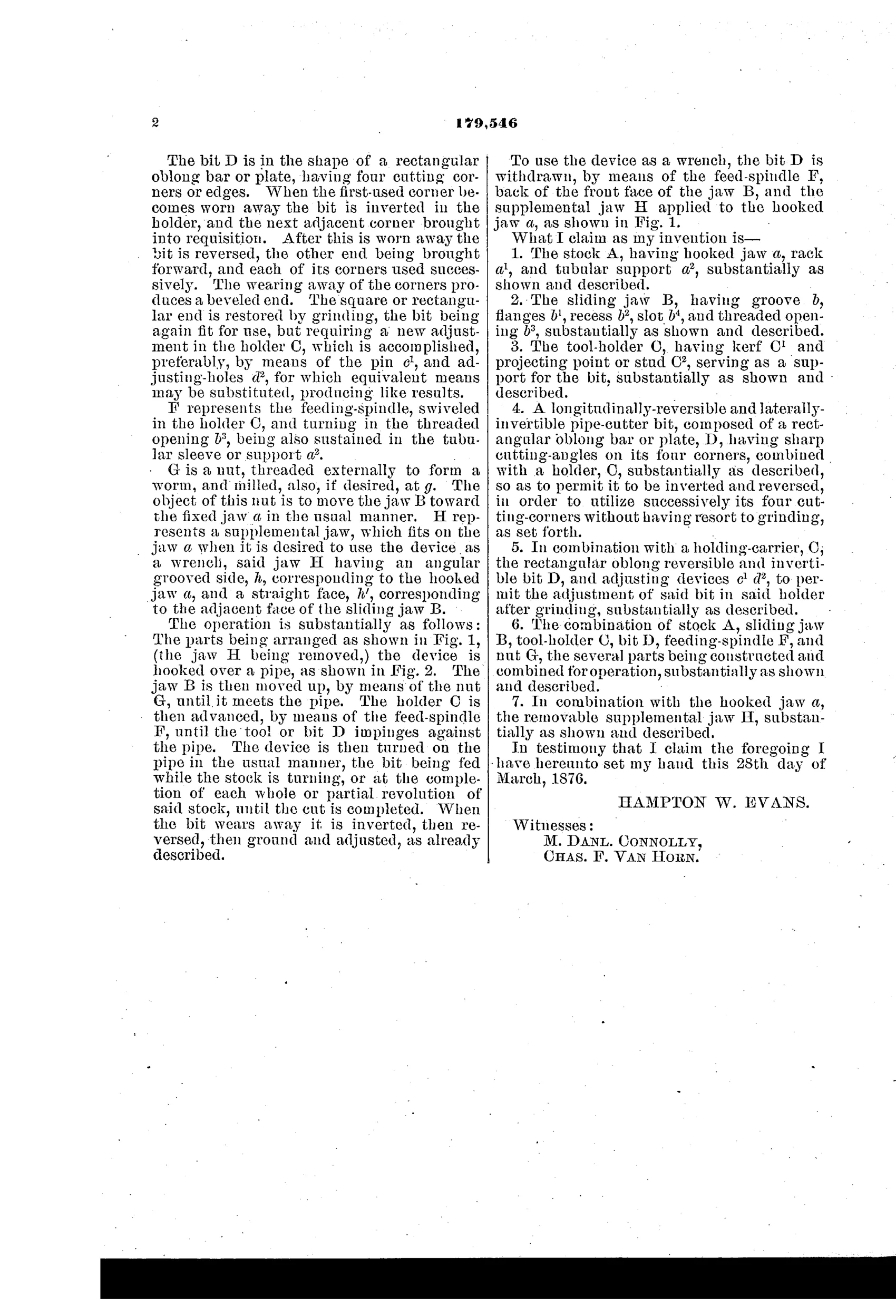
A four-cornered reversible bit pipe-cutter
⚙ How it works
A hooked jaw stock carries a sliding jaw advanced by a threaded worm nut to grip the pipe. A feed-spindle swiveled in a tool-holder advances a rectangular bit toward the pipe without changing the bit's angle relative to the hooked jaw. The bit has four sharp cutting corners so that when one corner wears, the bit can be inverted or reversed in its holder to bring a fresh corner into use, delaying the need for grinding. A removable supplemental jaw can be fitted onto the hooked jaw to convert the tool into an ordinary wrench for turning nuts.
⚙ What was claimed
“4. A longitudinally-reversible and laterally-invertible pipe-cutter bit, composed of a rectangular oblong bar or plate, D, having sharp cutting-angles on its four corners, combined with a holder, C, substantially as described, so as to permit it to be inverted and reversed, in order to utilize successively its four cutting-corners without having resort to grinding, as set forth.”
In plain English: A pipe-cutter bit shaped as a rectangular bar with four sharp corners that can be flipped and reversed in its holder to use each corner in turn before needing sharpening.
⚙ In the inventor’s words
“The object of my invention is, primarily, to provide a pipe-cutter, the tool or bit of which shall have four cutting points or edges, each of which may be used separately and successively without necessitating resort to grinding.”— Hampton W. Evans, from the specification
Fate unknown
No catalogued Evans pipe-cutter is documented in the usual references (DATAMP included); a marked specimen would settle it.
⚙ Commentary
Evans's real idea here isn't the cutter frame at all — it's the consumable. Instead of a round cutting wheel or a fixed blade, he holds a plain rectangular bar in a small carrier block, and each of its four corners is ground sharp. Dull one corner and you unclamp the bar, flip it over or turn it end for end, and you're cutting again. It's the indexable-insert concept, patented in 1876, decades before machine-shop tooling made that logic standard. The claim language even sounds modern: 'longitudinally-reversible and laterally-invertible.'
The rest of the tool is honest wrench-family engineering, which is why it earns a place here. Fig. 1's section shows a hooked jaw stock with a sliding jaw run in by a threaded worm nut — pure Coes-style screw wrench anatomy — gripping the pipe while a separate feed-spindle, swiveled in the tool-holder, presses the bit inward without changing its angle of attack. Two independent screws, one to hold and one to feed, is the correct division of labor, though it makes for a fussy tool compared with the rotating-wheel cutters that eventually won.
The supplemental jaw that converts the whole thing into a nut wrench is the era's signature move: every tool wanted to be two tools. That combination instinct, plus the resharpening economy of the four-corner bit, marks this as a thoughtful workshop mind at play, even if a scraping bit fights pipe less gracefully than a rolling cutter does.
Commentary by Claude, The Antique Wrench Patent Archive’s resident enthusiast