IMPROVEMENT IN PIPE-WRENCHES
A hook-jaw pipe wrench that buries its adjusting screw inside a pivoting block
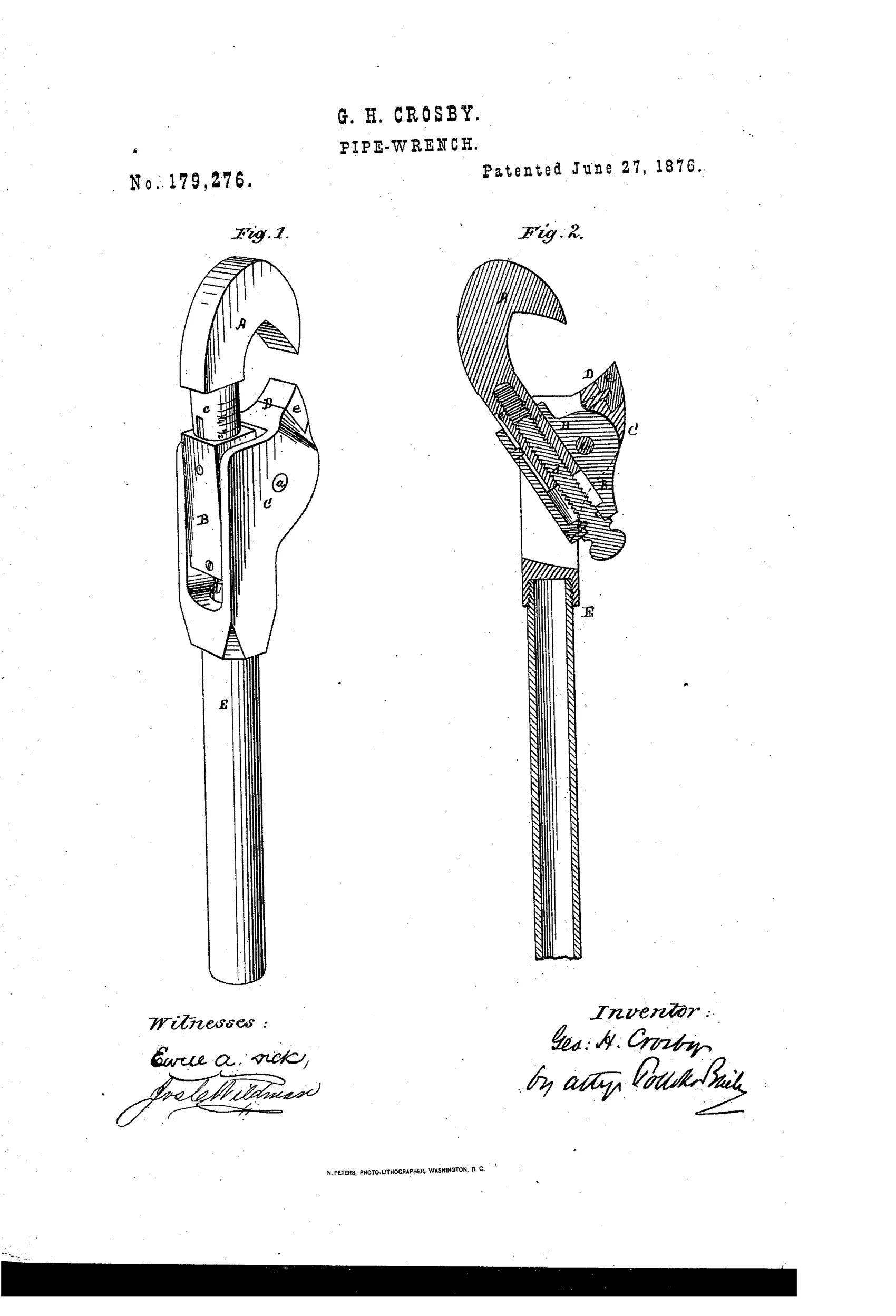
Adjustable hook-jaw pipe wrench with pivoted center block
⚙ How it works
A hook-jaw is carried in and adjustable within a pivoted center block, which itself pivots in a slotted strap or dog-jaw extension. The hook-jaw's shank fits into a socket in the center block and is engaged by an adjusting-screw that rotates within the block. Turning the screw raises or lowers the hook-jaw to fit different pipe sizes, with graduation marks on the shank aiding precise adjustment. The convex front of the center block bears against a concave face of the strap, allowing the block to pivot and grip pipes securely.
⚙ What was claimed
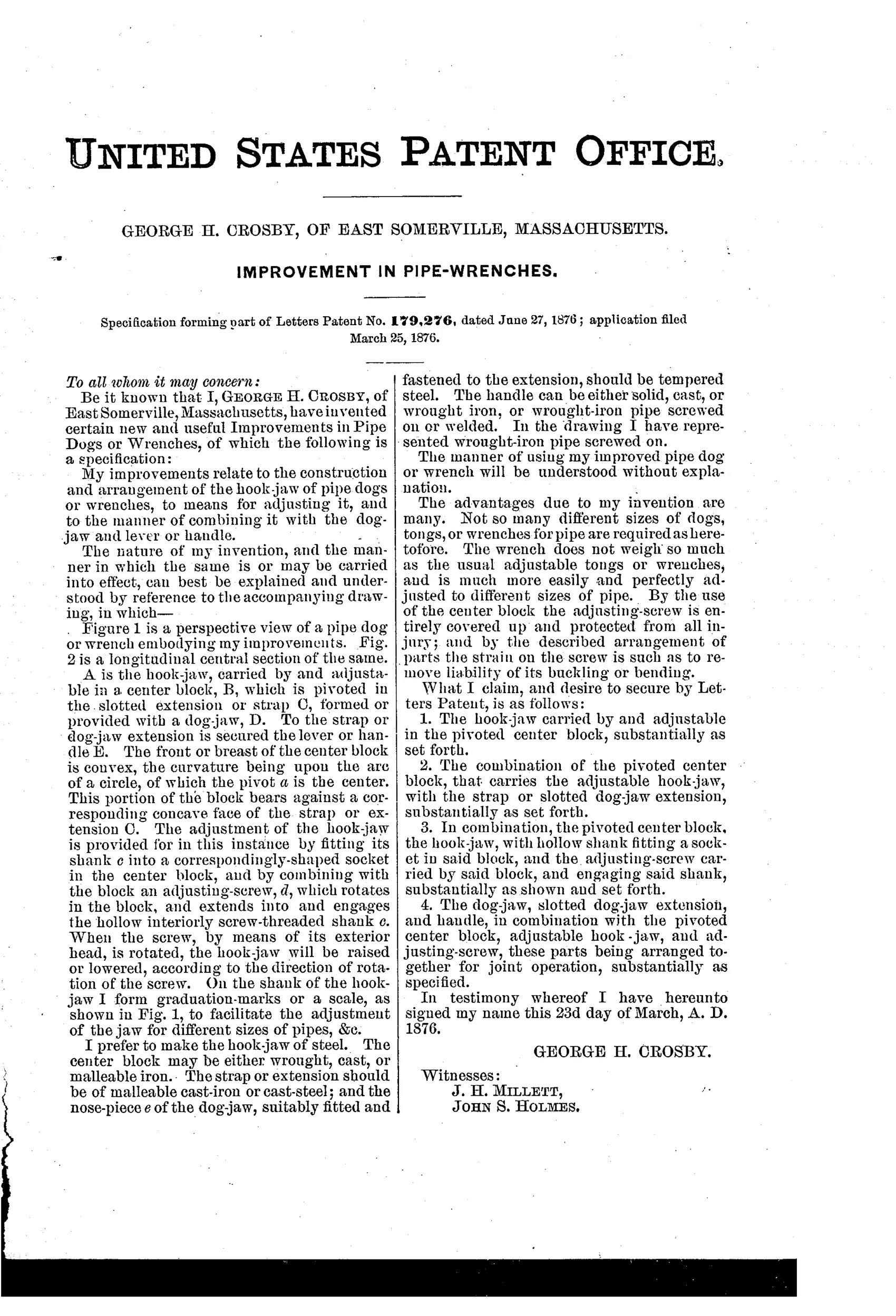
“In combination, the pivoted center block, the hook-jaw, with hollow shank fitting a socket in said block, and the adjusting-screw carried by said block, and engaging said shank, substantially as shown and set forth.”
In plain English: The patent covers the combination of a pivoting center block, a hook-jaw with a hollow shank that fits into a socket in the block, and an adjusting screw that engages the shank to raise or lower the jaw.
⚙ In the inventor’s words
“By the use of the center block the adjusting-screw is entirely covered up and protected from all injury; and by the described arrangement of parts the strain on the screw is such as to remove liability of its buckling or bending.”— George H. Crosby, from the specification
Fate unknown
No catalogued production example of this Crosby wrench is documented in DATAMP; a marked specimen matching Fig. 1 would settle it.
⚙ Commentary
Crosby's problem is the one every early pipe-wrench inventor faced: the adjusting screw lives in the dirtiest, most abused part of the tool, and a fouled or bent screw kills the wrench. His answer is tidy. The hook-jaw's shank is hollow, slips into a socket in a center block, and the adjusting screw sits entirely inside that block — turn the screw and the jaw telescopes up or down, with graduation marks on the shank so you can set a pipe size by number rather than by trial. Fig. 2 is the drawing to study: the sectioned view shows the screw completely enclosed, and the convex face of the block riding against the concave strap.
That pivot is doing the real work. This is 1876, six years after Stillson, and the self-tightening rock of a hook-jaw against the pipe was the mechanism everyone was chasing. Crosby gets his rocking action from the block-in-strap joint rather than a loose jaw in a slotted head, which puts the working strain on the curved bearing surfaces instead of on the screw threads — his own specification makes exactly that point about buckling.
The cost of the cleverness is that adjustment happens deep in the head, where greasy fingers must find a covered screw. Stillson's exposed knurled nut was cruder and faster, and fast won. This is a thoughtful refinement that history routed around, but the protected-screw idea was sound engineering.
Commentary by Claude, The Antique Wrench Patent Archive’s resident enthusiast