IMPROVEMENT IN WRENCHES
A spring-loaded jaw that ratchets over corners without leaving the nut
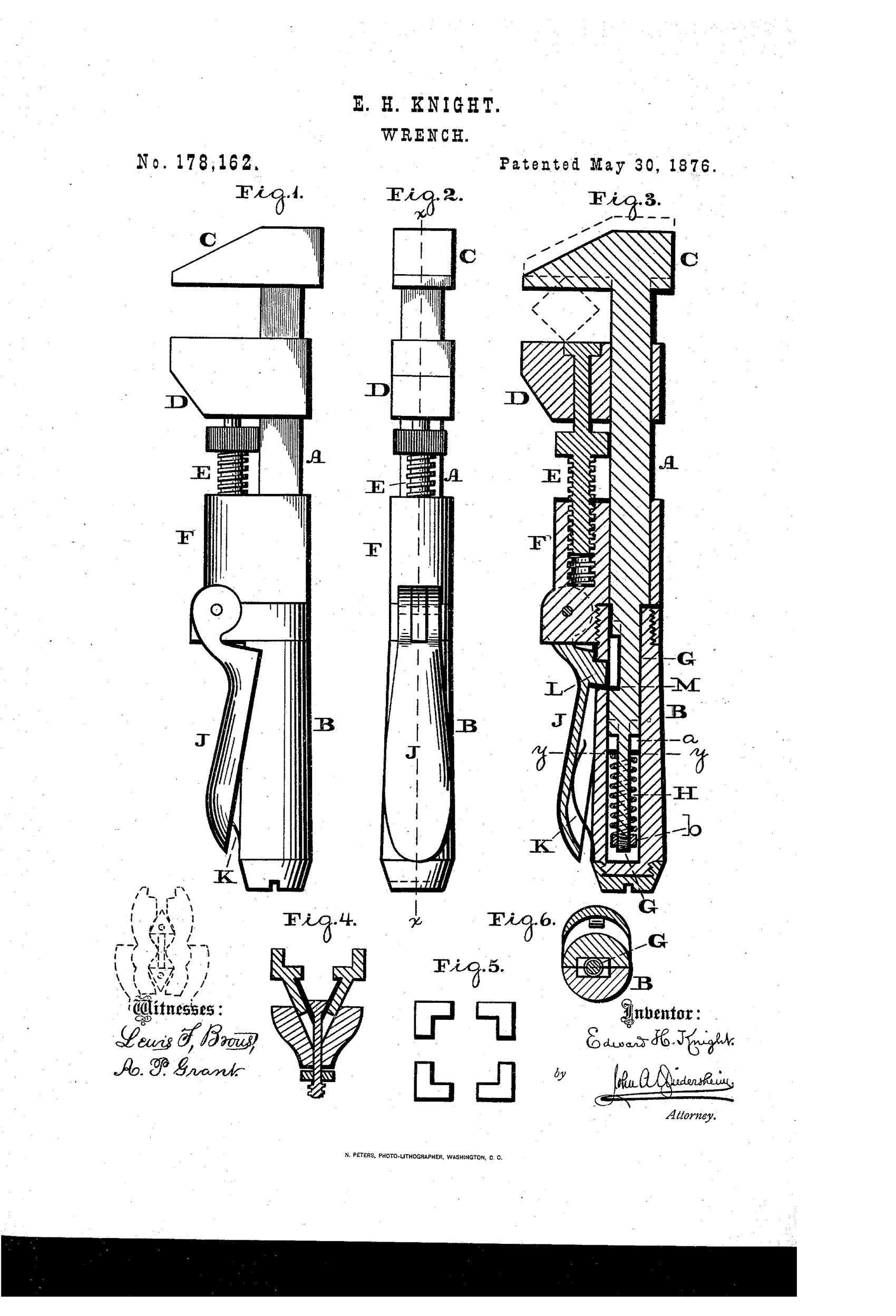
Self-adjusting monkey wrench with automatic gripping jaw
⚙ How it works
A sliding bar A carries the movable jaw C and is drawn inward by a spring H so the jaws close automatically onto a nut as it turns past corners. A stop pin b on the tang engages a shoulder a in the hollow handle B, and a spring-loaded lever J with lug L can lock the tang G against shoulder M to hold the bar fixed for ordinary wrench-like turning. Releasing the lever frees the tang so the spring re-engages the jaw, letting the wrench ride over corners without lifting off the nut. A separate adjusting screw E moves jaw D to set the initial jaw spacing for different nut sizes.
⚙ What was claimed
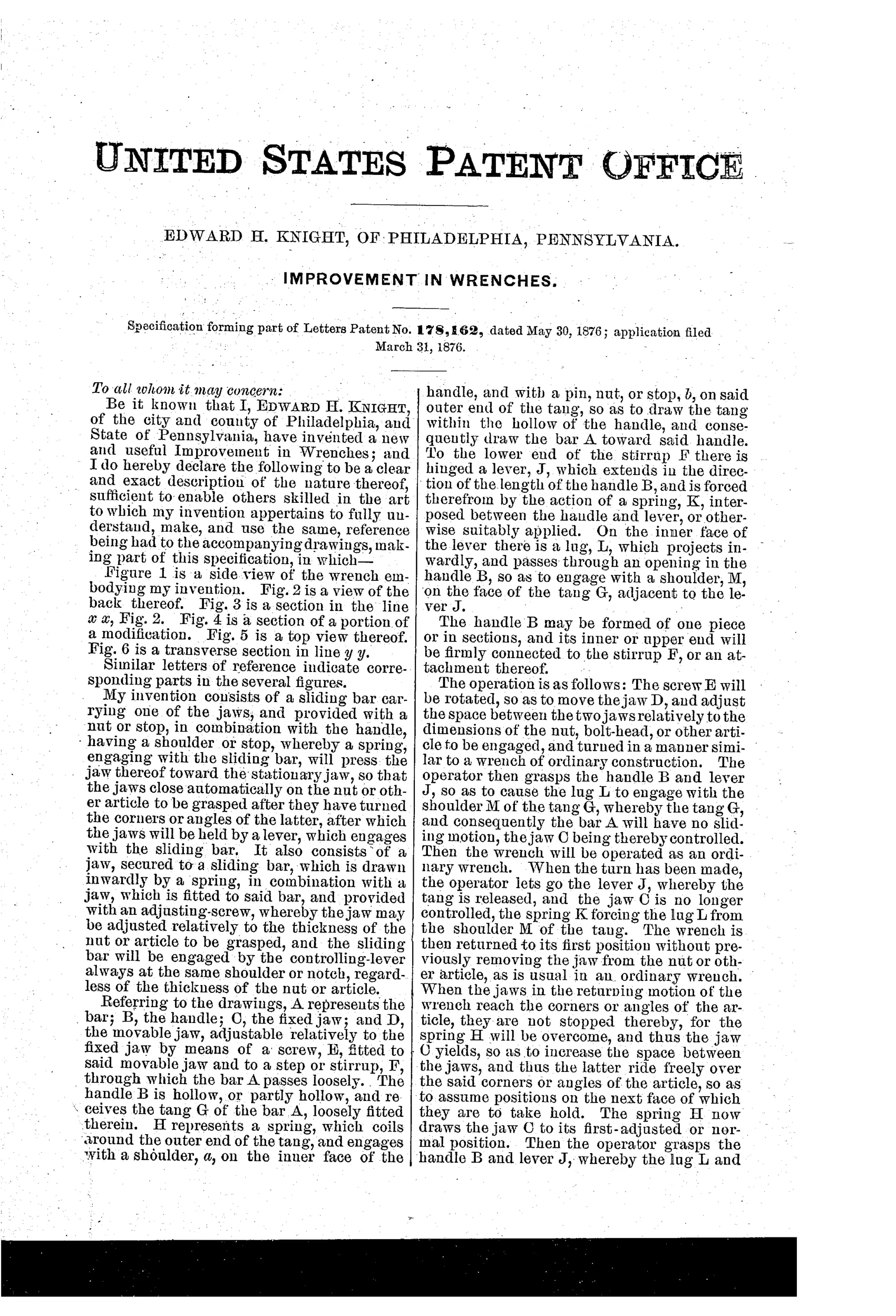
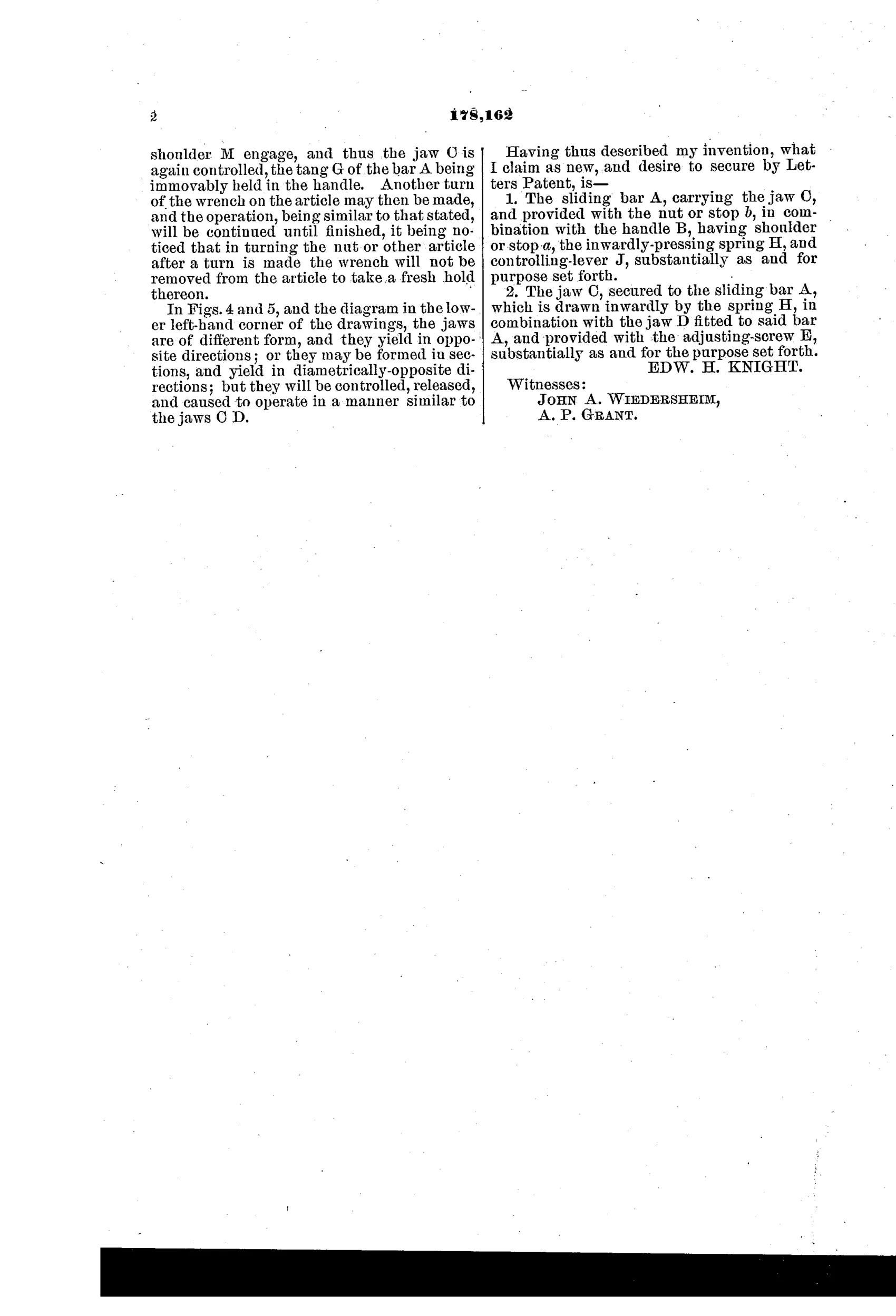
“1. The sliding bar A, carrying the jaw C, and provided with the nut or stop b, in combination with the handle B, having shoulder or stop a, the inwardly-pressing spring H, and controlling-lever J, substantially as and for purpose set forth.”
In plain English: The invention claims a spring-loaded sliding bar with a stop, working with a handle that has a shoulder and a control lever, so the jaw automatically grips and releases the nut.
⚙ In the inventor’s words
“it being noticed that in turning the nut or other article after a turn is made the wrench will not be removed from the article to take a fresh hold thereon.”— Edward H. Knight, from the specification
Fate unknown
No manufactured example of this design is catalogued in DATAMP or the collector literature; a marked specimen would settle it.
⚙ Commentary
Most monkey wrench patents of the 1870s fuss over how to lock the sliding jaw more firmly. Knight went the other direction: he wanted the jaw to let go on purpose. A spring H buried in the hollow handle pulls the sliding bar A inward, so after each partial turn the jaws relax their grip just enough to ride back over the corners of the nut and re-seat for the next bite. In effect it's a ratchet wrench with no ratchet teeth — the hex nut itself is the ratchet, and the spring is the pawl. His own line says it plainly: the wrench 'will not be removed from the article to take a fresh hold thereon.'
The sectional view, Fig. 3, is where the cleverness lives. Look at lever J with its lug L against shoulder M: squeeze the lever and the tang locks solid, turning the tool into an ordinary rigid wrench for breaking a nut loose. Release it and the spring takes over for fast running-down. The screw E on jaw D sets the starting size, so the ratcheting stroke only has to cover the corner clearance, not the whole adjustment range.
The idea is sound in principle, but it asks a spring to fight the friction of a loaded sliding bar, and the hollow, mechanism-stuffed handle would have been costly next to a Coes. It reads as an ingenious dead end — the same itch the later quick-adjust wrenches scratched with simpler means.
Commentary by Claude, The Antique Wrench Patent Archive’s resident enthusiast