COMBINATION GUN-TOOL
A dog-whistle that hides a nipple wrench, screwdriver, and two shell extractors
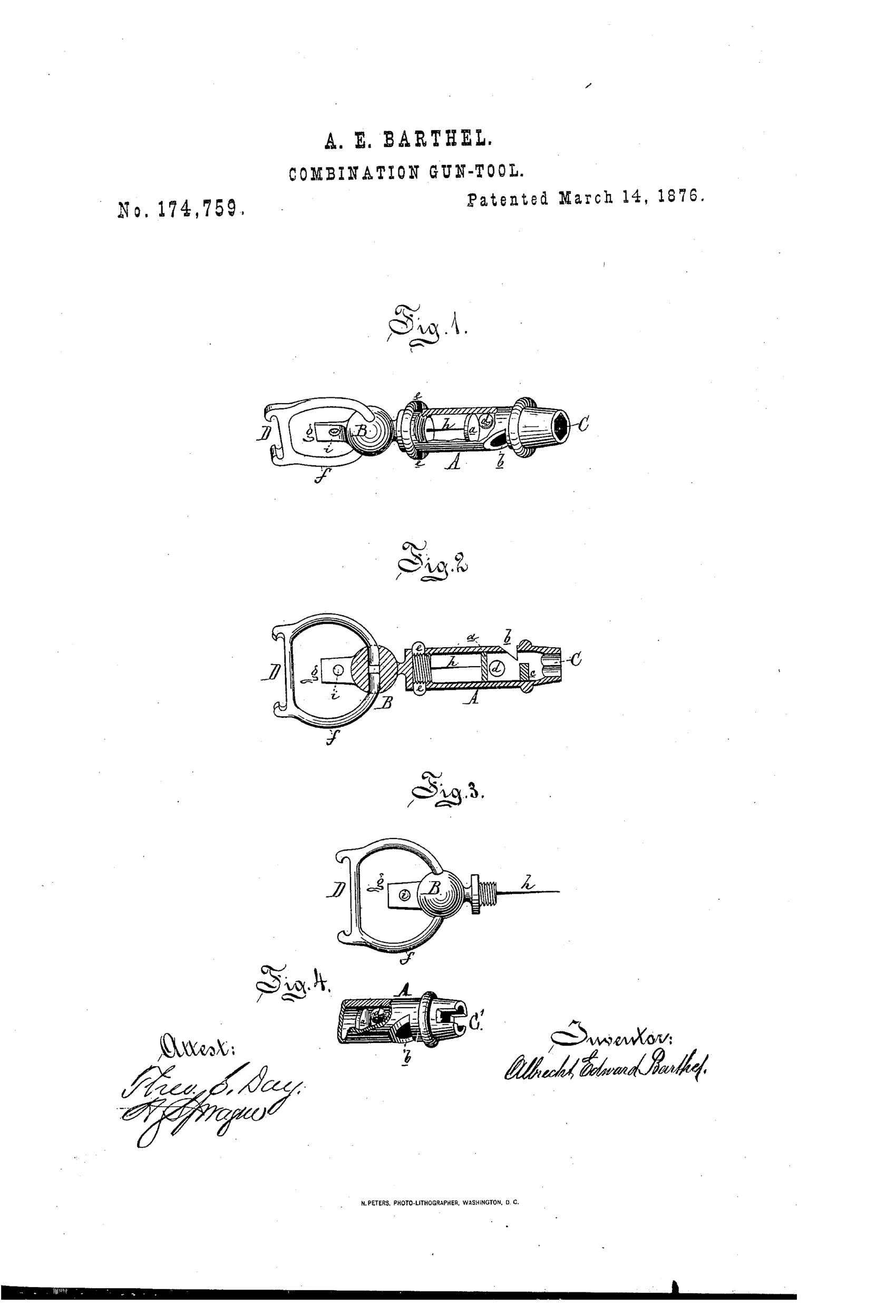
Combination gun-tool and dog-whistle
⚙ How it works
A metal cylinder is divided by a diaphragm into a whistle chamber and a tool chamber, with a notch and bridge-piece forming a dog-call at one end. The opposite end forms a hexagonal socket to fit the nut securing a firing-pin, allowing removal for cleaning. A screw-cap with a sprung ring closes the whistle end, the outer face of the cap forming a screwdriver, and the inner end holding a needle for clearing a stopped vent. The ring itself has a flat span with diagonal hooks to grasp a shell's base flange, plus a hole to slip over a pin-fire shell's pin for extraction.
⚙ What was claimed
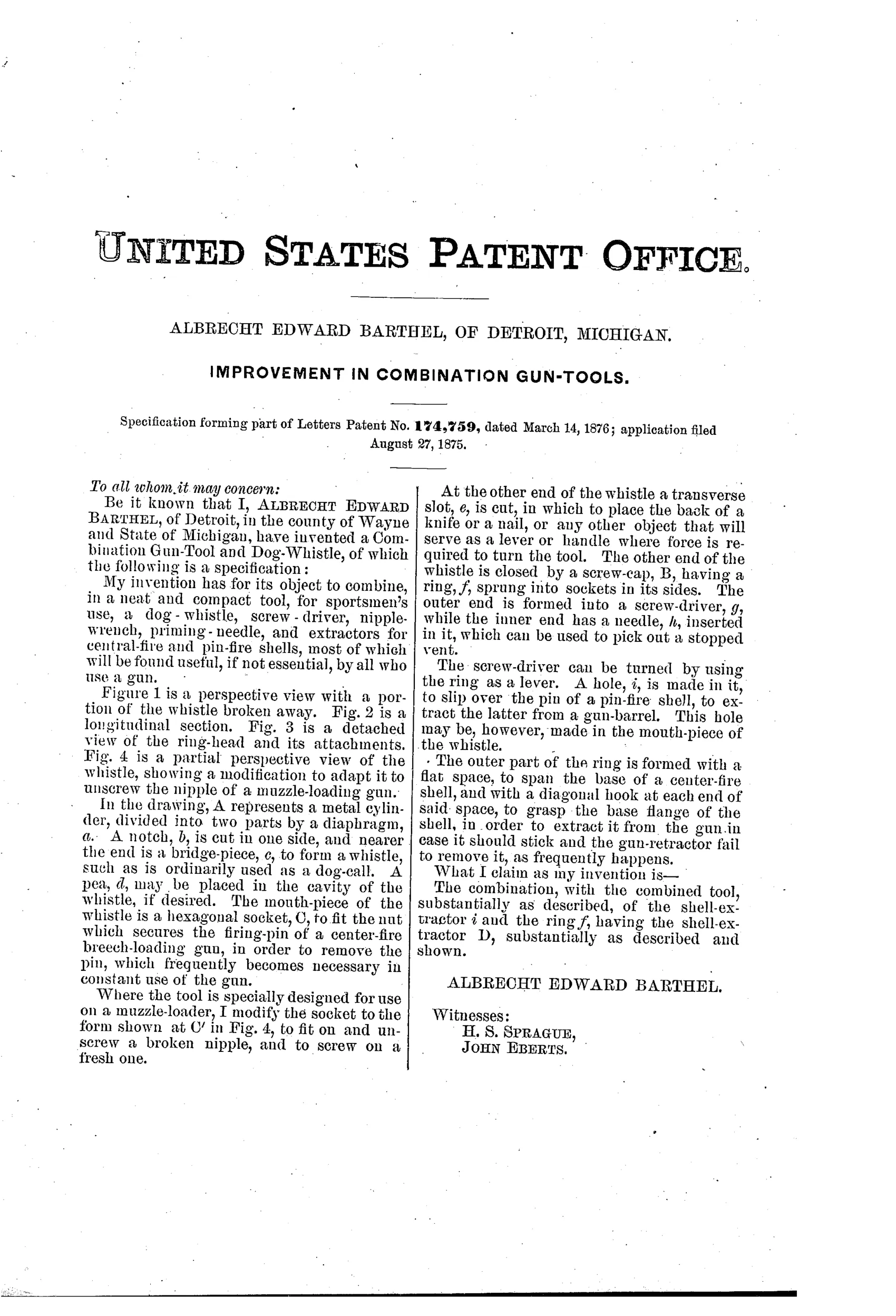
“The combination, with the combined tool, substantially as described, of the shell-extractor i and the ring f, having the shell-extractor D, substantially as described and shown.”
In plain English: The patent claims the combined tool's pin-fire shell extractor together with the ring that itself carries a center-fire shell extractor.
⚙ In the inventor’s words
“My invention has for its object to combine, in a neat and compact tool, for sportsmen's use, a dog-whistle, screw-driver, nipple-wrench, priming-needle, and extractors for central-fire and pin-fire shells, most of which will be found useful, if not essential, by all who use a gun.”— Albrecht Edward Barthel, from the specification
Fate unknown
Detroit gun-trade tools of this era sometimes reached production, but no marked example of Barthel's whistle-tool is documented; a surviving specimen would settle it.
⚙ Commentary
This one sits at the far edge of the wrench category — the wrench part is a hexagonal socket at the end of a dog-whistle. But it earns its place: Barthel's socket fits the nut holding a breechloader's firing pin, so a hunter could pull the pin for cleaning in the field, and Fig. 4 shows a modified socket C' for the nipple of a muzzle-loader, the classic nipple wrench that every percussion shooter carried.
The packing here is dense even by combination-tool standards. The cylinder is split by a diaphragm into a whistle chamber and a tool chamber. The screw-cap that closes the whistle end has a screwdriver blade on its face and a priming needle inside it. Then the ring — the loop D you see in Figs. 1 through 3, which reads at first as a mere lanyard bail — is itself two extractors: a flat span with diagonal hooks to catch a center-fire shell's rim, and a hole to slip over a pin-fire shell's pin and lever it out. The claim is specifically about that double-duty ring, which is fair, because it is the genuinely clever piece.
As mechanism it should work; nothing here fights anything else, which is rare in combination tools. The pin-fire feature dates it precisely — by the 1880s that extractor would be dead weight. A tidy, honest sportsman's tool from the last years pin-fire mattered in America.
Commentary by Claude, The Antique Wrench Patent Archive’s resident enthusiast