IMPROVEMENT IN PIPE-WRENCHES
Slide the jaw to the pipe first, then chase it with the nut
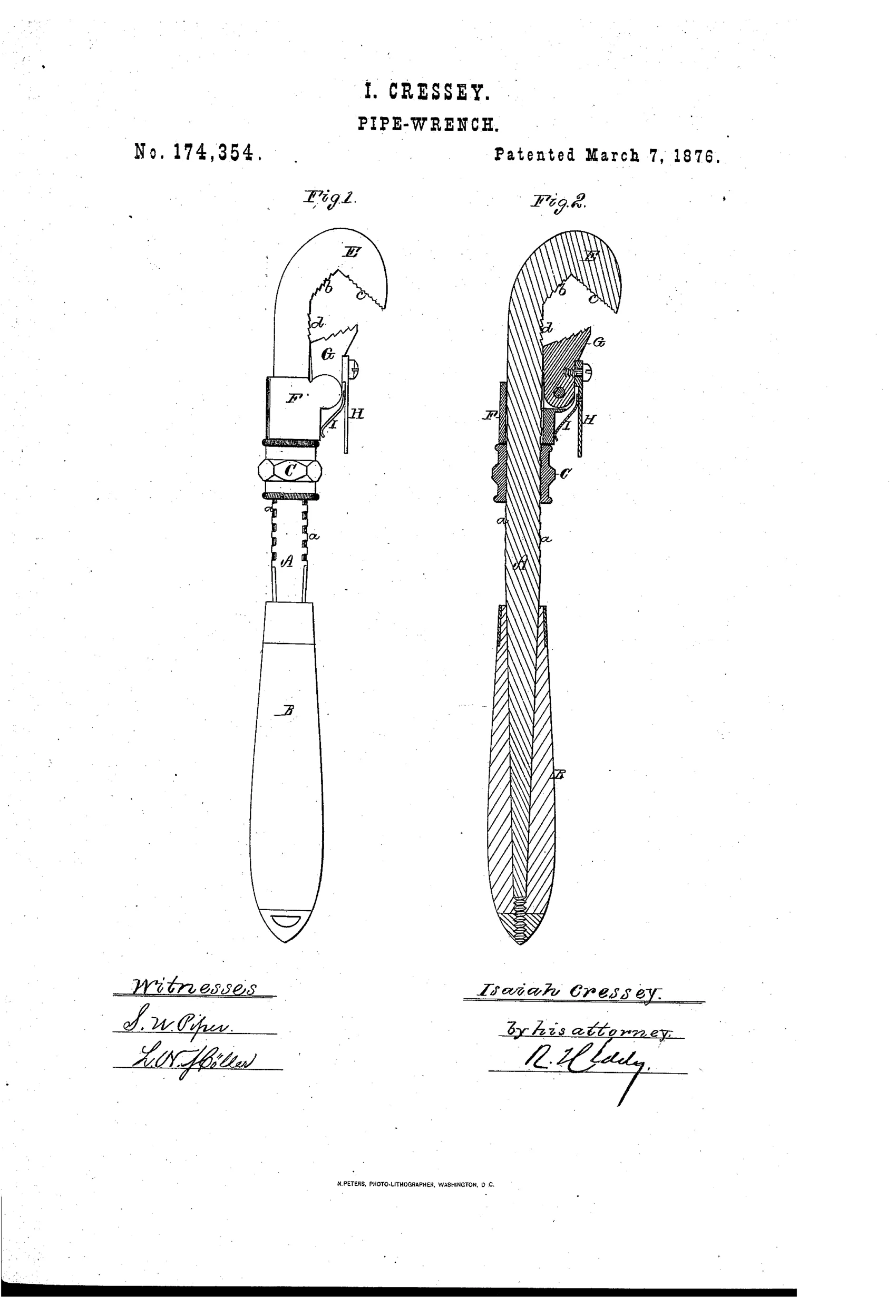
An adjustable pipe wrench with sliding movable jaw
⚙ How it works
The shank has a fixed hook-jaw with serrated inner surfaces and a threaded portion that carries a separate nut. A slide encompasses the shank independently of the nut and carries a pivoted, spring-loaded movable jaw with its own handle. The spring lets the movable jaw slip over a pipe when reversing, while the handle lets the operator quickly reposition the jaw against the pipe before running the nut up to tighten it. Because the nut and slide are disconnected, the jaw can be adjusted rapidly to fit the pipe, then locked in place by advancing the nut.
⚙ What was claimed
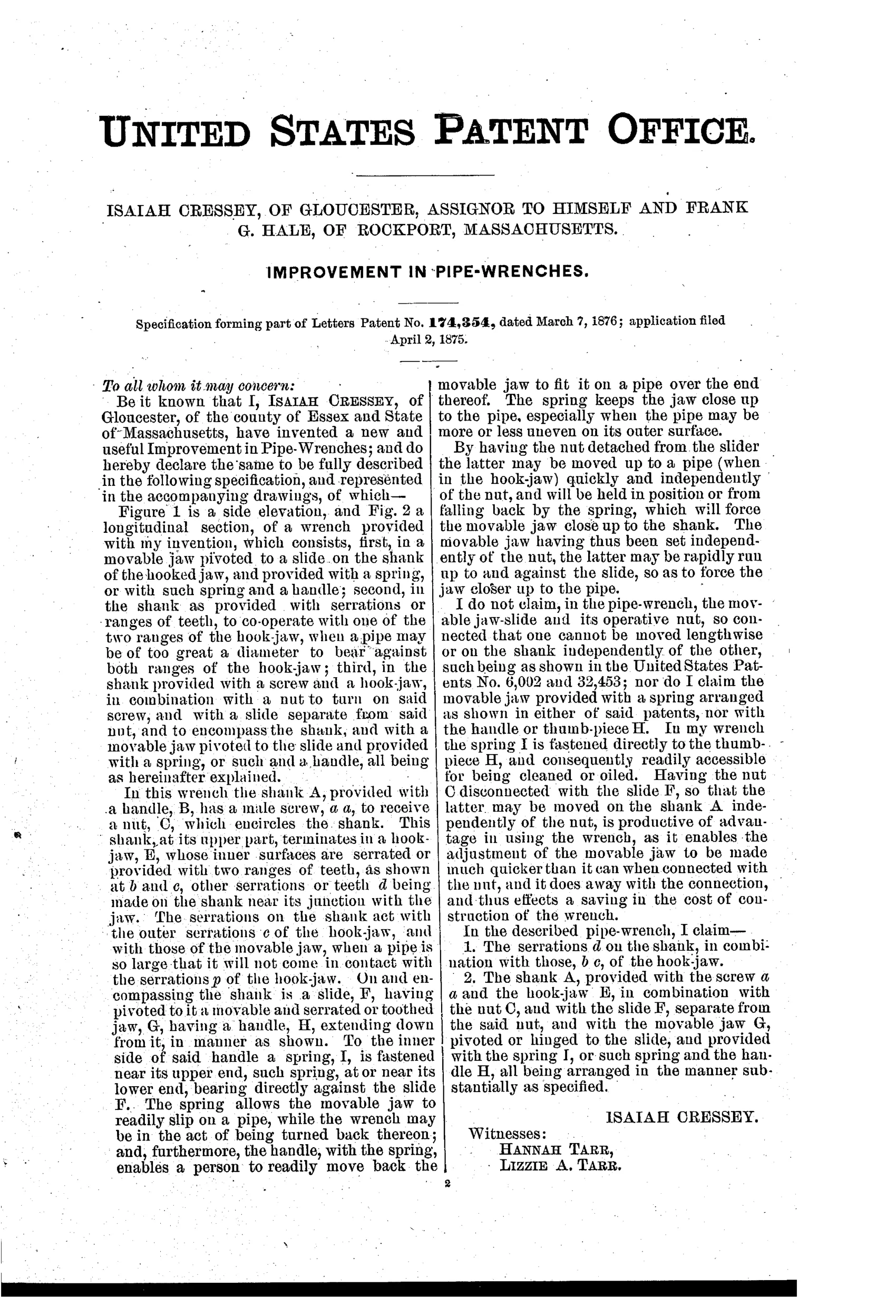
“The shank A, provided with the screw a a and the hook-jaw E, in combination with the nut C, and with the slide F, separate from the said nut, and with the movable jaw G, pivoted or hinged to the slide, and provided with the spring I, or such spring and the handle H, all being arranged in the manner substantially as specified.”
In plain English: The wrench's shank, screw, and fixed hook-jaw work together with a separately-moving nut and a slide carrying a spring-loaded, pivoting jaw with a handle, all arranged as described.
⚙ In the inventor’s words
“By having the nut detached from the slider the latter may be moved up to a pipe (when in the hook-jaw) quickly and independently of the nut, and will be held in position or from falling back by the spring, which will force the movable jaw close up to the shank.”— Isaiah Cressey, from the specification
Fate unknown
No manufactured example of this Gloucester design is documented in DATAMP or the collector literature; a marked specimen would settle it.
⚙ Commentary
Cressey's contribution here is a small act of disconnection. On an ordinary screw-adjusted pipe wrench, getting the jaw from wide open to snug on the pipe means spinning the nut the whole way — tedious when you're moving between pipe sizes. His fix: let the slide carrying the movable jaw travel freely on the shank, independent of the nut. You shove the slide up to the pipe by its little handle H, a spring holds it there so it doesn't fall back, and only then do you run the nut up behind it to lock everything solid. It's a quick-adjust idea, arriving well before the 1890s wave of one-hand mechanisms that collectors prize.
The spring earns its keep twice. Besides holding the slide in position, it lets the pivoted jaw G rock back and slip over the pipe on the return stroke — ratcheting action, so you can work in a tight space without resetting the grip each swing.
Fig. 2's section is worth a close look: the nut C rides the threaded portion of the shank while the slide F sits above it, plainly separate — the whole invention in one hatched drawing. The curved hook-jaw with its serrated throat is standard for the era; the disconnected nut-and-slide is the part that wasn't. Whether the friction of a spring alone would hold the slide under real shop grime is a fair question, but the logic is sound.
Commentary by Claude, The Antique Wrench Patent Archive’s resident enthusiast