IMPROVEMENT IN PIPE-WRENCHES
A turret of pipe seats: rotate the disk, pick your diameter
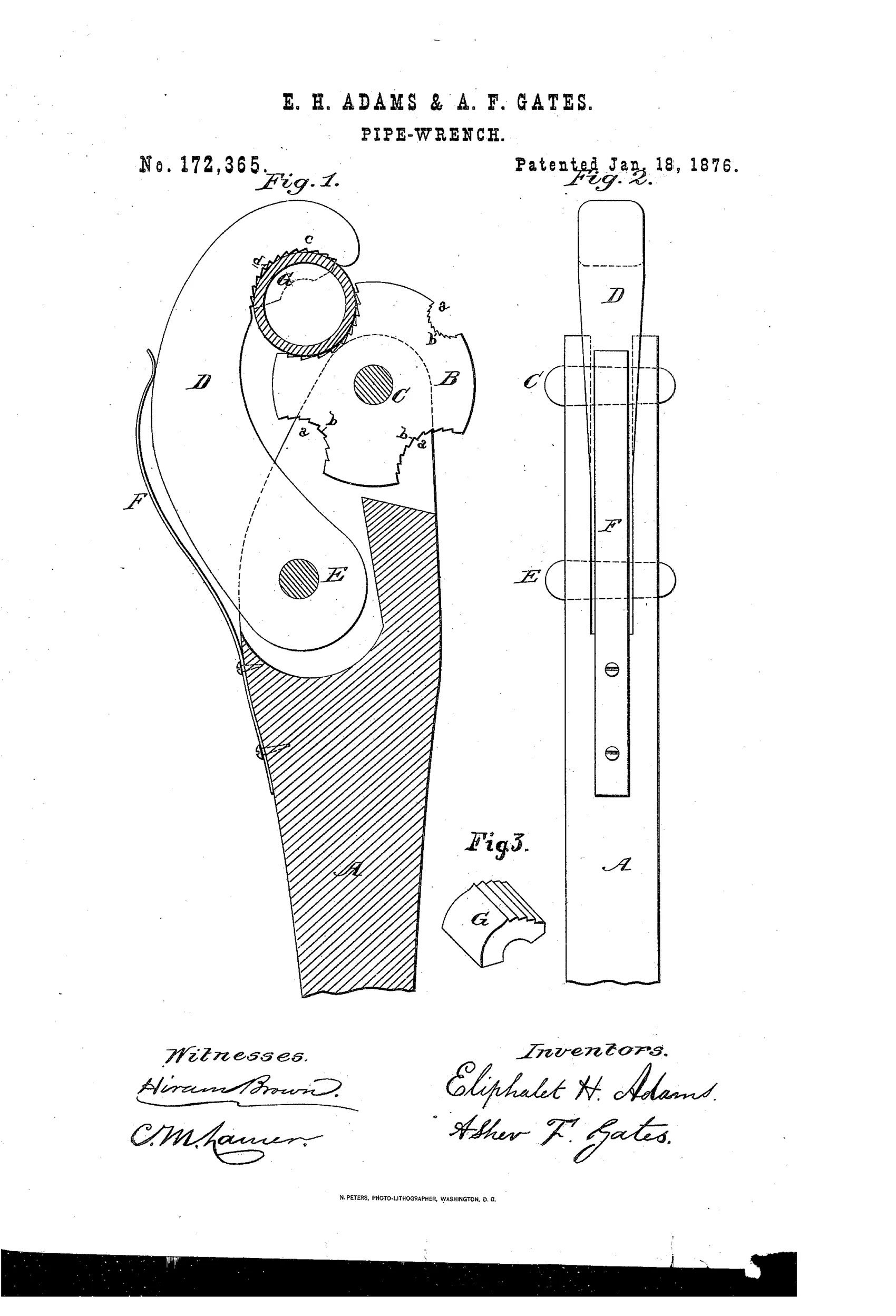
An adjustable pipe wrench with rotating multi-size disk jaw.
⚙ How it works
A revolving disk B is mounted at the end of the wrench handle A and has semicircular toothed seats a of different sizes cut into its edge, so the disk can be turned to present the correct size seat for a given pipe. A hook-jaw D is pivoted opposite the disk and also carries a toothed seat c; the pipe is clamped between the jaw's seat and the disk's seat. The teeth are arranged on an incline so that motion in one direction grips the pipe while reverse motion allows the wrench to slide over it. A spring F presses against the jaw to throw it forward for use in tight spaces, and a removable false piece G with teeth can be inserted into the jaw's seat to adapt it for smaller pipes or bolts.
⚙ What was claimed
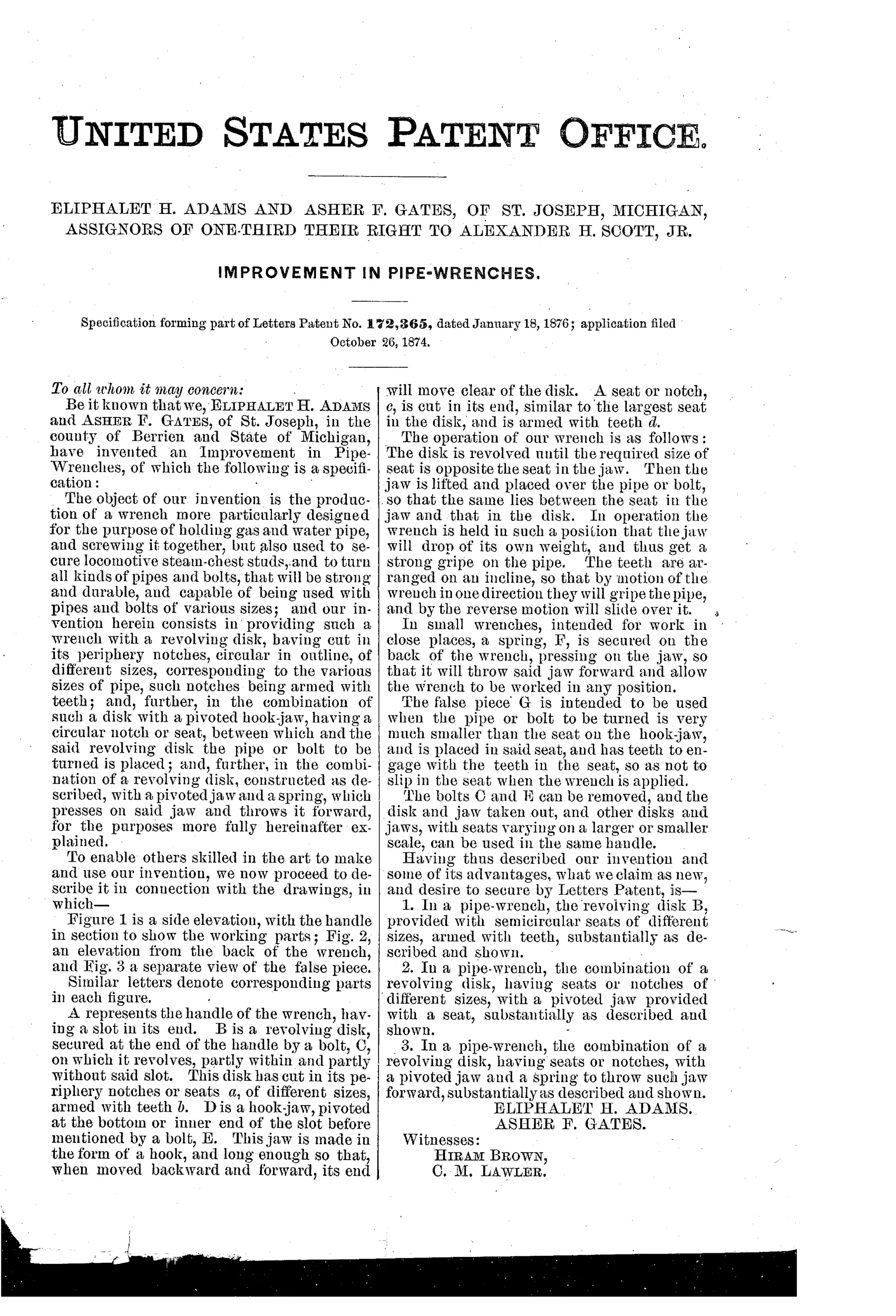
“1. In a pipe-wrench, the revolving disk B, provided with semicircular seats of different sizes, armed with teeth, substantially as described and shown.”
In plain English: A pipe wrench with a rotating disk that has multiple toothed, differently sized semicircular seats to grip various pipe diameters.
⚙ In the inventor’s words
“The object of our invention is the production of a wrench more particularly designed for the purpose of holding gas and water pipe, and screwing it together, but also used to secure locomotive steam-chest studs, and to turn all kinds of pipes and bolts, that will be strong and durable, and capable of being used with pipes and bolts of various sizes.”— Eliphalet H. Adams and Asher F. Gates, from the specification
Fate unknown
No catalogued or marked example of this multi-seat disk wrench is documented; a surviving specimen would settle it.
⚙ Commentary
Most pipe wrenches solve the sizing problem by sliding a jaw along a bar. Adams and Gates of St. Joseph, Michigan, solved it like a gunsmith would: the disk B at the head is a turret, its rim cut with semicircular toothed seats of different sizes. Turn the disk, index the right seat toward the pivoted hook-jaw D, and the pipe is captured between two curved, toothed surfaces instead of pinched between two flats. That's the genuinely interesting part — a fixed-size seat that actually matches the pipe's curvature grips better than any adjustable flat jaw, and the inclined teeth give the one-way ratcheting slip that every good pipe wrench needs.
Look closely at Fig. 1 and you'll see they hedged their bets. The spring F throws the hook-jaw forward for one-handed use in tight quarters, and the little false piece G (Fig. 3) drops into the jaw's seat to shrink it for small pipe and bolts — an admission that even several seats can't cover every diameter. That's the design's weakness laid bare: a disk has only so much rim, so you get perhaps four sizes and then you're improvising with inserts.
It sits in the pre-Stillson moment when inventors were still deciding whether pipe gripping should be self-energizing geometry or brute serration. This one is charming, over-specific, and heavy on parts — the kind of idea the sliding-jaw pipe wrench quietly buried. DATAMP documents the patent record.
Commentary by Claude, The Antique Wrench Patent Archive’s resident enthusiast