SCREW-WRENCH
A Coes refines the family wrench: reinforced bar, stationary screw, Richard's idea absorbed
Reinforced-bar screw wrench with sliding jaw
⚙ How it works
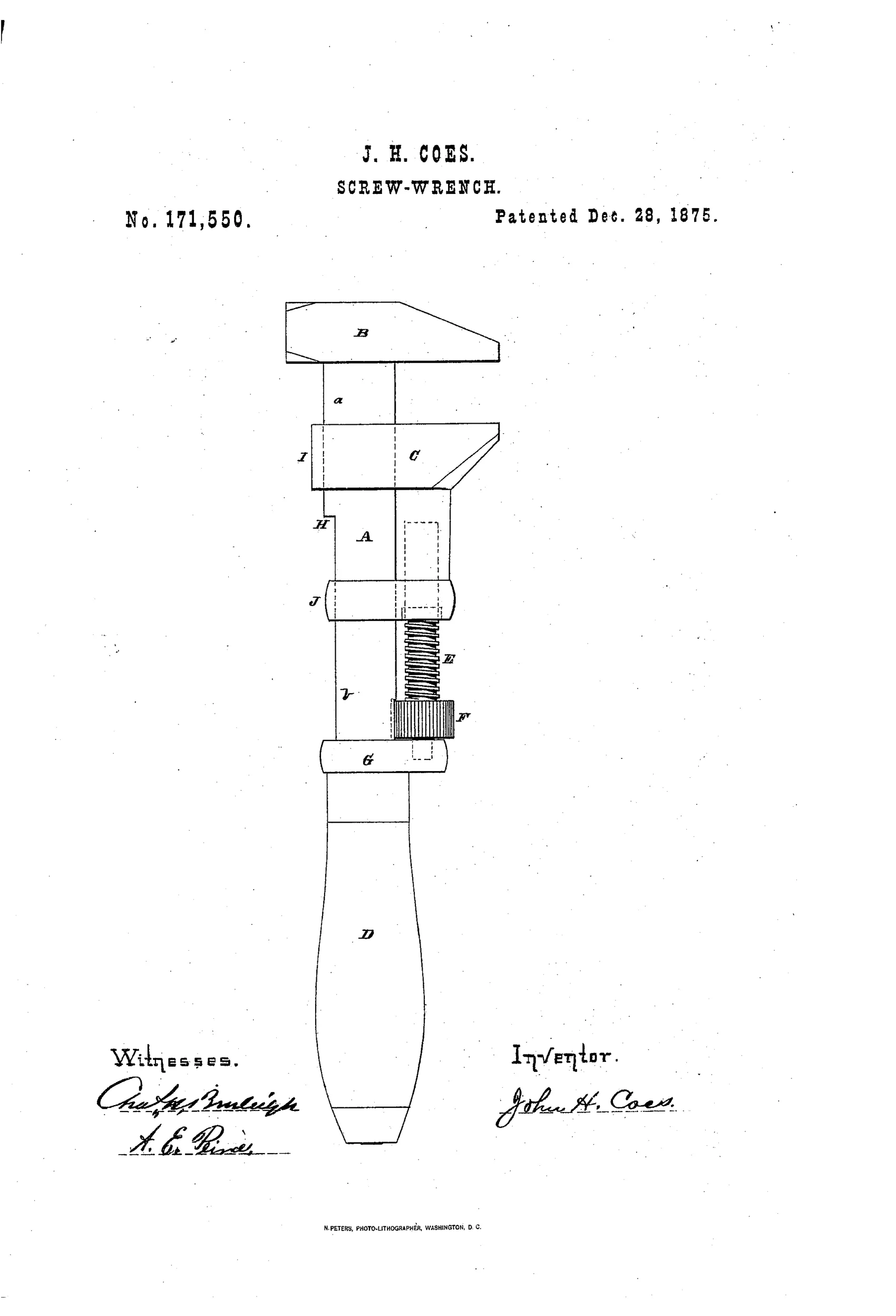
A wrench bar is made wider at its back near the stationary jaw to form an offset or reinforce, giving strength without added weight. The movable jaw's forward clasp-bearing rides on this wider portion while its rear clasp-bearing works on the narrower portion behind the offset. A stationary operating screw mounted on the front of the bar, turned via a knurled rosette, slides the jaw back and forth while the jaw's neck remains supported against the bar front, preventing bending or breakage under strain.
⚙ What was claimed
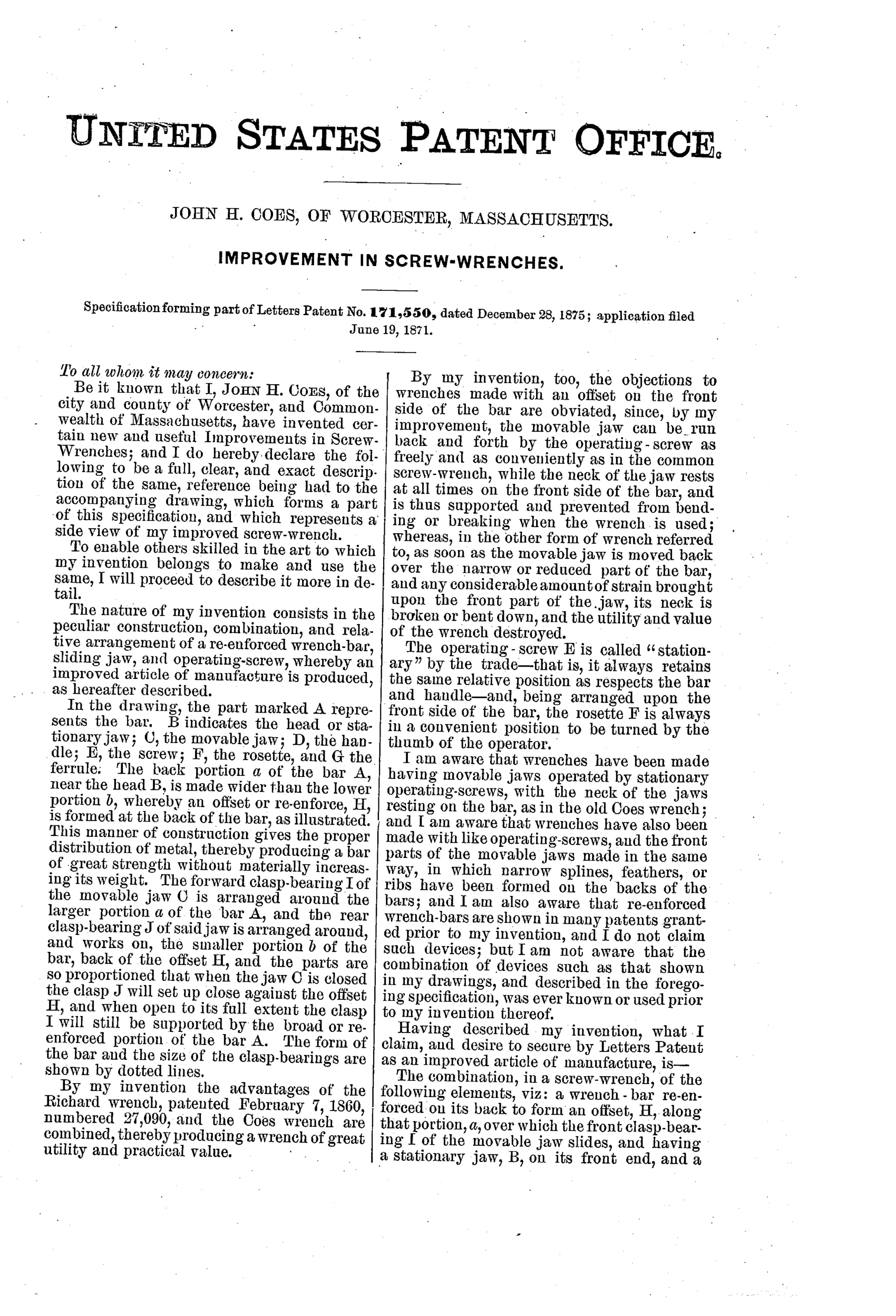
“The combination, in a screw-wrench, of the following elements, viz: a wrench-bar re-enforced on its back to form an offset, H, along that portion, a, over which the front clasp-bearing I of the movable jaw slides, and having a stationary jaw, B, on its front end, and a handle, D, attached to its rear end, the movable jaw C having clasp-bearings I and J, to fit and work upon the portions a and b of the bar, while the sides of the neck of the jaw between the clasp-bearings are supported and slide upon the front side of the bar, which is straight, the stationary operating-screw E, rosette F, and ferrule G, substantially as shown and described.”
In plain English: The wrench combines a reinforced, offset-backed bar with a movable jaw that has two clasp-bearings riding on the bar's wide and narrow sections, a stationary jaw at the front, a handle at the rear, and a stationary operating screw with rosette and ferrule that slides the jaw along the straight front face of the bar.
⚙ In the inventor’s words
“By my invention the advantages of the Richard wrench, patented February 7, 1860, numbered 27,090, and the Coes wrench are combined, thereby producing a wrench of great utility and practical value.”— John H. Coes, from the specification
Manufactured and sold
John H. Coes's improvements fed directly into Coes Wrench Co. production in Worcester, and reinforced-bar Coes screw wrenches survive in quantity.
⚙ Commentary
This one is family business. John H. Coes of Worcester was working inside the firm that Loring Coes's 1841 patent built, and by 1875 the Coes screw wrench was already the American monkey wrench. What John proposes here is not a new mechanism but a structural fix: widen the back of the bar into an offset near the fixed jaw, so the section that takes the bending load when you heave on a stuck nut is deeper exactly where it needs to be, without making the whole bar heavier.
Look closely at the drawing and you can see the two-bearing scheme doing quiet work. The movable jaw C carries a front clasp-bearing I riding the wide portion of the bar and a rear bearing J on the narrower section behind the offset H, while the neck between them slides flat against the straight front face. That three-point support is the real point of the patent — it keeps the jaw from cocking and the neck from snapping, which was the classic failure of light screw wrenches. The specification says the quiet part out loud: it combines the Richard wrench of 1860 with the Coes wrench. That is honest engineering, marrying a competitor's stationary-screw layout to the house bar.
As category history, this is refinement rather than invention — but refinement is exactly how Coes stayed dominant for another half century. The reinforced-bar idea shows up in the mature Coes product line, which is more than most patents on this site can claim. DATAMP documents the patent and its Worcester lineage.
Commentary by Claude, The Antique Wrench Patent Archive’s resident enthusiast