IMPROVEMENT IN WRENCHES
A pivoted handle whose cam clamps the jaw tighter with every swing, either direction
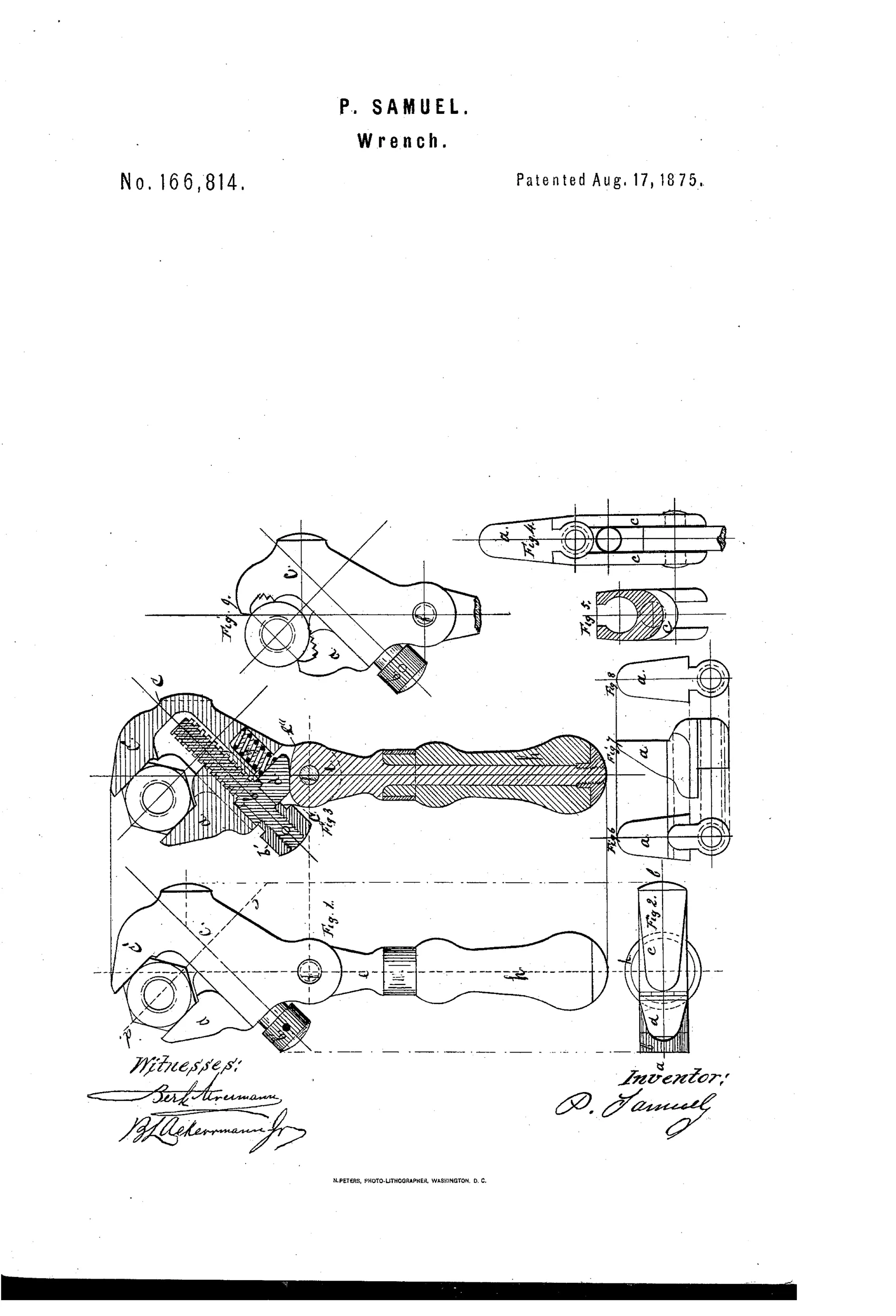
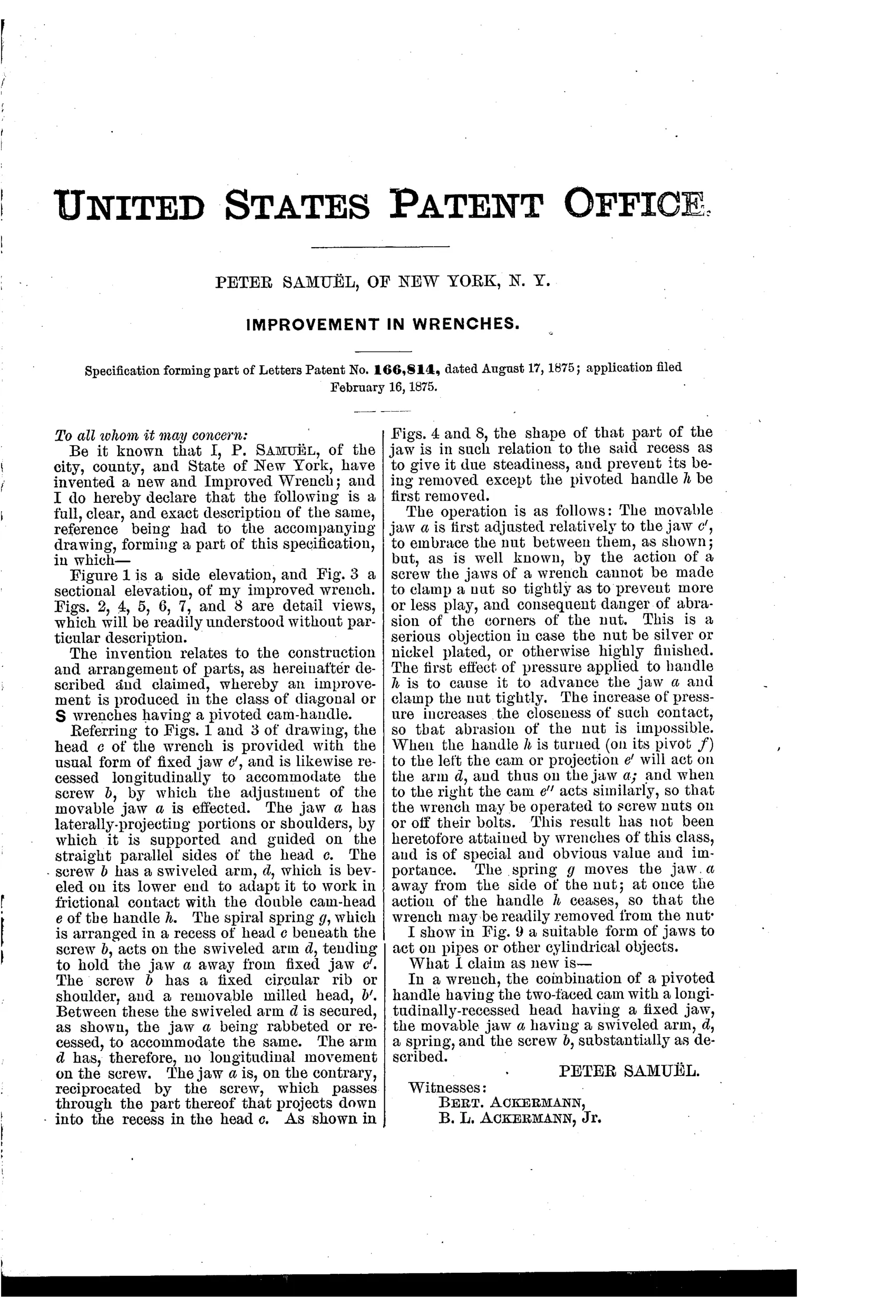
Cam-lever actuated self-tightening s-shaped wrench
⚙ How it works
The wrench head has a fixed jaw and a movable jaw guided on parallel sides, adjusted by a screw with a swiveled arm. A pivoted handle carries a two-faced cam that bears on the swiveled arm, so swinging the handle in either direction advances the movable jaw to clamp tightly on a nut. A spiral spring beneath the screw pushes the movable jaw away from the fixed jaw when pressure is released, allowing easy removal. This cam-and-spring arrangement lets the tool be worked like a ratchet to run nuts on or off without repeatedly resetting the screw.
⚙ What was claimed
“In a wrench, the combination of a pivoted handle having the two-faced cam with a longitudinally-recessed head having a fixed jaw, the movable jaw a having a swiveled arm, d, a spring, and the screw b, substantially as described.”
In plain English: The patent claims a wrench combining a pivoted handle with a two-sided cam, a recessed head with a fixed jaw, a movable jaw with a swiveling arm, a spring, and an adjusting screw, all working together as described.
⚙ In the inventor’s words
“This result has not been heretofore attained by wrenches of this class, and is of special and obvious value and importance.”— Peter Samuel, from the specification
Fate unknown
No manufactured example of this cam-handle wrench is documented; a marked specimen or catalog listing would settle it.
⚙ Commentary
Peter Samuel's idea here is to make the handle do double duty. Instead of rigidly joining head to grip, he pivots the handle and puts a two-faced cam at its inner end, bearing on a swiveled arm attached to the movable jaw. Swing the handle to turn the nut and the cam presses the jaw home; the harder you pull, the tighter it grips. Because the cam has two faces, this works in both directions — a genuinely thoughtful touch that many one-way self-tighteners of the era skipped.
The spring is the other half of the trick, and it's easy to miss in the sectional view of Fig. 3. A spiral spring under the adjusting screw pushes the movable jaw open the moment handle pressure relaxes. Set the screw once for the nut size, and you can rock the wrench back and forth like a ratchet — grip, turn, release, swing back, grip again — without ever touching the adjustment. That's the real claim of value, and Samuel isn't shy about saying so.
Where it sits in the story: this is the 1870s crowd chasing quick, one-hand nut-running, twenty years before the bicycle wrenches made compactness the game. The mechanism looks workable, though the pivoted handle adds joints and cost that Coes-pattern wrenches simply didn't have — the usual reason these clever cam designs stayed on paper. Fig. 9's alternate pipe jaw shows he was hedging toward the combination-tool market too. DATAMP documents the patent.
Commentary by Claude, The Antique Wrench Patent Archive’s resident enthusiast