IMPROVEMENT IN PIPE-WRENCHES
A ratcheting grip that tightens itself: pull one way, slip back the other
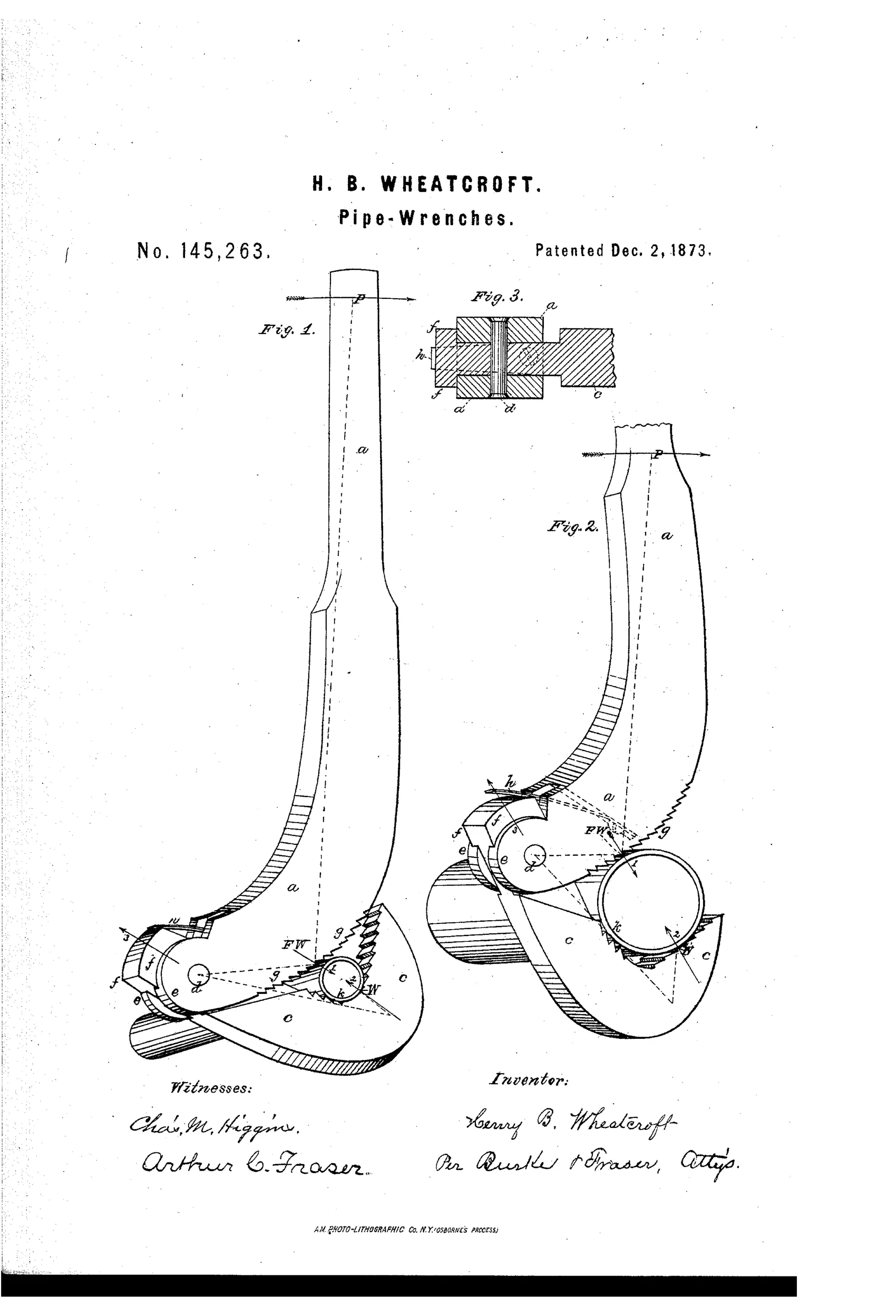
Self-adjusting pipe wrench with pivoting dog
⚙ How it works
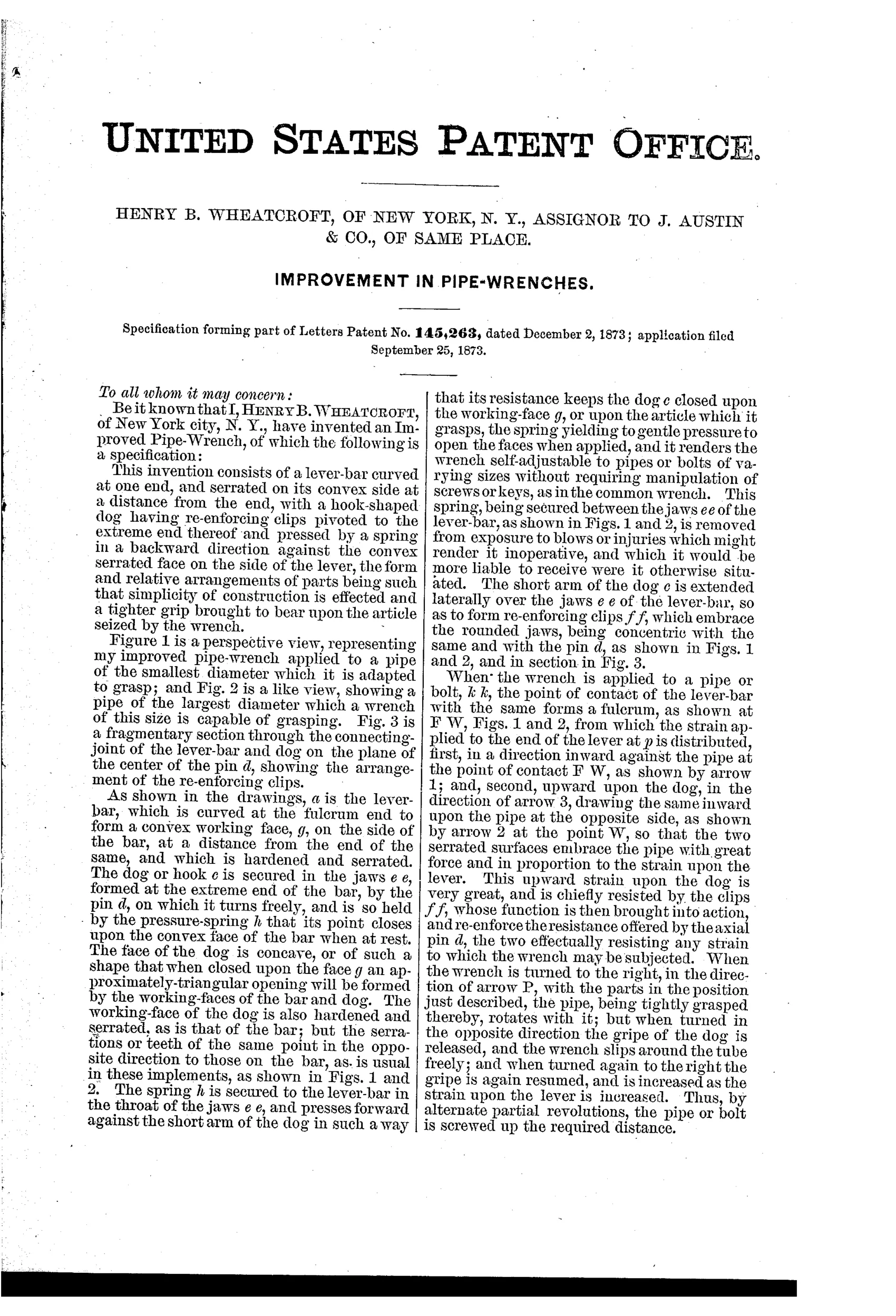
A curved lever-bar has a serrated convex face near its end, forming a fulcrum against the pipe. A hook-shaped dog is pivoted at the extreme end of the bar and pressed by a spring against the serrated face, forming a triangular gripping opening. As the lever is turned, strain at the pivot pin drives the dog and bar face together, tightening the grip proportionally to applied force. Reversing the turning direction releases the dog, letting the wrench slip freely around the pipe for repositioning.
⚙ What was claimed
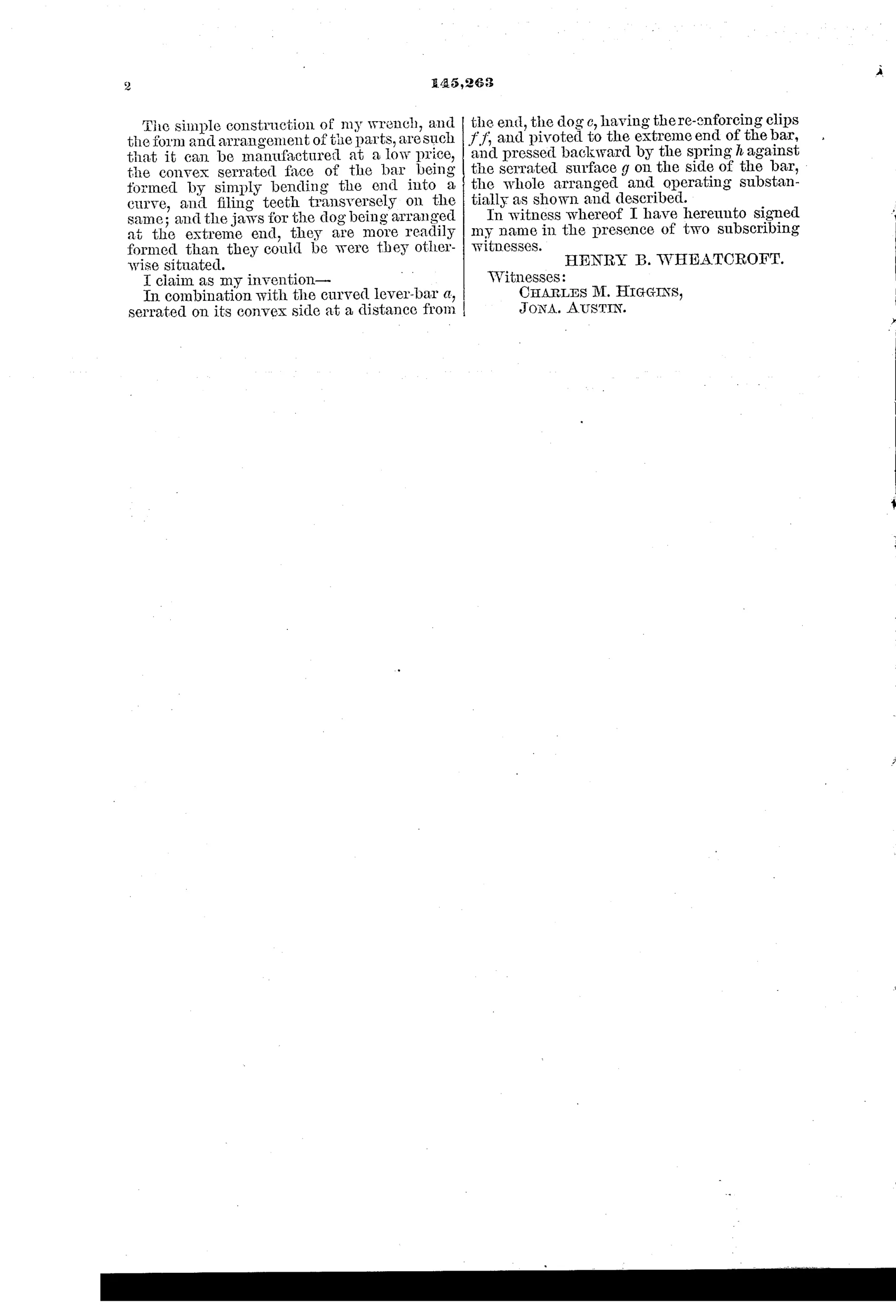
“In combination with the curved lever-bar a, serrated on its convex side at a distance from the end, the dog c, having the re-enforcing clips ff, and pivoted to the extreme end of the bar, and pressed backward by the spring h against the serrated surface g on the side of the bar, the whole arranged and operating substantially as shown and described.”
In plain English: The wrench combines a curved, serrated lever-bar with a spring-loaded pivoting dog that has reinforcing clips, all working together to grip a pipe as described.
⚙ In the inventor’s words
“Thus, by alternate partial revolutions, the pipe or bolt is screwed up the required distance.”— Henry B. Wheatcroft, from the specification
Fate unknown
The assignment to J. Austin & Co. suggests commercial intent, but I know of no catalogued or marked example; a surviving specimen matching the drawing would settle it.
⚙ Commentary
Wheatcroft's wrench has no adjusting screw at all. The pipe sits in a triangular pocket formed between a serrated face on the curved bar and a hook-shaped dog pivoted at the bar's tip, with a spring holding the dog closed. Pull the handle and the strain at the pivot pin wedges the dog and the serrations into the pipe — the harder you pull, the harder it bites. Reverse the stroke and the dog relaxes, letting the wrench slide freely around the pipe. That gives you ratchet action on a tool with no ratchet: 'by alternate partial revolutions, the pipe or bolt is screwed up the required distance,' as the patent puts it.
The two perspective views tell the capacity story deliberately — Fig. 1 shows the smallest pipe the geometry will hold, Fig. 2 the largest, with the same dog swung wide. Note the reinforcing clips (f, f) straddling the dog at the pivot; Wheatcroft knew the pin was the weak point, since all the gripping force passes through it. Fig. 3's section through that joint is the honest engineering in the sheet.
This is the self-energizing grip idea that would eventually win the pipe-wrench war — Stillson had patented his loose-jaw version just a few years earlier — but Wheatcroft's fixed-geometry pocket limits the size range badly. It reads as a clever dead end: right principle, wrong architecture. The assignment to J. Austin & Co. at least shows someone paid for the rights.
Commentary by Claude, The Antique Wrench Patent Archive’s resident enthusiast