Self-Adjusting Pipe-Wrenches.
An 1873 pipe wrench that grips by geometry alone — no screw, no adjustment
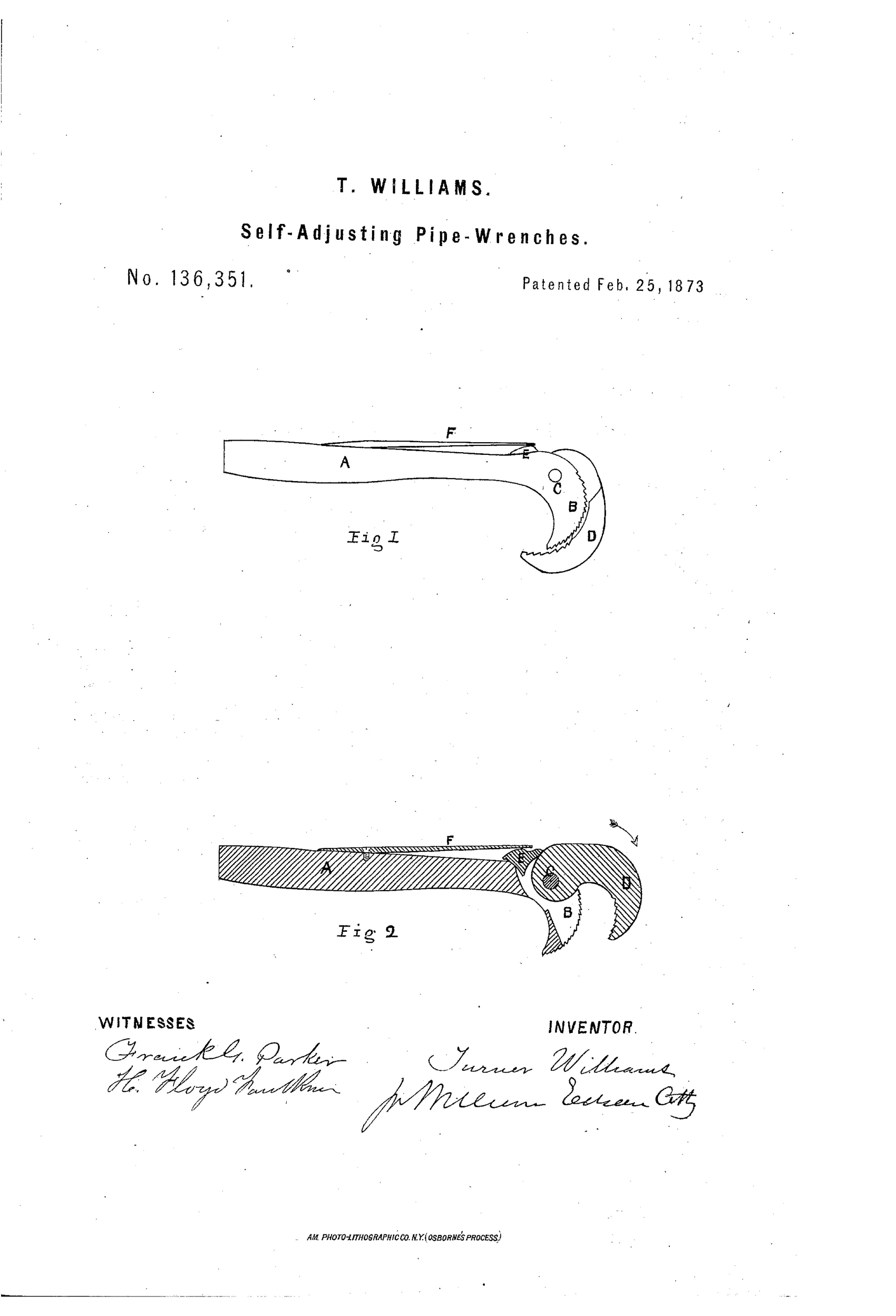
Self-adjusting pipe wrench with swinging scroll jaw.
⚙ How it works
A fixed jaw B with a curved, toothed bearing surface is attached to handle A, and a movable jaw D swings on pivot C which is eccentric to the fixed jaw's curve. As the wrench is applied, the movable jaw's eccentric pivot causes it to swing toward and close upon the fixed jaw, automatically gripping the intervening pipe or bolt. A spring F acting through block E presses against the back of the movable jaw to bias it closed onto the fixed jaw, though this spring may be replaced by a hand lever if desired.
⚙ What was claimed
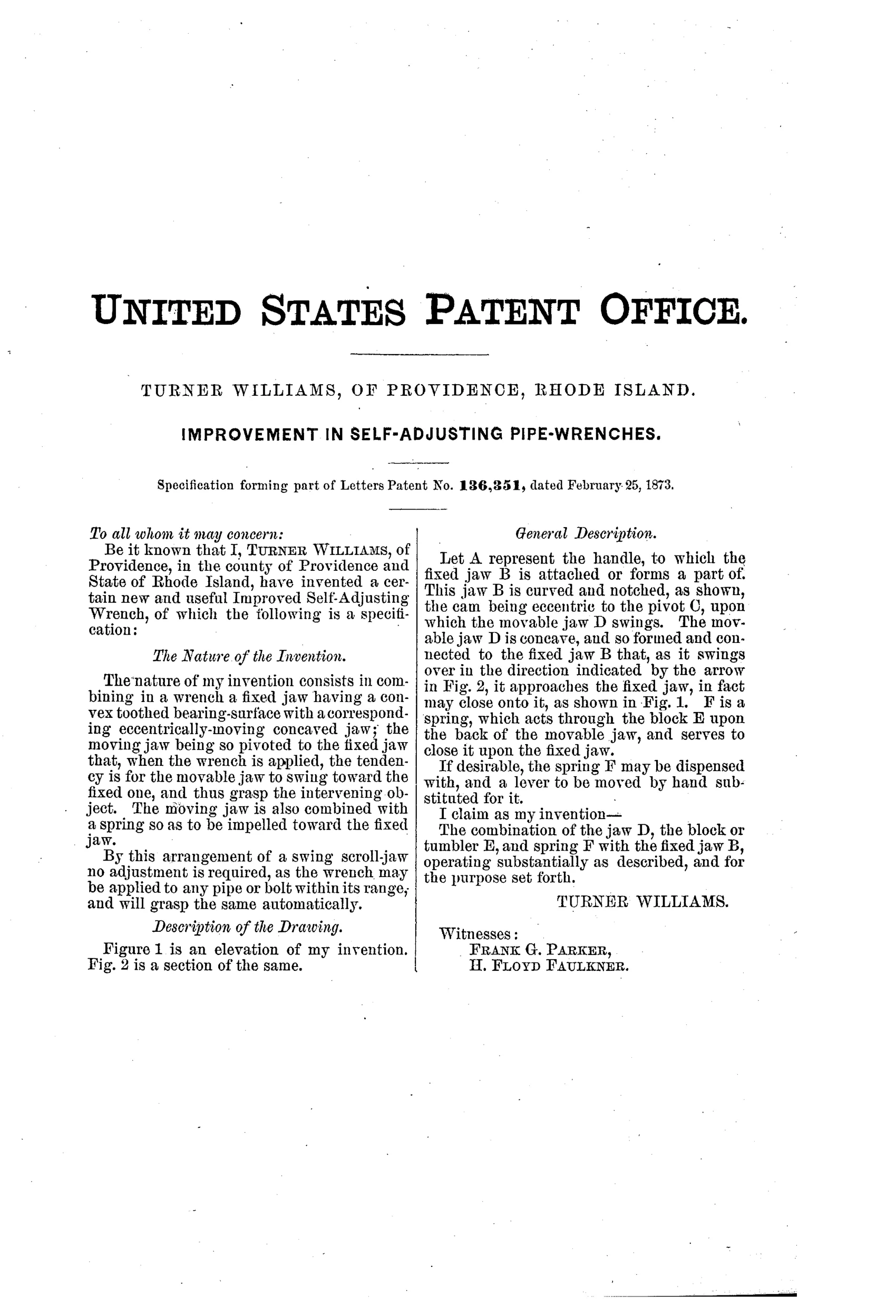
“The combination of the jaw D, the block or tumbler E, and spring F with the fixed jaw B, operating substantially as described, and for the purpose set forth.”
In plain English: The invention claims the combination of the swinging jaw, the block/tumbler, and the spring working together with the fixed jaw to automatically grip the pipe.
⚙ In the inventor’s words
“By this arrangement of a swing scroll-jaw no adjustment is required, as the wrench may be applied to any pipe or bolt within its range, and will grasp the same automatically.”— Turner Williams, from the specification
Fate unknown
The eccentric-jaw principle was later produced commercially by others, but no wrench marked to this patent is well documented; a surviving specimen would settle it.
⚙ Commentary
Turner Williams's idea is the eccentric-cam grip, and it's worth pausing over how clean it is. The movable jaw D swings on pivot C, but that pivot is deliberately offset from the center of the fixed jaw's curved, toothed face. Swing the jaw one way and the gap opens; pull the handle against a pipe and the eccentricity forces the jaw to close down harder. The harder you pull, the tighter it bites — the same self-energizing principle that makes a cam cleat hold a rope. The spring F and tumbler block E in Fig. 2 exist only to keep the jaw kissed against the work so the wedging action can start; Williams even notes you could substitute a hand lever.
What a casual reader might miss in the drawing is how much of the wrench is that hooked fixed jaw B — its serrated inner scroll is the working surface, and the whole geometry lives in the relationship between that curve and the offset pivot. Get the eccentricity wrong and the wrench either slips or jams.
This is 1873, just four years after Stillson's screw-adjusted pipe wrench, and Williams is chasing the same prize the whole category chased for decades: one-hand, no-adjustment gripping. Self-adjusting cam pipe wrenches did eventually become a real commercial family, so the concept was sound. Whether this particular Providence version was ever forged is another question — DATAMP is the place to check for a marked example.
Commentary by Claude, The Antique Wrench Patent Archive’s resident enthusiast