IMPROVEMENT IN PIPE TONGS AND CUTTERS.
A fulcrum screw under the lever turns pipe tongs into a cutter too
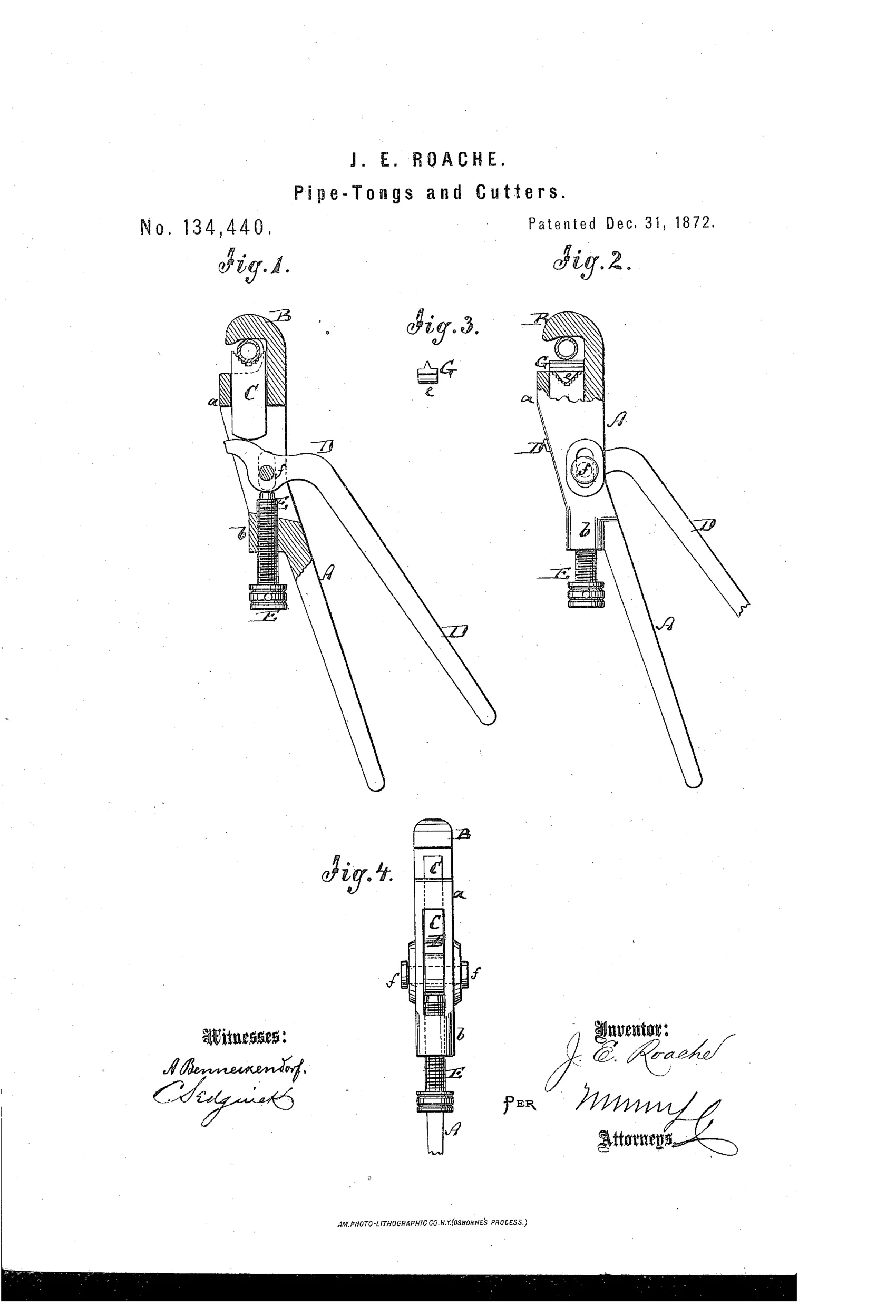
Adjustable pipe tongs with attachable cutter
⚙ How it works
A fixed hook-shaped jaw B is rigidly connected to handle A, while a movable jaw C slides vertically in a chamber formed on the handle. The lower end of jaw C rests on a lever D whose fulcrum is the tip of an adjustable screw E, so turning the screw raises or lowers the lever and thus the jaw to fit different pipe sizes. A separate cutter G with a V-shaped shank e can be fitted into the V-shaped recess on jaw C, converting the tongs into a cutting tool operated by the same lever action.
⚙ What was claimed
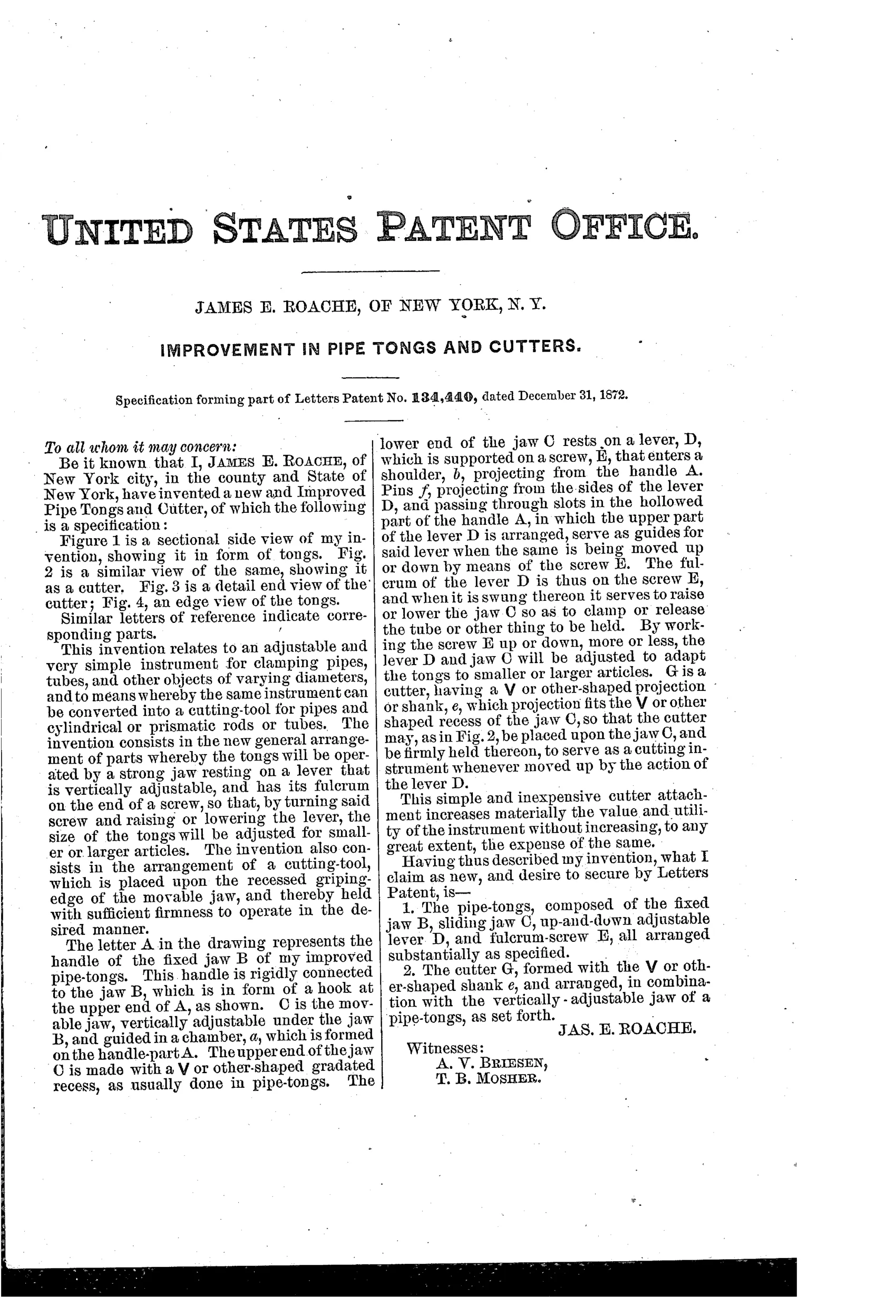
“1. The pipe-tongs, composed of the fixed jaw B, sliding jaw C, up-and-down adjustable lever D, and fulcrum-screw E, all arranged substantially as specified.”
In plain English: The tongs combine a fixed jaw, a sliding jaw, a vertically adjustable lever, and a fulcrum screw working together to grip pipes of varying sizes.
⚙ In the inventor’s words
“This simple and inexpensive cutter attachment increases materially the value and utility of the instrument without increasing, to any great extent, the expense of the same.”— James E. Roache, from the specification
Fate unknown
No catalogued example of this design is known to me; a marked specimen or trade listing would settle it.
⚙ Commentary
Roache's tongs solve the adjustment problem from an unusual direction. Most adjustable pipe wrenches of the era move the jaw directly — a screw or cam acting on the sliding jaw itself. Here the sliding jaw C simply rests on lever D, and the adjustment screw E acts on the lever's fulcrum. Turn the screw, and the whole lever geometry shifts up or down, carrying the jaw with it. It means the gripping squeeze still comes through the lever from the handles, so the screw only sets the range; the bite itself is applied by hand pressure, which is the right instinct for pipe work where you want the jaw to cinch tighter under load.
The cutter attachment is the selling point Roache himself emphasizes — a small V-shanked cutter G that drops into a matching recess in the sliding jaw, converting the tongs into a pipe cutter driven by the same lever. Fig. 3 shows how modest the part is: essentially a hardened wedge with a dovetail-like seat. His own words are candid about the economics — the attachment 'increases materially the value' without much added cost.
Where does it sit? It's a workmanlike combination tool in the crowded pipe-tong field, a generation before Stillson-pattern wrenches swept the trade. The lever-and-fulcrum-screw arrangement adds parts that a direct screw adjustment avoids, which may be why the pattern didn't take hold. DATAMP documents the patent; a marked survivor is another matter.
Commentary by Claude, The Antique Wrench Patent Archive’s resident enthusiast