Improvement in Rotary-Wrench
A reversible ratchet wrench from 1872, decades before ratchets became common
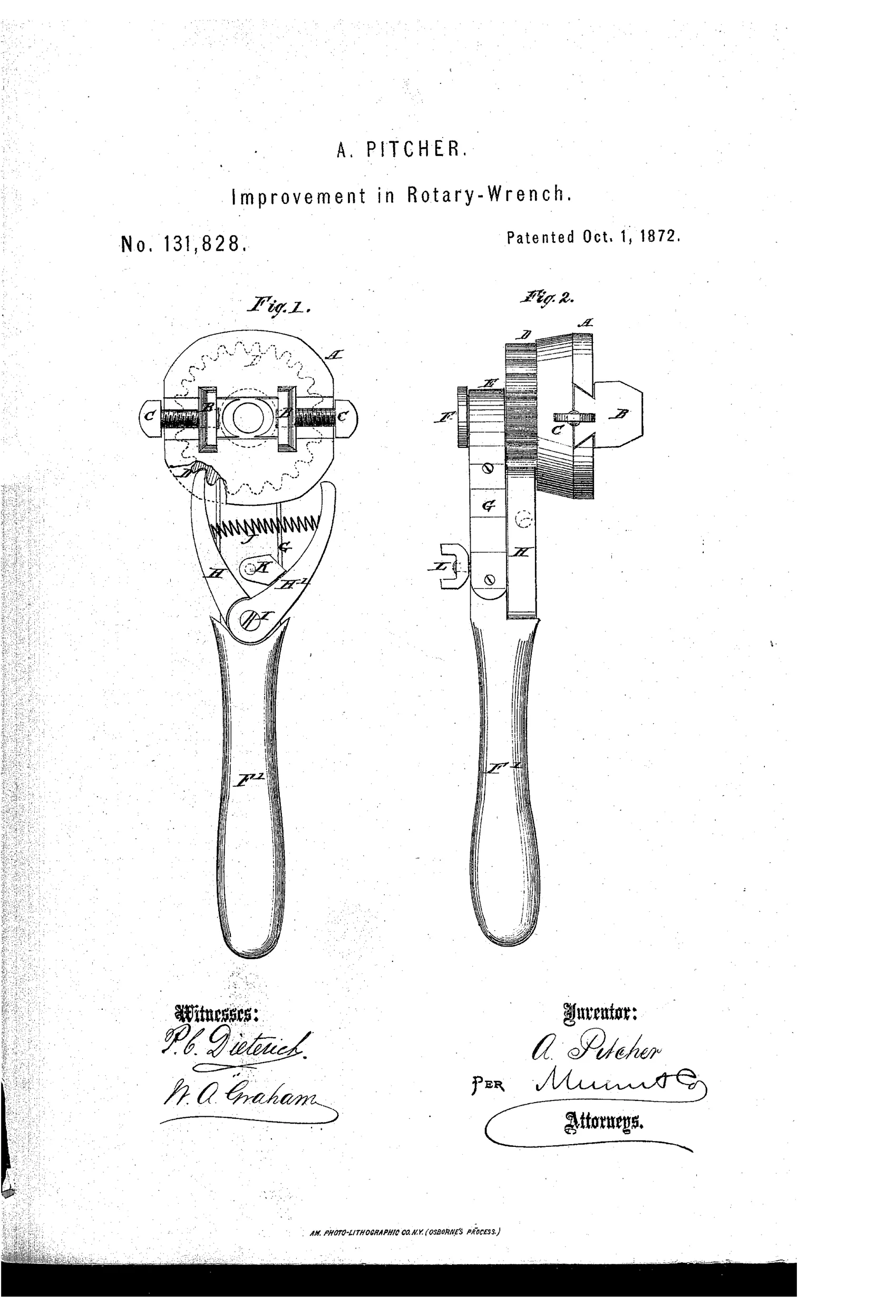
Ratcheting rotary wrench with reversible dual-pawl mechanism
⚙ How it works
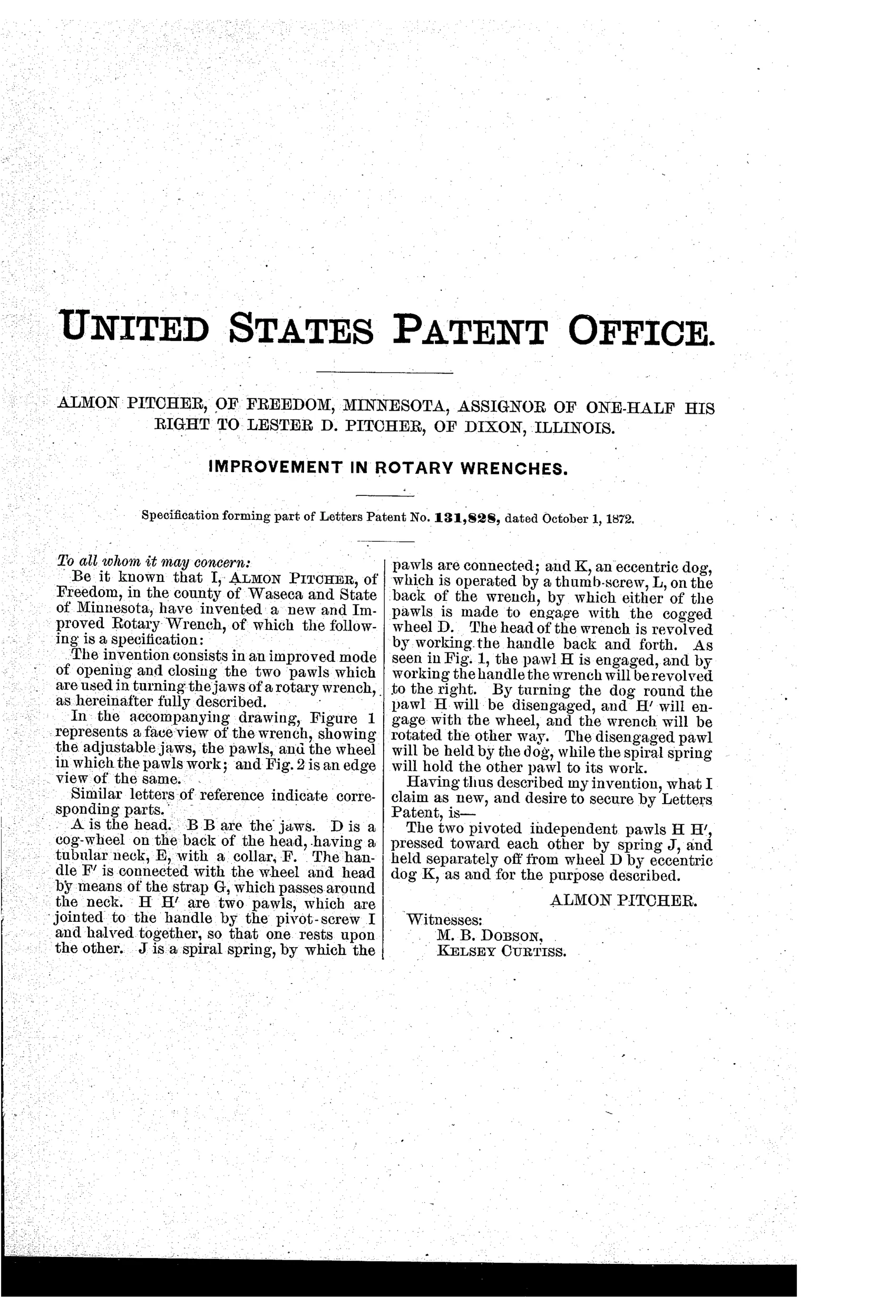
The wrench head carries a cog-wheel D on its back with a tubular neck E and collar F, connected to the handle F' by a strap G. Two independent pawls H and H' are pivoted together at pivot-screw I, halved so one rests on the other, and pressed toward each other by spiral spring J. An eccentric dog K, operated by thumb-screw L on the back of the wrench, selectively disengages one pawl from the cogged wheel D while allowing the other to engage it. Working the handle back and forth revolves the head in the direction determined by which pawl is engaged, allowing quick reversal of rotation without removing the wrench from the work.
⚙ What was claimed
“The two pivoted independent pawls H H', pressed toward each other by spring J, and held separately off from wheel D by eccentric dog K, as and for the purpose described.”
In plain English: The claim covers two independently pivoted pawls that are pushed together by a spring but can each be individually held away from the ratchet wheel by a rotating eccentric dog, enabling reversible ratcheting action.
⚙ In the inventor’s words
“The disengaged pawl will be held by the dog, while the spiral spring will hold the other pawl to its work.”— Almon Pitcher, from the specification
Fate unknown
No manufactured example of this design appears in the standard collector references; a marked specimen or period advertisement would settle it.
⚙ Commentary
Almon Pitcher of Freedom, Minnesota was chasing something the trade wouldn't fully deliver for another generation: a wrench you could work back and forth in a tight spot without lifting it off the nut, and reverse without flipping the tool over. His answer is a cogged wheel on the back of the head and a pair of pawls pivoted on a single screw, halved so they nest against each other, with one spiral spring pressing both toward the teeth. An eccentric dog turned by a thumb-screw lifts whichever pawl you want out of engagement — the spring keeps the other one working. That's a genuinely economical way to get selectable direction: one spring, one pivot, one selector.
Look at Fig. 2 and you see the cost of the idea. The whole head is a rotating assembly — wheel, tubular neck, collar — held to the handle by a strap. Every ounce of torque you apply passes through those pawl teeth and that strap joint. For light farm work it would ratchet along happily; lean on a rusted nut and the small teeth of wheel D are the weak link.
As a piece of the pre-1900 story, this sits in the sparse early chapter of ratcheting wrenches, well before the mechanism became routine on socket handles. The reversing dog is the clever bit, and the claim is drawn tightly around it. DATAMP records the patent; a production wrench is another matter.
Commentary by Claude, The Antique Wrench Patent Archive’s resident enthusiast