IMPROVEMENT IN FORK-WRENCHES.
A pear-shaped cam-head squeezes the jaws shut with one flick of a lever
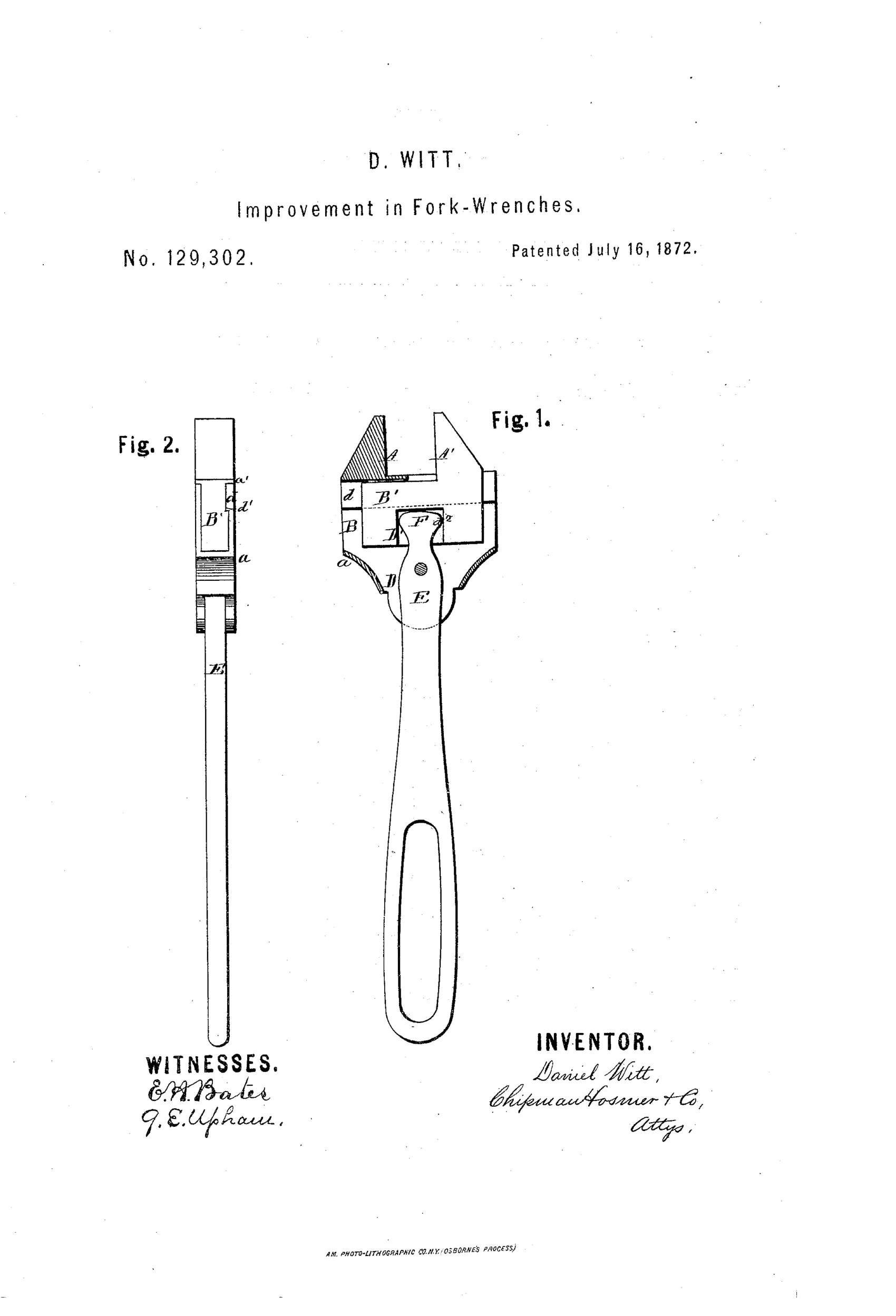
Adjustable fork-wrench with cam-lever operated sliding jaw
⚙ How it works
One jaw's base slides through an open chamber in the other jaw's base to adjust the wrench opening. An operating lever pivoted in the chamber has an enlarged, pear-shaped cam-head that engages a rectangular recess in the sliding jaw's shank. Turning the lever causes its cam-head shoulders to press against the recess walls, sliding the jaw closed or open with a firm, uniform grip achieved through a short lever movement. Recesses below the cam-head prevent the lever from stopping short during operation.
⚙ What was claimed
“The jaw A', having the base B', provided with the rectangular recess D', in combination with the jaw A having the chamber B in its base, and the lever E constructed with the angular cam-head F having rounded shoulders d1 and sides sloping toward the neck, substantially as specified.”
In plain English: The claim covers the sliding jaw with a rectangular recess working together with the fixed jaw's chamber and a lever having a rounded, angular cam-head that slides the jaw open and closed.
⚙ In the inventor’s words
“By means of this head and the recess D' the lever obtains a firm and uniform purchase on the jaw at all parts of its movement, and is brought close to the griping parts thereof, making the wrench more effectual, and the jaws brought together and opened by a short movement of the lever.”— Daniel Witt, from the specification
Fate unknown
No manufactured example of Witt's cam-lever fork-wrench is documented in DATAMP or the collector literature; a marked specimen would settle it.
⚙ Commentary
Daniel Witt's 1872 fork-wrench is an early entry in the quick-adjust chase — the pursuit that would consume wrench inventors for the next thirty years. His answer is a lever pivoted between the jaws, ending in an enlarged pear-shaped cam-head that sits in a rectangular recess cut into the sliding jaw's shank. Swing the lever and the cam's rounded shoulders bear against the recess walls, driving the jaw open or closed through a short arc. No screws, no ratchets: one hand, one motion.
The subtle part of the drawing is the cam geometry itself. Witt claims specifically the rounded shoulders and the sides sloping toward the neck — the shape is what keeps the lever's purchase 'firm and uniform at all parts of its movement,' so the mechanical advantage doesn't collapse just as the jaws bite. He also cuts small recesses below the cam-head so the lever can't hang up mid-stroke, which tells you he actually worked the motion through rather than sketching a wish.
The weakness is the one that haunted most cam quick-adjusts: the holding force is only the lever's friction against the work. A stubborn nut wants to lever the jaws back open, and there's no positive lock shown. Ingenious for grabbing pipe or worn nuts fast; dubious for heavy torque. A characteristic 1870s attempt — clever, plausible, and pointing at the problem the great 1890s designs would finally solve.
Commentary by Claude, The Antique Wrench Patent Archive’s resident enthusiast