IMPROVEMENT IN WRENCHES.
A manufacturing claim: slide the one-piece jaw on, then weld the step below it.
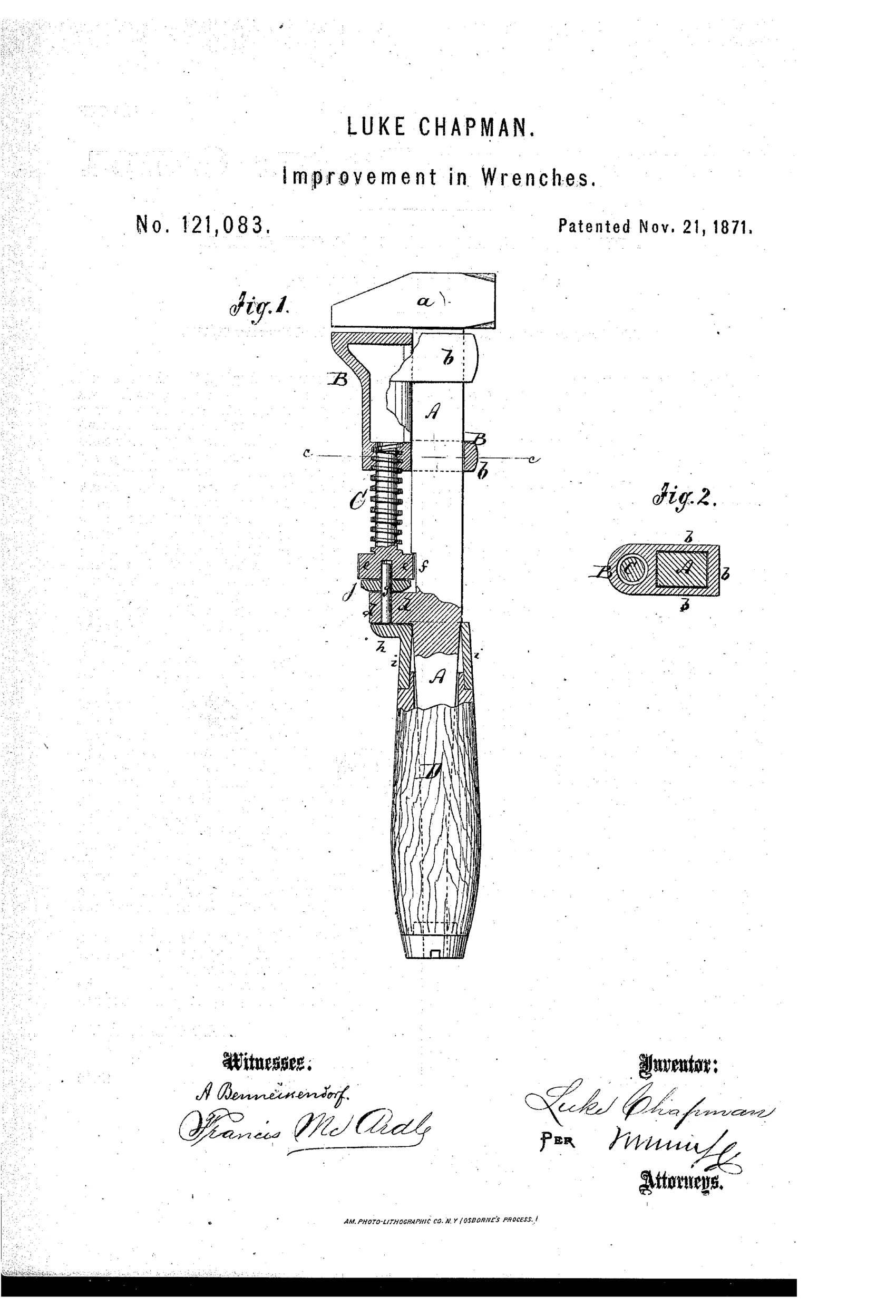
Monkey wrench with welded shank step design
⚙ How it works
The wrench has a shank A cast or forged in one piece with the upper head a, and a movable jaw B is slid onto the shank before a supporting step d is welded onto the shank to retain it. An adjusting screw C threads into the movable jaw B, with its lower end centered on a pin g that is fitted through the step d and held by a lip h projecting from a ferrule i. A washer j is interposed between the step d and the lower end of the screw, allowing the screw's upper end to retain one or two threads in the movable jaw even when the jaw is raised fully against the head a.
⚙ What was claimed
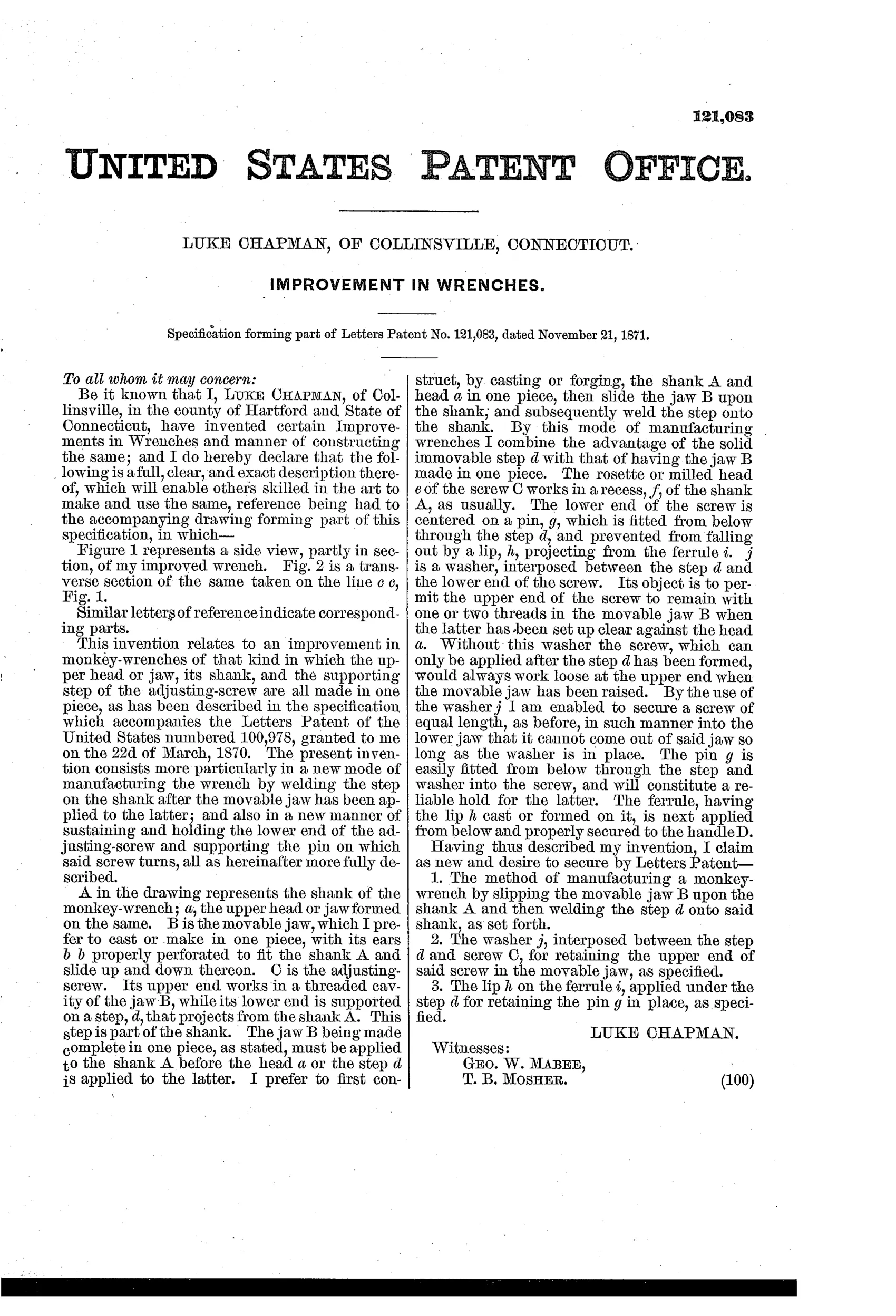
“The method of manufacturing a monkey-wrench by slipping the movable jaw B upon the shank A and then welding the step d onto said shank, as set forth.”
In plain English: The invention claims the specific manufacturing method of first sliding the movable jaw onto the shank, then welding the supporting step onto the shank afterward.
⚙ In the inventor’s words
“By this mode of manufacturing wrenches I combine the advantage of the solid immovable step d with that of having the jaw B made in one piece.”— Luke Chapman, from the specification
Fate unknown
The construction is entirely practical, but I know of no wrench documented to this patent; a specimen or DATAMP manufacturer link would settle it.
⚙ Commentary
Most wrench patents of the 1870s claim a mechanism. Luke Chapman claims a sequence of operations. His problem was a real one for monkey-wrench makers: if the step that supports the adjusting screw is forged solid with the shank, the movable jaw can't be slipped over it, so makers either split the jaw into pieces or bolted the step on afterward — both weaker options. Chapman's answer is blunt and smart: thread the finished one-piece jaw onto the bare shank first, then forge-weld the step in place beneath it, trapping the jaw forever.
The drawing rewards a slow look. The screw C doesn't just bear on the step d — its lower end rides on a pin g held by a lipped ferrule i, with a washer j spacing the screw up from the step. That spacing is deliberate: it means even with the jaw run all the way up against the fixed head, a thread or two stays engaged, so the screw can never drop free of the jaw. That's the kind of small courtesy a user notices only when a cheaper wrench loses its screw.
In the arc from Coes's 1841 pattern onward, this is a refinement of production rather than of adjustment — no quick-adjust cleverness, just a sounder way to build the standard article. Collinsville, Connecticut was a serious metalworking town, and this reads like a shop-floor solution written up for the Patent Office.
Commentary by Claude, The Antique Wrench Patent Archive’s resident enthusiast