SCREW-WRENCH.
A fully exposed adjusting nut, thirteen years after Coes set the pattern
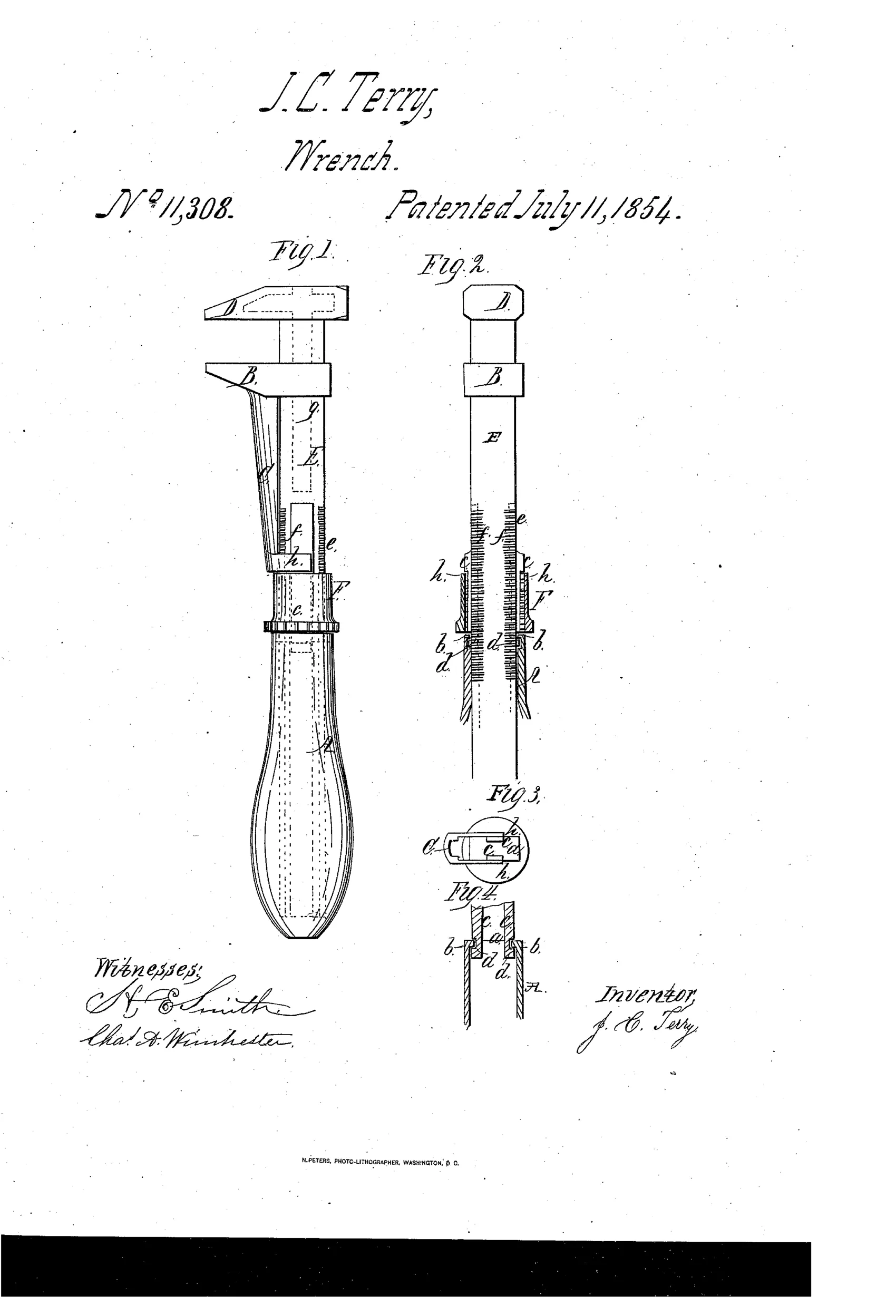
An improved screw wrench with strap-secured jaw
⚙ How it works
The stationary jaw's shank is attached to the hollow handle by two straps that pass through the screw nut and into the handle. These straps have grooves near their lower ends that engage projections inside the handle's oblong opening when twisted into place, locking the jaw and shank securely to the handle. The movable jaw's threaded shank passes through the stationary jaw and between the two straps, engaging the screw nut so that turning the nut advances or retracts the movable jaw. Because the operator's fingers wrap around the entire nut at opposing points, greater turning leverage is achieved than in wrenches where the nut is partly embedded in the jaw shank.
⚙ What was claimed
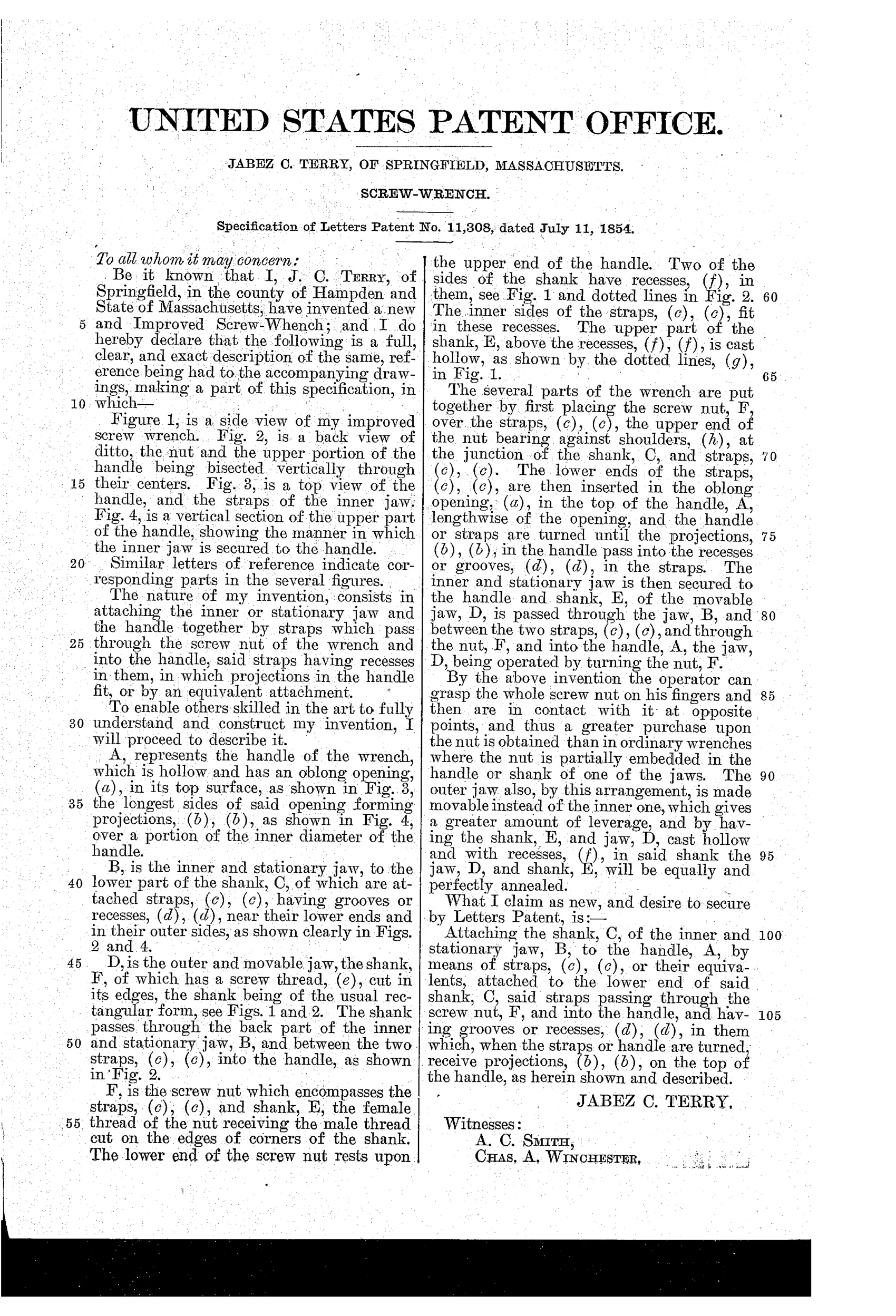
“Attaching the shank, C, of the inner and stationary jaw, B, to the handle, A, by means of straps, (c), (c), or their equivalents, attached to the lower end of said shank, C, said straps passing through the screw nut, F, and into the handle, and having grooves or recesses, (d), (d), in them which, when the straps or handle are turned, receive projections, (b), (b), on the top of the handle, as herein shown and described.”
In plain English: The invention claims a method of securing the wrench's fixed jaw to its handle using straps that run through the screw nut into the handle, with grooves that lock onto handle projections when twisted into position.
⚙ In the inventor’s words
“By the above invention the operator can grasp the whole screw nut on his fingers and then are in contact with it at opposite points, and thus a greater purchase upon the nut is obtained than in ordinary wrenches where the nut is partially embedded in the handle or shank of one of the jaws.”— Jabez C. Terry, from the specification
Fate unknown
No manufactured example of Terry's strap-secured design is documented; a marked specimen or period hardware listing would settle it.
⚙ Commentary
Jabez Terry's 1854 wrench is a quiet argument about ergonomics. In the Coes-style screw wrench that had dominated since 1841, the knurled nut sits partly buried in the shank — your thumb pushes on maybe a third of its circumference. Terry pulls the nut fully clear of everything. His fixed jaw hangs from two flat straps that flank the movable jaw's threaded shank, pass through the nut, and drop into a hollow handle. The nut floats free between straps, so the operator can wrap fingers around it at opposing points and get real purchase. That's the whole pitch, and it's a legitimate one — anyone who has fought a stiff monkey wrench nut with a greasy thumb understands the complaint.
The locking detail is the part worth studying in Figs. 3 and 4: the straps carry grooves near their lower ends, and a quarter-twist of the handle drives internal projections into those grooves — a bayonet fitting, essentially, holding the whole business end to the wooden handle. Elegant to assemble, but it puts every ounce of turning strain through two slender straps and a twist-lock joint. A Coes wrench takes that strain through a solid forged shank.
So Terry traded structural directness for grip comfort, which is probably why this reads as an interesting refinement rather than a new direction. The exposed-nut idea would echo in later designs; the strap-and-bayonet handle would not. DATAMP documents the patent; the wrench itself is harder to find.
Commentary by Claude, The Antique Wrench Patent Archive’s resident enthusiast