IMPROVEMENT IN COMBINED TOOLS.
One dovetailed slot serves screwdriver, screw-holder, wrench jaw, awl, and tack hammer
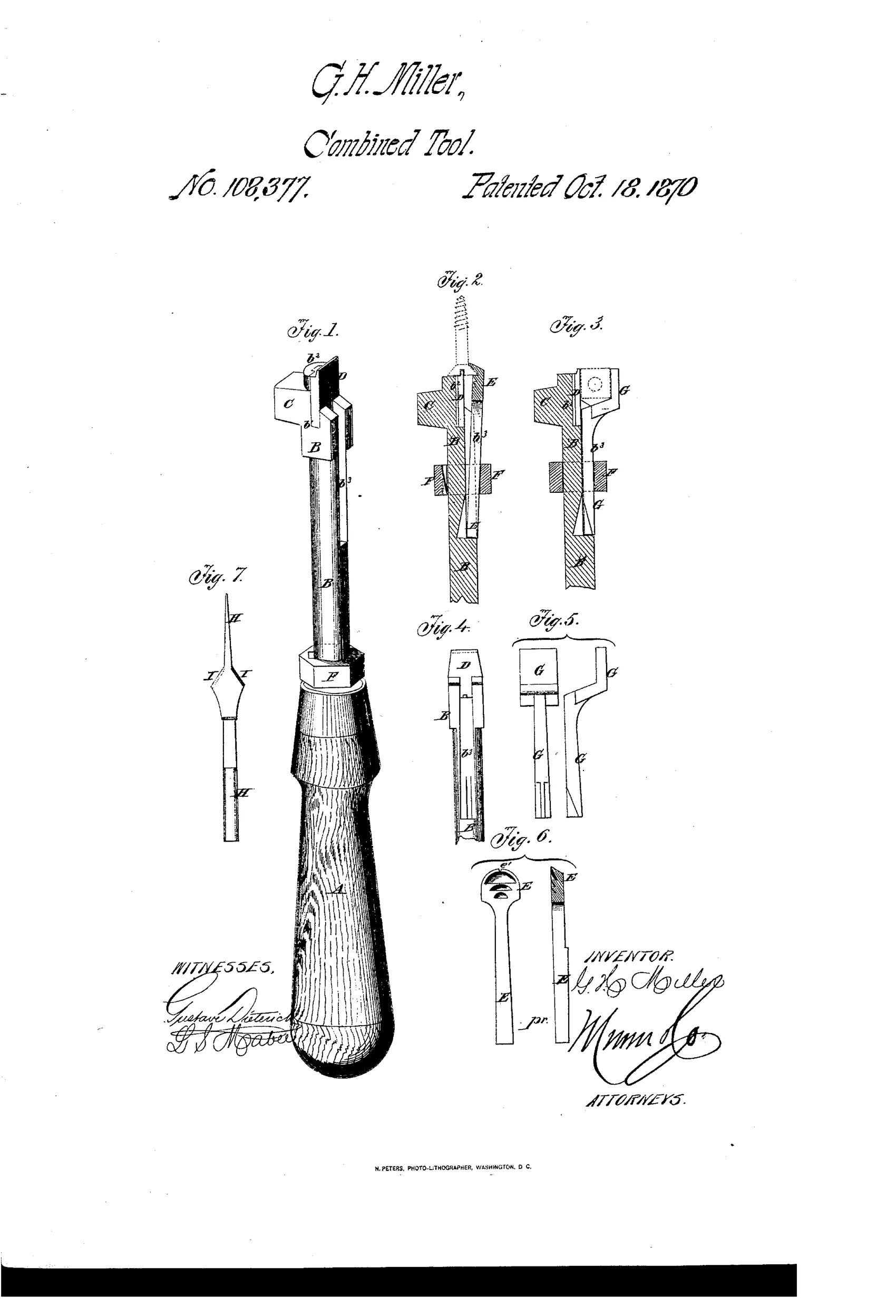
Multi-attachment combination hand tool with interchangeable screwdriver, wrench, awl
⚙ How it works
A hollow wooden handle A holds a shank B with a dovetailed slot at its forward end that accepts interchangeable detachable steel points D, held by a dovetailed rib and groove and secured by a sliding ring F. The shank's side groove b3 accepts a screw-holding clamp E with curved notches to grip screw heads while starting them, or a pivoting jaw piece G that combines with the driver point D to form an adjustable wrench, using an inclined tenon and notch to set jaw width. A separate boring awl H with side wings I for countersinking can also be fitted into the same groove and locked by the same slide ring, and a hammer-head projection C on the shank allows driving small tacks.
⚙ What was claimed
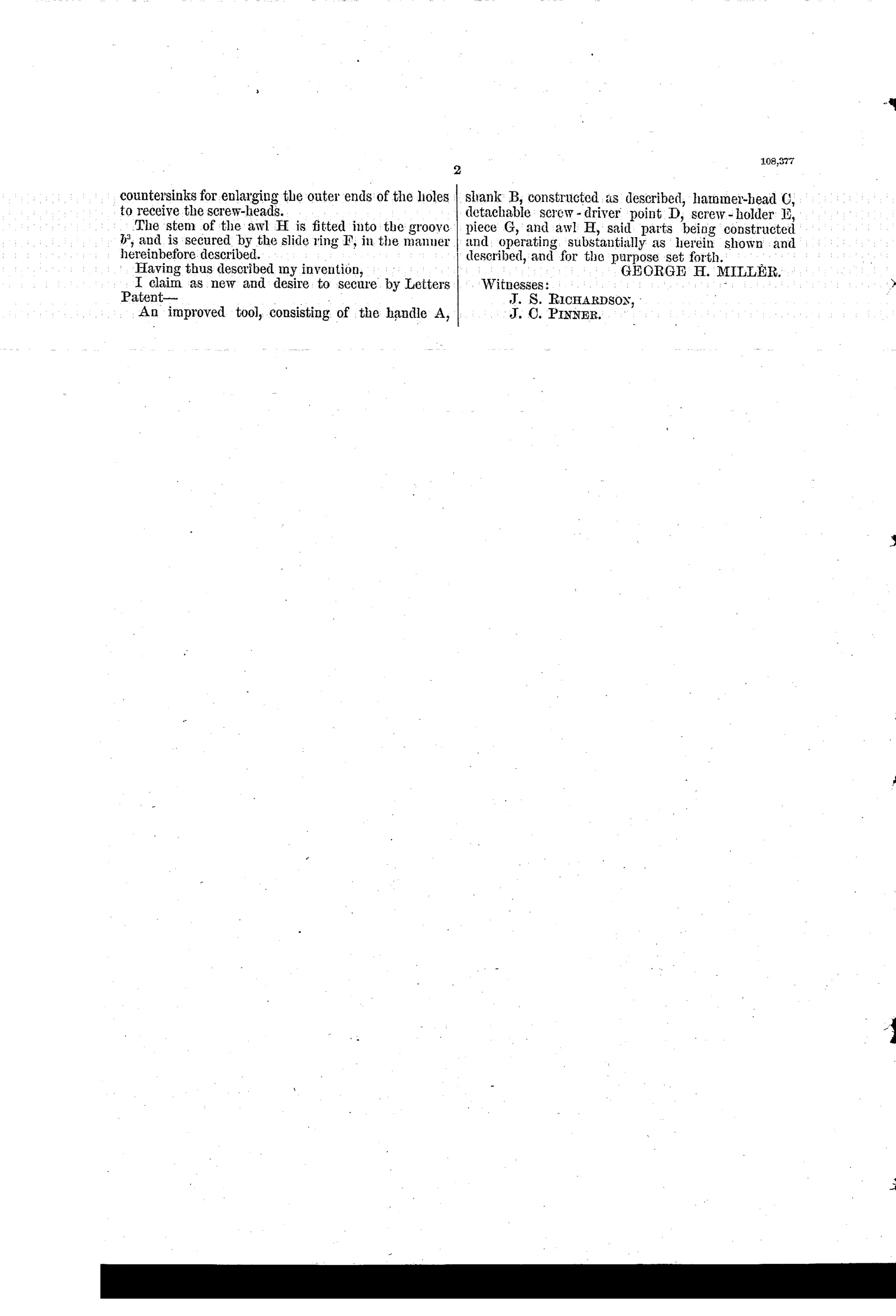
“An improved tool, consisting of the handle A, shank B, constructed as described, hammer-head C, detachable screw-driver point D, screw-holder E, piece G, and awl H, said parts being constructed and operating substantially as herein shown and described, and for the purpose set forth.”
In plain English: The invention is a combination hand tool made of a handle, shank, hammer head, swappable screwdriver tip, screw-holding clamp, wrench jaw piece, and awl, all built and working together as shown.
⚙ In the inventor’s words
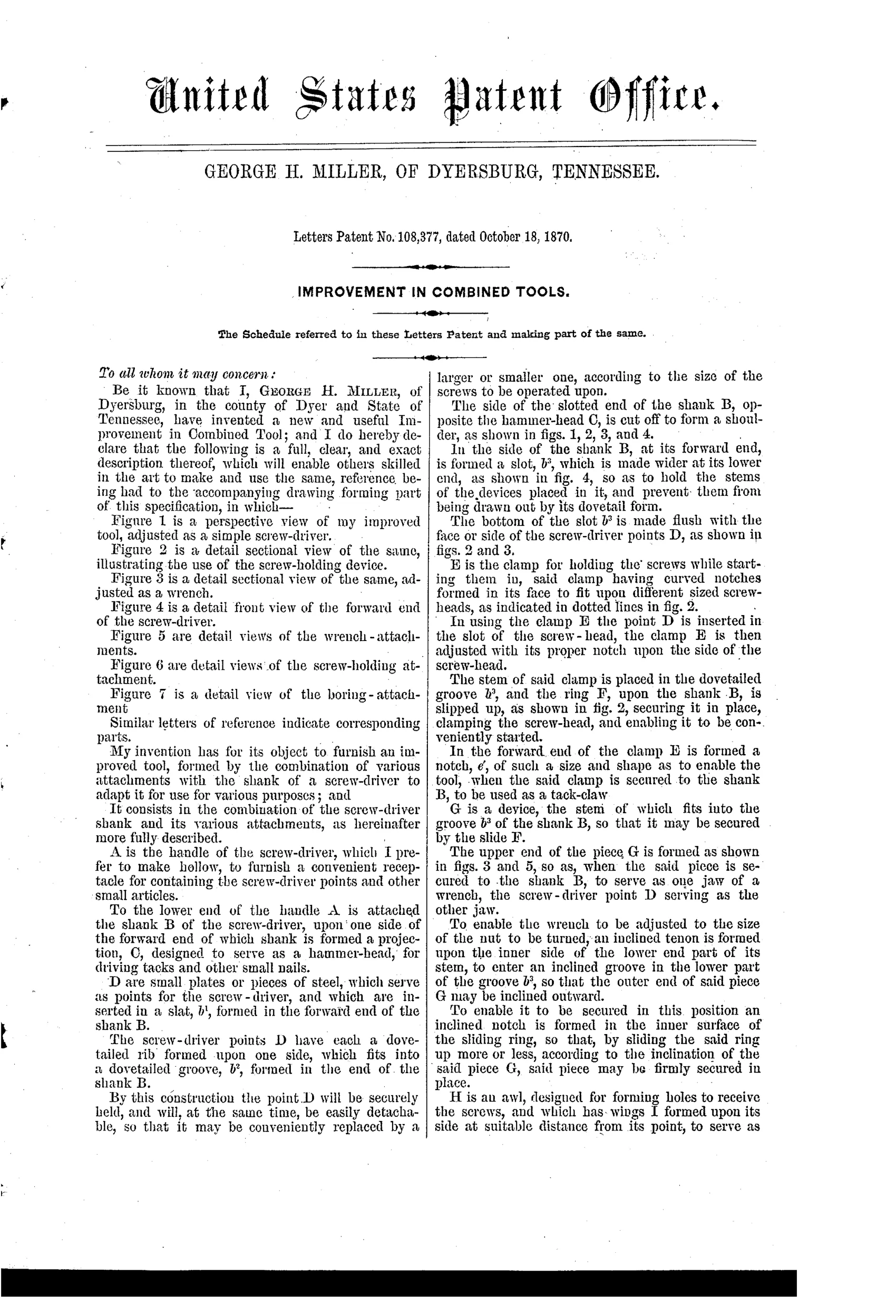
“To the lower end of the handle A is attached the shank B of the screw-driver, upon one side of the forward end of which shank is formed a projection, C, designed to serve as a hammer-head, for driving tacks and other small nails.”— George H. Miller, from the specification
Fate unknown
No manufactured example or catalogue listing is documented at DATAMP or elsewhere; a marked specimen would settle it, though a lone Tennessee inventor and this many fitted parts argue against quantity production.
⚙ Commentary
George Miller of Dyersburg, Tennessee, packed five tools into one handle in 1870, and the interesting part is how frugally he did it. There is exactly one attachment interface: a dovetailed groove on the side of the shank, locked by a single sliding ring F. The screw-holding clamp, the wrench jaw, and the boring awl all mount in the same slot the same way. That's honest design economy — one machined feature, one retention part, many functions.
The wrench is the piece that earns this a place here, and it's the shakiest. Fig. 3 shows the pivoting piece G swinging against the screwdriver point D to form the second jaw, with an inclined tenon and notch setting the opening. So the flat blade of your screwdriver becomes one gripping face of the wrench. On a snug nut with light torque that works; lean on it and you're prying a dovetailed bit sideways in its slot, held only by a friction ring. Any pre-1900 collector who has handled implement wrenches knows what happens next.
The screw-holder E, with its curved notches gripping the head while you start a screw one-handed, is the genuinely practical feature — an idea that kept getting reinvented for decades. The hammer-head boss C for tacks is the tell that Miller was designing a household everything-tool, not a mechanic's wrench. It's a charming farmhouse gadget from the great post-war combination-tool boom, and probably a dead end.
Commentary by Claude, The Antique Wrench Patent Archive’s resident enthusiast