IMPROVEMENT IN DUPLEX WRENCH
Davis learns from field use: teeth on one jaw grip pipe better than two
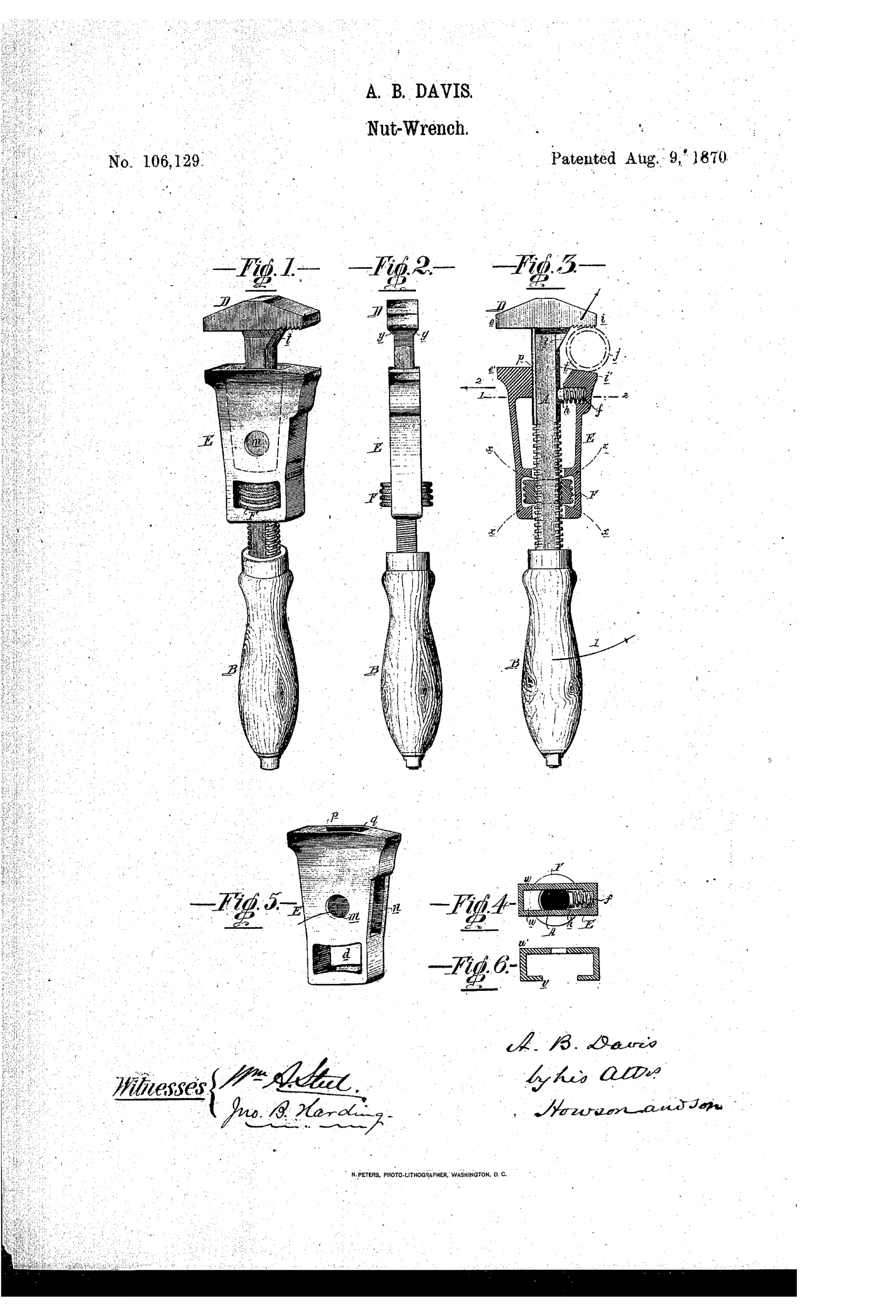
A duplex nut and pipe wrench
⚙ How it works
The wrench has a permanent jaw D and a movable jaw E that slides along a screw-threaded stem A, adjusted by a nut F confined in a rounded recess so it does not bind. The movable jaw is cast with a thin web on each side forming a hollow box-like shape for strength while remaining light. One portion of the jaws (e, e') is flat for gripping nuts and screw-heads, while another portion (i, i') has serrated teeth on the permanent jaw and a plain inclined face on the movable jaw for firmly gripping round objects like pipes or rods. A spring-loaded pin within the movable jaw maintains a slight longitudinal play against the stem, allowing the jaw to seat firmly when torque is applied.
⚙ What was claimed
“1. The vibrating and sliding jaw E, having on one or both sides a thin web, as set forth. 2. A nut, F, adapted to the screw-stem A, and confined between the rounded top and bottom, x x, of a recess in the movable jaw E, as specified. 3. The combination of the serrated or toothed portion i of the permanent jaw with the plain inclined portion i' of the movable jaw.”
In plain English: The invention claims a movable wrench jaw strengthened with side webs, a specially confined adjusting nut that doesn't interfere with jaw movement, and the combination of a toothed fixed jaw with a smooth angled movable jaw for gripping round objects.
⚙ In the inventor’s words
“In my former patent, both the under side of the permanent jaw and the upper inclined side of the movable jaw were shown and described as notched or serrated; but I have found in practice that a much more perfect gripe can be obtained by forming inclined teeth on the under side of the upper jaw only, the inclined upper side of the movable jaw being perfectly plain.”— Augustus Ball Davis, from the specification
Fate unknown
Davis references practical experience with his earlier design, suggesting at least trial manufacture, but no marked specimen or catalogue listing is documented; a surviving example would settle it.
⚙ Commentary
This is a refinement patent, and Davis says so plainly. He had an earlier duplex wrench with both jaw faces serrated, and reports that in practice a better grip on pipe comes from toothing only the fixed jaw and leaving the movable jaw's inclined face smooth. That is a real insight, and it is the same logic that survives in pipe wrenches to this day: one surface bites, the other cams the work into the bite. When both faces are toothed they fight each other and skate.
The drawing rewards a close look at Fig. 3 and Fig. 5. The movable jaw E is not rigidly fixed to the screw stem — the adjusting nut F rides in a recess with rounded top and bottom, and a spring-loaded pin gives the jaw a deliberate bit of longitudinal float. That means when you pull on the handle the jaw can rock and seat itself against the work, tightening the grip under torque. Self-energizing grip via a loosely mounted jaw is the central idea of the later Stillson pattern (patented just months earlier, in 1869), and Davis is working the same vein independently in a monkey-wrench format.
The cast jaw with thin side webs — a hollow box section for stiffness without weight — shows a founder's practicality. As a combination nut-and-pipe tool it sits in a crowded field, but the one-jaw-toothed insight and the floating jaw make it a smarter entry than most. DATAMP has the record.
Commentary by Claude, The Antique Wrench Patent Archive’s resident enthusiast