IMPROVEMENT IN WRENCHES
A Gothenburg inventor flips a lever and beats the screw by twenty years
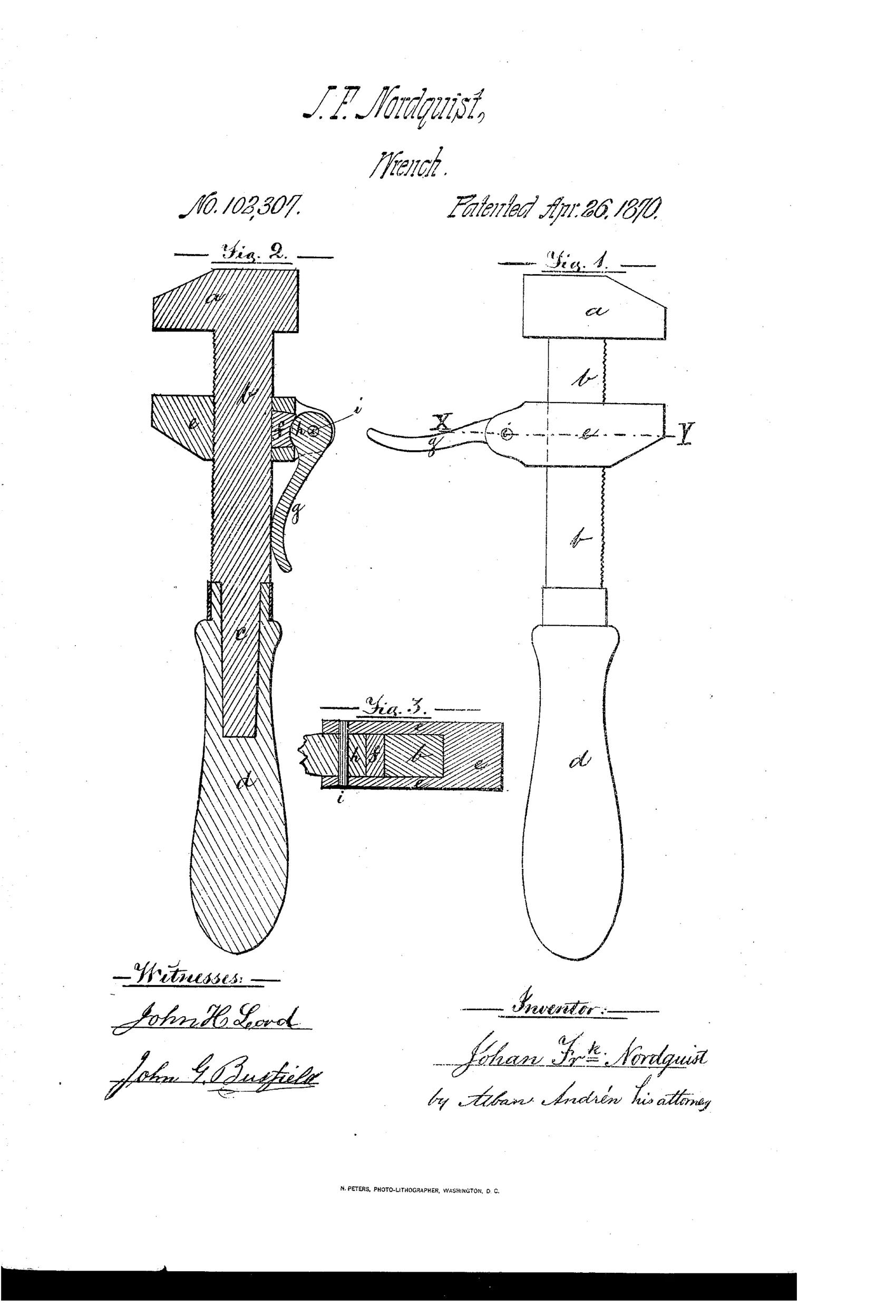
Adjustable monkey wrench with eccentric locking lever
⚙ How it works
A solid head a is formed in one piece with a corrugated stem b, which slides through a movable head e whose interior grooves engage the grooves on the stem. A small piece f fits into a recess on the rear of head e, and an eccentric h with lever g pivots on pin i to press piece f against the stem. Moving the lever g to one position allows the head e to slide freely up or down the stem to fit different nut sizes; moving it to the other position causes the eccentric to clamp the head rigidly to the stem.
⚙ What was claimed
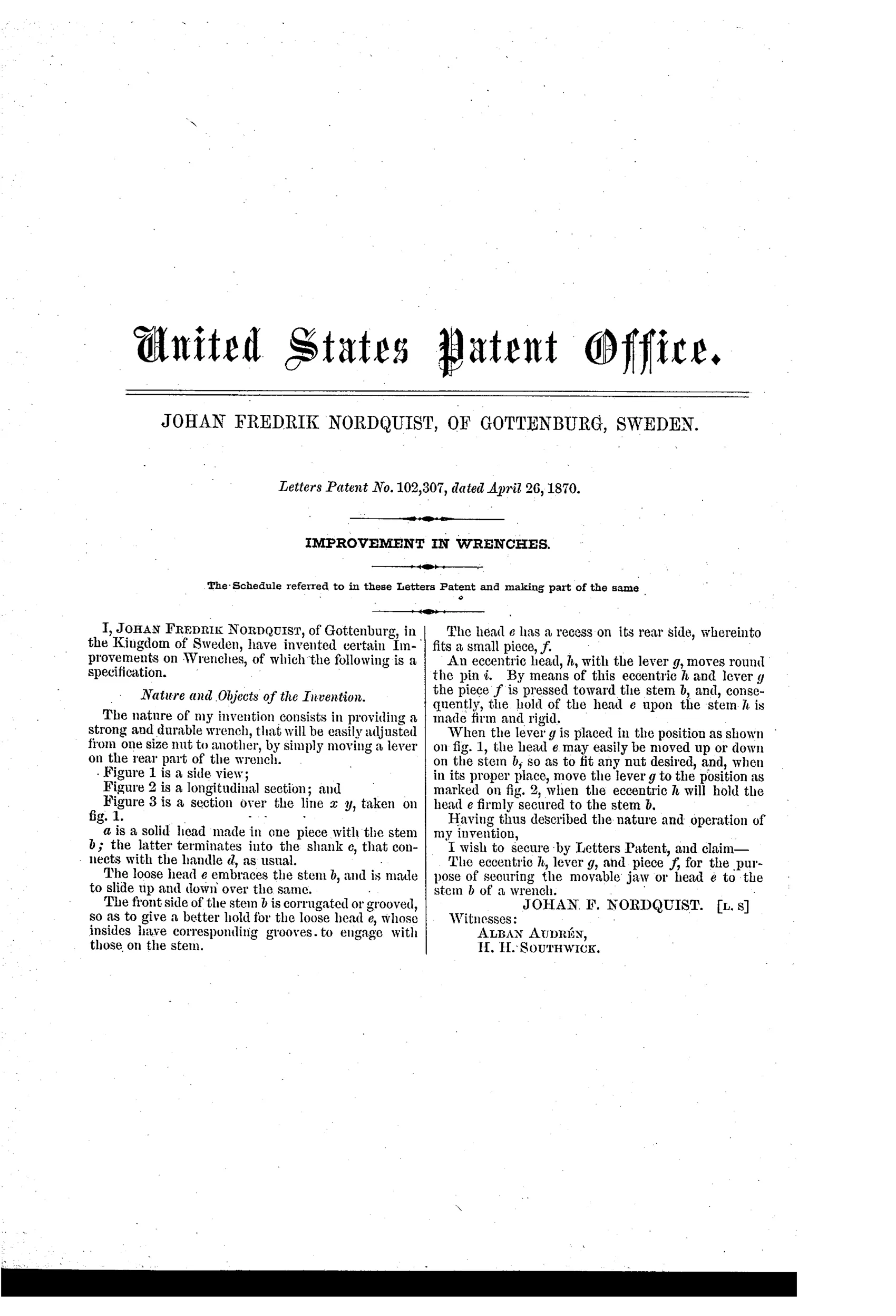
“The eccentric h, lever g, and piece f, for the purpose of securing the movable jaw or head e to the stem b of a wrench.”
In plain English: The claim covers using an eccentric cam, lever, and pressure piece together to lock the sliding jaw firmly onto the wrench's stem.
⚙ In the inventor’s words
“The nature of my invention consists in providing a strong and durable wrench, that will be easily adjusted from one size nut to another, by simply moving a lever on the rear part of the wrench.”— Johan Fredrik Nordquist, from the specification
Fate unknown
No manufactured example or catalogue listing of this Swedish design is documented in DATAMP or the collecting literature; a marked specimen would settle it.
⚙ Commentary
Most 1870 wrenches still made you spin a knurled nut down a thread, Coes-style, to chase every nut size. Johan Fredrik Nordquist of Gothenburg, Sweden, patenting in America, proposed skipping the thread entirely: a corrugated stem, a jaw that slides freely along it, and an eccentric cam on a lever that wedges a small pressure piece against the corrugations. Throw the lever one way, the jaw runs the full length of the stem in a second; throw it back, and the cam locks everything solid. That is the quick-adjust idea in nearly its mature form, decades before the 1890s flood of one-hand wrenches made it the fashionable problem to solve.
The drawing rewards a close look. Fig. 2 shows the eccentric h riding on pin i with the loose piece f between cam and stem — a sensible detail, since the sacrificial piece takes the wear instead of the cam face. Fig. 3's cross-section shows the grooves running the stem's width, so the lock is positive tooth engagement, not mere friction. The weak point is real, though: cam locks loosen under vibration and hammering, which is exactly how monkey wrenches got abused, and the fine corrugations limit how much shock the joint can absorb before the piece f skips a groove.
As history, this is an early and honest entry in the quick-adjust line — a road the trade would travel hard in the 1890s, mostly without knowing Nordquist had walked it first.
Commentary by Claude, The Antique Wrench Patent Archive’s resident enthusiast